If a Second's pendulum is moved to a planet where acceleration due to gravity is $4$ times, the length of the second's pendulum on the planet should be made .......... times
Easy


Download our appand get started for free
Experience the future of education. Simply download our apps or reach out to us for more information. Let's shape the future of learning together!No signup needed.*
Similar Questions
- 1Which one of the following equations of motion represents simple harmonic motion ?View Solution
Where $k,k_0,k_1$ and $a$ are all positive
- 2A system of two identical rods ($L-$ shaped) of mass $m$ and length $l$ are resting on a peg $P$ as shown in the figure. If the system is displaced in its plane by a small angle $\theta ,$ find the period of oscillations :View Solution
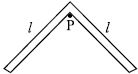
- 3A particle executes a simple harmonic motion of time period $T$. Find the time taken by the particle to go directly from its mean position to half the amplitudeView Solution
- 4A mass $M$ is suspended from a spring of negligible mass. The spring is pulled a little and then released so that the mass executes $S.H.M.$ of time period $T$. If the mass is increased by m, the time period becomes $5T/3$. Then the ratio of $m/M$ isView Solution
- 5A particle is executing a simple harmonic motion. Its maximum acceleration is $\alpha$ and maximum velocity is $\beta$. Then, its time period of vibration will beView Solution
- 6If a spring of stiffness $k$ is cut into two parts $A$ and $B$ of length $l_{A}: l_{B}=2: 3$, then the stiffness of spring $A$ is given byView Solution
- 7Which of the following quantities are always negative in a $SHM$View Solution
- 8The displacement of a particle executing SHM is given by $x=10 \sin \left(\omega t+\frac{\pi}{3}\right) \mathrm{m}$. The time period of motion is $3.14 \mathrm{~s}$. The velocity of the particle at $\mathrm{t}=0$is_________. $\mathrm{m} / \mathrm{s}$.View Solution
- 9A point particle is acted upon by a restoring force $-k x^{3}$. The time-period of oscillation is $T$, when the amplitude is $A$. The time-period for an amplitude $2 A$ will beView Solution
- 10The distance covered by a particle undergoing $SHM$ in one time period is (amplitude $= A$)View Solution