If a simple pendulum is taken to place where g decreases by $2\%$, then the time period
Medium
Download our app for free and get started
(d) $T = 2\pi \sqrt {\frac{l}{g}} $ ==> $T \propto \frac{l}{{\sqrt g }}$
$ \Rightarrow \frac{{\Delta T}}{T} \times 100 = - \frac{1}{2}\left( {\frac{{\Delta g}}{g}} \right) \times 100$$ = - \frac{1}{2}( - \,2\% ) = 1\% .$

Download our appand get started for free
Experience the future of education. Simply download our apps or reach out to us for more information. Let's shape the future of learning together!No signup needed.*
Similar Questions
- 1The equation of motion of a particle of mass $1\,g$ is $\frac{{{d^2}x}}{{d{t^2}}} + {\pi ^2}x = 0$ where $x$ is displacement (in $m$ ) from mean position. The frequency of oscillation is .... $s$ (in $Hz$ )View Solution
- 2A uniform thin ring of radius $R$ and mass $m$ suspended in a vertical plane from a point in its circumference. Its time period of oscillation is ........View Solution
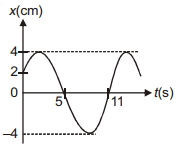
- 3Figure shows the position-time graph of an object in $S.H.M.$ The correct equation representing this motion is ..........View Solution
- 4A particle moves with simple harmonic motion in a straight line. In first $\tau \,s$, after starting from rest, it travels a distance $a$, and in next $\tau \,s$, it travels $2a$ in same direction thenView Solution
- 5The resultant of two rectangular simple harmonic motions of the same frequency and equal amplitudes but differing in phase by $\frac{\pi }{2}$ isView Solution
- 6The kinetic energy and the potential energy of a particle executing $S.H.M.$ are equal. The ratio of its displacement and amplitude will beView Solution
- 7The ratio of frequencies of two pendulums are $2 : 3$, then their length are in ratioView Solution
- 8View SolutionThe total energy of a particle executing simple harmonic motion is
- 9The period of oscillation of a mass $M$ suspended from a spring of negligible mass is $T$. If along with it another mass $M$ is also suspended , the period of oscillation will now beView Solution
- 10A particle of mass $m$ moves in a one-dimensional potential energy $U(x) = -ax^2 + bx^4,$ where $'a'$ and $'b'$ are positive constants. The angular frequency of small oscillations about the minima of the potential energy is equal toView Solution