The ratio of frequencies of two pendulums are $2 : 3$, then their length are in ratio
Easy


Download our appand get started for free
Experience the future of education. Simply download our apps or reach out to us for more information. Let's shape the future of learning together!No signup needed.*
Similar Questions
- 1A body executing simple harmonic motion has a maximum acceleration equal to $ 24\,metres/se{c^2} $ and maximum velocity equal to $ 16\;metres/sec $. The amplitude of the simple harmonic motion isView Solution
- 2A particle free to move along the $x-$axis has potential energy given by $U(x) = k[1 - \exp {( - x)^2}]$ for $ - \infty \le x \le + \infty $, where k is a positive constant of appropriate dimensions. ThenView Solution
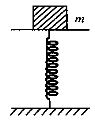
- 3A mass of $2.0\, kg$ is put on a flat pan attached to a vertical spring fixed on the ground as shown in the figure. The mass of the spring and the pan is negligible. When pressed slightly and released the mass executes a simple harmonic motion. The spring constant is $200\, N/m.$ What should be the minimum amplitude of the motion so that the mass gets detached from the pan (take $g = 10 m/s^2$).View Solution
- 4The maximum velocity of a particle, executing simple harmonic motion with an amplitude $7\ mm$, is $4.4\ m/s$. The period of oscillation is .... $sec$View Solution
- 5View SolutionThe graph between velocity and position for a damped oscillation will be
- 6A simple harmonic motion is represented by $F(t) = 10\sin \,(20\,t + 0.5)$. The amplitude of the $S.H.M.$ is $a$ $=$ ....View Solution
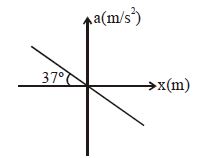
- 7The acceleration displacement graph of a particle executing $SHM$ is shown in figure. The time period of simple harmonic motion isView Solution
- 8For a simple pendulum, a graph is plotted between its kinetic energy $(KE)$ and potential energy $(PE)$ against its displacement $d$. Which one of the following represents these correctly? (graphs are schematic and not drawn to scale)View Solution
- 9Starting from the origin a body oscillates simple harmonically with a period of $2\ s$. After what time will its kinetic energy be $75\%$ of the total energy?View Solution
- 10View SolutionA pendulum is swinging in an elevator. Its period will be greatest when the elevator is