MCQ
If a vector $\vec A$ is parallel to another vector $\vec B$ then the resultant of the vector $\vec A \times \vec B$ will be equal to
  • A
    $A$
  • B
    $\vec A$
  • Zero vector
  • D
    Zero

Answer

Correct option: C.
Zero vector
c
(c) $\overrightarrow A \times \overrightarrow B = AB\sin \theta \,\hat n$

for parallel vectors $\theta = 0^\circ $ or $180^\circ $, $\sin \theta = 0$

$\therefore $ $\overrightarrow A \times \overrightarrow B = \hat 0$


Need a full question paper?

Generate a complete, print-ready paper with questions like this in minutes — across 16+ boards, with answer keys.
Start Generating Free

Similar questions

If temperature of gas increases from $27°C$ to $927°C$ the $K.E.$ will be
A boat moves with a speed of $5 \,km/h $ relative to water in a river flowing with a speed of $3 \,km/h$ and having a width of $1 \,km$. The minimum time taken around a round trip is.........$min$
A plane is revolving around the earth with a speed of $100\, km/hr $ at a constant height from the surface of earth. The change in the velocity as it travels half circle is.........$km/hr$
Where should be the centre of gravity of a body ?
The escape velocity of a body on the surface of the earth is $11.2 \,km/s$. If the earth's mass increases to twice its present value and the radius of the earth becomes half, the escape velocity would become ......... $km/s$
A spring of force constant $k$ is cut into two pieces such that one piece is double the length of the other. Then the long piece will have a force constant of
A particle of mass $m$ is projected with a velocity $v$ making an angle of $30^{\circ}$ with the horizontal. The magnitude of angular momentum of the projectile about the point of projection when the particle is at its maximum height $h$ is
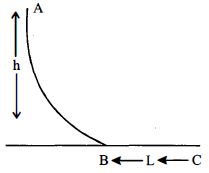
A small ball of mass $m$ starts at a point $A$ with speed $v_0$ and moves along a frictionless track $AB$ as shown. The track $BC$ has coefficient of friction $\mu $. The ball comes to stop at $C$ after travelling a distance $L$ which is
In the solar system, which is conserved
Two bodies of masses ${m_1}$ and ${m_2}$ have equal kinetic energies. If ${p_1}$ and ${p_2}$ are their respective momentum, then ratio ${p_1}:{p_2}$ is equal to