Question
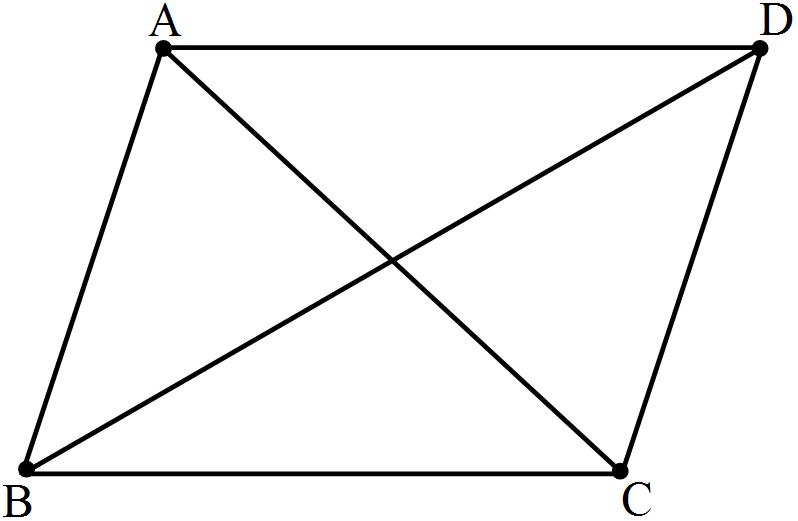
If $\text{ABCD}$ is a parallelogram, then prove that
$\text{ar}(\triangle\text{ABD})=\text{ar}(\triangle\text{BCD}) \ =\text{ar}(\triangle\text{ABC})=\text{ar}(\triangle\text{ACD})=\frac{1}{2}\text{ar} (\|^{ gm} \text{ABCD})$
Answer


Given, $\text{ABCD}$ is a parallelogram.
To prove: $\text{ar}(\triangle\text{ABD})=\text{ar}(\triangle\text{BCD})=\text{ar}(\triangle\text{ABC})$
$\ =\text{ar}(\triangle\text{ACD})=\frac{1}{2}\text{ar} (\|^{ gm} \text{ABCD})$
Proof: We know that diagonal of a parallelogram divides it into two equal triangles.
Since,$AC$ is the diagonal
Then, $\text{ar}(\triangle\text{ABC})=\text{ar}(\triangle\text{ACD})=\frac{1}{2}\text{ar} (\|^{ gm} \text{ABCD}) ...(1)$
Since, BD is the diagonal
Then $\text{ar}(\triangle\text{ABD})=\text{ar}(\triangle\text{BCD})=\frac{1}{2}\text{ar} (\|^{gm} \text{ABCD}) ...(2)$
Compare equation $(1)$ and $(2)$
$\therefore\text{ar}(\triangle\text{ABC})=\text{ar}(\triangle\text{ACD})=\text{ar}(\triangle\text{ABD})$
$\ =\text{ar}(\triangle\text{BCD})=\frac{1}{2}\text{ar} (\|^{ gm} \text{ABCD})$

Need a full question paper?

Generate a complete, print-ready paper with questions like this in minutes — across 16+ boards, with answer keys.

Start Generating Free

Similar questions

If $3x = a + b + c,$ then the value of $(x - a)^3 + (x - b)^3 + (x - c)^3 - 3(x - a) (x - b) (x - c)$ is:
M is a point on side BC of a triangle ABC such that AM is the bisector of $\angle\text{BCA}.$ Is it true to say that perimeter of the triangle is greater than 2AM? Give reason for your answer?
If $2$ and $0$ are the zeros of the polynomial $f(x) = 2x^3 - 5x^2 + ax + b$ then find the values of $a$ and $b.$
Hint: $f(x) = 0$ and $f(0) = 0.$
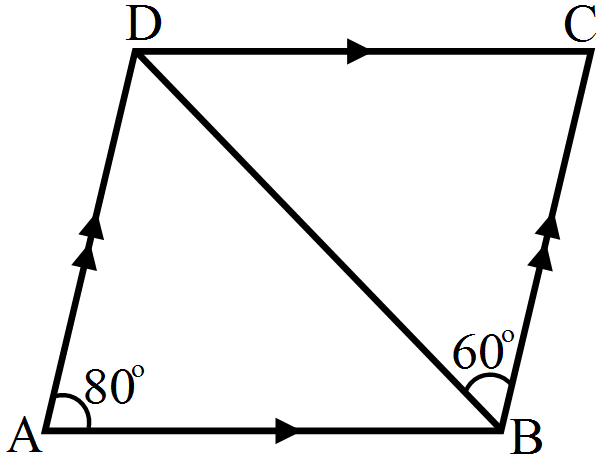
In the adjoining figure, ABCD is a parallelogram in which $\angle\text{DAB}=80^{\circ}$ and $\angle\text{DBC}=60^{\circ}.$ Calculate $\angle\text{CDB}$ and $\angle\text{ADB}.$
Show that if the diagonals of a quadrilateral are equal and bisect each other at right angles, then it is a square.
Draw the graph of the line 4x + 3y = 24.
  1. Write the coordinates of the point where this line interects the x-axis and the y-axis.
  2. Use this graph to find the area of the triangle formed by the graph line and the coordinate axes.
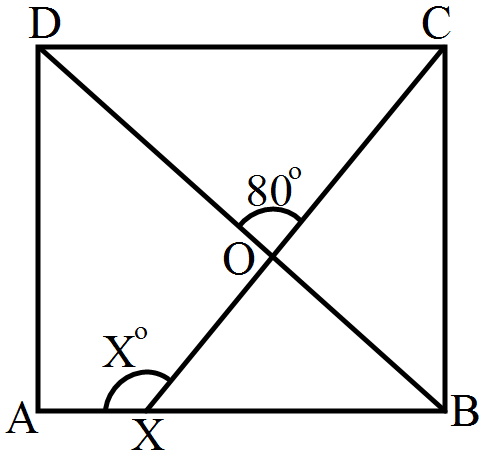
In the adjoining figure, ABCD is a square. A line segment CX cuts AB at X and the diagonal BD at O such that $\angle\text{COD}=80^{\circ}$ and $\angle\text{OXA}=\text{x}^{\circ}.$ Find the value of x.
ABCD is a quadrilateral such that A is the centre of the circle passing through B, C and D. Prove that $\angle\text{CBD}+\angle\text{CDB}=\frac{1}{2}\angle\text{BAD}.$
Prove that in a triangle, other than an equilateral triangle, angle opposite the longest side is greater than $\frac{2}{3}$ of a right angle.
100 surnames were randomly picked up from a local telephone directory and frequency distribution of the number of letters in the English alphabet in the surnames was found as follows:
Number of letters
1-4
4-6
6-8
8-12
12-20
Number of surnames
6
30
44
16
4
  1. Draw a histogram to depict the given information.
  2. Write the class interval in which the maximum number of surnames lie.