MCQ
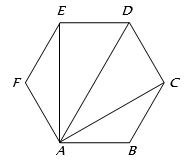
If $ ABCDEF$  is a regular hexagon and $\overrightarrow {AB} + \overrightarrow {AC} + \overrightarrow {AD} + \overrightarrow {AE} + \overrightarrow {AF} = \lambda \,\overrightarrow {AD} ,$ then $\lambda = $
  • A
    $2$
  • $3$
  • C
    $4$
  • D
    $6$

Answer

Correct option: B.
$3$
b
(b) By triangle law, $\overrightarrow {AB} = \overrightarrow {AD} - \overrightarrow {BD} ,$

$\overrightarrow {AC} = \overrightarrow {AD} - \overrightarrow {CD} $
Therefore, $\overrightarrow {AB} + \overrightarrow {AC} + \overrightarrow {AD} + \overrightarrow {AE} + \overrightarrow {AF} $

= $3\overrightarrow {AD} + (\overrightarrow {AE} - \overrightarrow {BD} ) + (\overrightarrow {AF} - \overrightarrow {CD} ) = 3\overrightarrow {AD} $

Hence $\lambda = 3$, [Since $\overrightarrow {AE} = \overrightarrow {BD,} \,\overrightarrow {AF} \, = \overrightarrow {CD} ]$.
Need a full question paper?

Generate a complete, print-ready paper with questions like this in minutes — across 16+ boards, with answer keys.

Start Generating Free

Similar questions

For $a \in R$ (the set of all real numbers), $a \neq-1, \lim _{n \rightarrow \infty} \frac{\left(1^a+2^a+\ldots+n^a\right)}{(n+1)^{a-1}[(n a+1)+(n a+2)+\ldots+(n a+n)]}=\frac{1}{60}$. Then $a=$

$(A)$ $5$ $(B)$ $7$ $(C)$ $\frac{-15}{2}$ $(D)$ $\frac{-17}{2}$

If $(a, b)$ be the orthocentre of the triangle whose vertices are $(1,2),(2,3)$ and $(3,1)$, and $I_1=\int_{\mathrm{a}}^{\mathrm{b}} \mathrm{x} \sin \left(4 \mathrm{x}-\mathrm{x}^2\right) \mathrm{dx}, \mathrm{I}_2=\int_{\mathrm{a}}^{\mathrm{b}} \sin \left(4 \mathrm{x}-\mathrm{x}^2\right) \mathrm{dx}$ , then $36 \frac{\mathrm{I}_1}{\mathrm{I}_2}$ is equal to :
A cone whose height is always equal to its diameter is increasing in volume at the rate of $40 \ cm^3 / \sec$ At what rate is the radius increasing when its circular base area is $1 m^2\ ?$
If $A$ is a square matrix such that $A^2 = A,$ then $(I + A)^3 - 7A$ is equal to:
On $Z$ an operation $^*$ is defined by $a ^* b = a^2 + b^2$ for all $a, b \in Z$. The operation $^*$ on $Z$ is:
If $A$ and $B$ are square matrices of size $n \times n$ such that ${A^2} - {B^2} = \left( {A - B} \right)\left( {A + B} \right)$ ,then which ofthe following will be always true ?
$\int_{}^{} {\frac{{\sqrt {\tan x} }}{{\sin x\cos x}}} \;dx = $
If a line makes 45°, 60° with positive direction of axes x and y then the angles it makes with the z-axis is:
Area enclosed by the parabola $ay = 3({a^2} - {x^2})$ and $x -$ axis is
If $X$  is a square matrix of order  $ 3 × 3$  and $\lambda $ is a scalar, then adj ($\lambda X)$ is equal to