Question
If $\text{A}=\displaystyle \begin{vmatrix} 5 &\text{amp; x} \\ \text{y} &\text{amp; 6} \end{vmatrix}\text{B}=\displaystyle \begin{vmatrix} -4 &\text{amp; y} \\-4 &\text{amp; 5} \end{vmatrix}$ and $\text{A}+\text{B}=1$ then the values of x and y respectively are:
  1. -4, 4
  2. -4, -4
  3. 4, 4
  4. 4, -4

Answer

  1. -4, 4

Solution:

$\text{A+B =1},\text{ i.e.,} \displaystyle \begin{vmatrix} 1&\text{amp; }\text{x+y} \\\text{y}-4 &\text{amp;} 1 \end{vmatrix}=\begin{vmatrix} 1&\text{amp; } 0 \\ 0 &\text{amp; } 1 \end{vmatrix}$

or $\text{x}=\text{y}=0,\text{ y}-4=0$

$\therefore\text{ x} = -4, \text{ y}=4$

Need a full question paper?

Generate a complete, print-ready paper with questions like this in minutes — across 16+ boards, with answer keys.

Start Generating Free

Similar questions

Which of the following is not true about feasibility?
  1. It cannot be determined in a graphical solution of an LPP.
  2. It is independent of the objective function.
  3. It implies that there must be a convex region satisfying all the constraints.
  4. Extreme points of the convex region gives the optimum solution.
Let f, g : R → R be defined by f(x) = 3x + 1 and g(x) = x2 - 2, ∀ x ∈ R, respectively. Then, f o g is:
  1. 3x2 - 5
  2. 9x2 + 6x - 1
  3. 3x2
  4. 9x2 - 6x - 3
Let  $\bar r$ be a vector in plane of $\hat i - 2\hat j + \hat k$ and $\hat i - \hat j - \hat k$  such that $\vec r.\left( {\hat i + \hat j} \right) + 2 = 0$ and length of projection of $\vec r$ on $\hat i - \hat j$ is $4\sqrt 2$, then magnitude of vector  $\vec r$ is
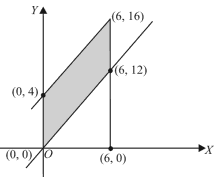
The feasible region for an LPP is shown shaded in the figure. Let $F=3 x-4 y$ be the objective function.
Minimum value of $F$ is
Image
The distance of the plane 2x - 3y + 6z + 7 = 0 from the point (2, -3, -1) is:
  1. 4
  2. 3
  3. 2
  4. $\frac{1}{5}$
Number of points where the function $f(x) = $ maximum $\left( {\sqrt {2x - {x^2}} ,2 - x} \right)$ is non differentiable is 
The general solution of the differntial equation $\frac{\text{dy}}{\text{dx}}+\text{y}\cot\text{x}=\text{coses}\ \text{x}$ is: 
  1. $\text{x}+\text{y}\sin\text{x}=\text{C}$
  2. $\text{x}+\text{y}\cos\text{x}=\text{C}$
  3. $\text{y}+\text{x}(\sin\text{x}+\cos\text{x})=\text{C}$
  4. $\text{y}\sin\text{x}=\text{x}+\text{C}$ 
The value of $\int \frac{\sec x}{\operatorname{cosec}^2 x} d x$
If $a, b, c$  are mutually perpendicular vectors of equal magnitudes, then the angle between the vectors $a$ and $a + b + c$ is
$\int_{}^{} {\frac{{{x^3}}}{{\sqrt {1 - {x^8}} }}dx = } $