Question
If an object is positively charged, theoretically the mass of the object$........$?

Answer

If an object is positively charged it loses some of its electrons. The mass of an electron is $9.11 \times 10^{-31}\ kg.$ So, if a positively charged body loses $'n\ ’$ number of electrons, it mass decrease by the amount $n \times 9.11\ E^{-31}\ kg.$

Need a full question paper?

Generate a complete, print-ready paper with questions like this in minutes — across 16+ boards, with answer keys.
Start Generating Free

Similar questions

Two charges $q_1$ and $q_2$ are placed in vacuum at a distance $d$ and the force acting between them is $F$. If a medium of dielectric constant $4$ is introduced around them, the force now will be
On increasing the reverse bias to a large value in a PN-junction diode, current(a) Increases slowly(b) Remains fixed(c) Suddenly increases(d) Decreases slowly
       
The mass of ions deposited during a given interval of time in the process of electrolysis depends on(a) The current(b) The resistance(c) The temperature(d) The electric power
       
Potassium has a bcc structure with nearest neighbour distance $4.525 \mathring A$ . Its molecular weight is $39.$ Its density in $\ kg/m^3$ is
An airplane with wingspan $50m$ is flying horizontally with a speed of $360\ kmhr^{-1 }$ over a place where the vertical component of the earth's magnetic field is $2\times 10^{-2}.$ The potential difference between the tips of the wings would be
The ratio of specific heat capacity to molar heat capacity of a body:
  1. Is a universal constant.
  2. Depends on the mass of the body.
  3. Depends on the molecular weight of the body.
  4. Is dimensionless.
The matter-wave picture of electromagnetic wave/radiation elegantly incorporated the:
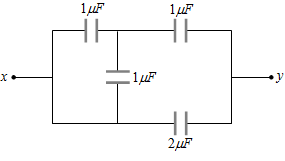
Four capacitors are connected as shown in the figure. Their capacities are indicated in the figure. The effective capacitance between points $x$  and $y$  is $($in $μF)$
In a p-n junction with open ends:
Back isotopes of hydrogen has ________ proton. Fill in the blank.