Question
On increasing the reverse bias to a large value in a PN-junction diode, current(a) Increases slowly(b) Remains fixed(c) Suddenly increases(d) Decreases slowly
       

Answer

(c) Suddenly increases

Need a full question paper?

Generate a complete, print-ready paper with questions like this in minutes — across 16+ boards, with answer keys.
Start Generating Free

Similar questions

The term on the RHS of the Gauss’s law shows the:
Velocity of light in a medium is $=1.5 \times 10^8 \mathrm{~m} / \mathrm{s}$.  Its refractive index will be
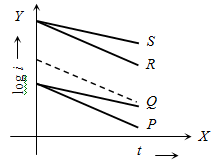
In an $RC$ circuit while charging, the graph of in $i$ versus time is as shown by the dotted line in the diagram figure, where $i$ is the current. When the value of the resistance is doubled, which of the solid curve best represents the variation of in $i$ versus time
The energy of a charged capacitor resides in(a) The electric field only
 (b) The magnetic field only(d) Neither in electric nor magnetic field(d) Neither in electric nor magnetic field
   
   
$1\ g$ of hydrogen is converted into $0.993\ g$ of helium in a thermonuclear reaction. The energy released is
The half-life of a radioactive substance is 40 years. How long will it take to reduce to one fourth of its original amount and what is the value of decay constant(a) 40 year, 0.9173/year(b) 90 year, 9.017/year(c) 80 year, 0.0173 year(d) None of these
   
   
The photoelectric current does not depend upon the:
  1. Frequency of incident light.
  2. Work function of the metal.
  3. Stopping potential.
  4. Intensity of incident light.
The magnetic dipole moment of a current carrying coil does not depend upon:
For nuclei with A > 100:
  1. The binding energy of the nucleus decreases on an average as A increases.
  2. The binding energy per nucleon decreases on an average as A increases.
  3. If the nucleus breaks into two roughly equal parts, energy is released.
  4. If two nuclei fuse to form a bigger nucleus, energy is released.
Which one of following is charge less ?