Question
If $cos A = {3\over 4} , $ then $32\sin \left( {\frac{A}{2}} \right)\sin \left( {\frac{{5A}}{2}} \right) = $

Answer

c
(c) $32\sin \frac{A}{2}\sin \frac{{5A}}{2} = 16(\cos 2A - \cos 3A)$ 

$ = 16(2{\cos ^2}A - 1 - 4{\cos ^3}A + 3\cos A)$ 

$ = 16\left( {2 \times \frac{9}{{16}} - 1 - 4 \times \frac{{27}}{{64}} + 3 \times \frac{3}{4}} \right) = 11$.

Need a full question paper?

Generate a complete, print-ready paper with questions like this in minutes — across 16+ boards, with answer keys.
Start Generating Free

Similar questions

Let $f : R \rightarrow R$ be a differentiable function with $f(0)=1$ and satisfying the equation $f(x+y)=f(x) f^{\prime}(y)+f^{\prime}(x) f(y)$ for all $x, y \in R$ Then, the value of $\log _c(f(4))$ is. . . . . .
The positive integer $k$ for which $\frac{(101)^{k 2}}{k !}$ is a maximum is
A jar contains $7$ white marbles and $3$ blue marbles. Given that the $4$ marbles are chosen from the jar at the same time, then the standard deviation of the number of the blue marbles choosen is $\frac {\sqrt a}{b}$  where $a$ and $b$ are co-prime numbers and $a$ is square free then $a + b$ is
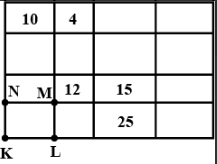
A rectangle is divided into $16$ sub-rectangles as in the figure, the number in each sub-rectangle represents the area of that sub-rectangle. What is the area of the rectangle $K L M N$ ?
The value of the limit $\mathop {\lim }\limits_{x \to 0} \frac{{{e^x} - {e^{ - x}} - 2x}}{{x - \sin \,x}}$ is 
$\mathop {\lim }\limits_{x \to \infty } \frac{{{{(x + 1)}^{10}} + {{(x + 2)}^{10}} + ..... + {{(x + 100)}^{10}}}}{{{x^{10}} + {{10}^{10}}}}$ is equal to
$\prod\limits_{n = 1}^{10} {\left( {\frac{{\left( {6\sum\limits_{i = 0}^n i } \right) + 1}}{{\left( {6\sum\limits_{j = 0}^n {(j - 1)} } \right) + 1}}} \right)} $ equals to
If the domain of the function $f(x)=\frac{\sqrt{x^2-25}}{\left(4-x^2\right)}$ $+\log _{10}\left(x^2+2 x-15\right)$ is $(-\infty, \alpha) U[\beta, \infty)$, then $\alpha^2+\beta^3$ is equal to :
If three positive numbers $a, b$ and $c$ are in $A.P.$ such that $abc\, = 8$, then the minimum possible value of $b$ is
Let $\vec{a}=2 \hat{i}+5 \hat{j}-\hat{k}, \vec{b}=2 \hat{i}-2 \hat{j}+2 \hat{k}$ and $\overrightarrow{\mathrm{c}}$ be three vectors such that $(\vec{c}+\hat{i}) \times(\vec{a}+\vec{b}+\hat{i})=\vec{a} \times(\vec{c}+\hat{i}) \cdot \vec{a} \cdot \vec{c}=-29$, then $\overrightarrow{\mathrm{c}} \cdot(-2 \hat{\mathrm{i}}+\hat{\mathrm{j}}+\hat{\mathrm{k}})$ is equal to :