MCQ
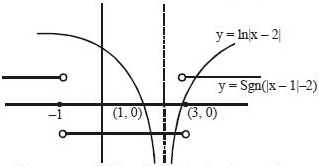
If $f(x) = \cos \left( {{{\tan }^{ - 1}}\left( {\sin \left( {{{\cos }^{ - 1}}x} \right)} \right)} \right) + \sin \left( {{{\cot }^{ - 1}}\left( {\cos \left( {{{\sin }^{ - 1}}x} \right)} \right)} \right)$ has range $\left[ {m,M),} \right.$ then number of solutions of the equation $\operatorname{sgn} \left( {\left| {x - 1} \right| - 2} \right) = \ln \left| {x - 2} \right|$ is (where sgn denotes signum function)
  • A
    $m^2+1$
  • B
    $m^2-M$
  • C
    $M^2+1$
  • $m^2+M$

Answer

Correct option: D.
$m^2+M$
d
$f(x)=\cos \left(\tan ^{-1}\left(\sin \left(\cos ^{-1} x\right)\right)\right)$

$+\sin \left(\cot ^{-1}\left(\cos \left(\frac{\pi}{2}-\cos ^{-1} x\right)\right)\right)$

$=\cos \left(\tan ^{-1}\left(\sin \left(\cos ^{-1} x\right)\right)\right)+\sin \left(\cot ^{-1}\left(\sin \left(\cos ^{-1} x\right)\right)\right)$

$=\cos \left(\tan ^{-1}\left(\sin \left(\cos ^{-1} x\right)\right)\right)+\sin \left(\frac{\pi}{2}-\tan ^{-1}\left(\sin \left(\cos ^{-1} x\right)\right)\right)$

$=\cos \left(\tan ^{-1}\left(\sin \left(\cos ^{-1} x\right)\right)\right)+\cos \left(\tan ^{-1}\left(\sin \left(\cos ^{-1} x\right)\right)\right)$

$=2 \cos \left(\tan ^{-1}\left(\sin \left(\cos ^{-1} x\right)\right)\right)=\frac{2}{\sqrt{2-x^{2}}} \in[\sqrt{2}, 2]$

From graph, Number of solutions of 

Sgn $\left( {\left| {x - 1} \right| - 2} \right) = \ln \left| {x - 2} \right|$ is $4$

Need a full question paper?

Generate a complete, print-ready paper with questions like this in minutes — across 16+ boards, with answer keys.

Start Generating Free

Similar questions

If $\text{A}=\begin{bmatrix}1&2&\text{x}\\0&1&0\\0&0&1\end{bmatrix}$ and $\text{B}=\begin{bmatrix}1&-2&\text{y}\\0&1&0\\0&0&1\end{bmatrix}$ and $AB = I_3,$ then $x + y$ equals :
For any real numbers $\alpha$ and $\beta$, let $y_{\alpha, \beta}(x), x \in R$, be the solution of the differential equation

$\frac{d y}{d x}+\alpha y=x e^{\beta x}, y(1)=1$

Let $S=\left\{y_{\alpha \beta}(x): \alpha, \beta \in R \right\}$. Then which of the following functions belong(s) to the set $S$ ?

$(A)$ $f( x )=\frac{ x ^2}{2} e ^{- x }+\left( e -\frac{1}{2}\right) e ^{- x }$

$(B)$ $f( x )=-\frac{ x ^2}{2} e ^{- x }+\left( e +\frac{1}{2}\right) e ^{- x }$

$(C)$ $f( x )=\frac{ e ^{ x }}{2}\left( x -\frac{1}{2}\right)+\left( e -\frac{ e ^2}{4}\right) e ^{- x }$

$(D)$ $f( x )=\frac{ e ^{ x }}{2}\left(\frac{1}{2}- x \right)+\left( e +\frac{ e ^2}{4}\right) e ^{- x }$

lf $x + \left| y \right| = 2y,$ then $y$ as a function of $x,$ at $x = 0$ is
Choose the correct answer from the given four options.The domain of the function defined by $\text{f}(\text{x})=\sin^{-1}\sqrt{\text{x}-1}$ is:
Let $x$ denote the total number of one-one functions from a set $A$ with $3$ elements to a set $B$ with $5$ elements and $y$ denote the total number of one-one functions from the set $A$ to the set $A \times B$. Then ...... .
The radius of a circular plate is increasing at the rate of 0.01cm/sec. The rate of increase of its area when the radius is 12cm, is:
Let $\vec{a}=\hat{i}+4 \hat{j}+2 \hat{k}, \vec{b}=3 \hat{i}-2 \hat{j}+7 \hat{k}$ and $\overrightarrow{ c }=2 \hat{ i }-\hat{ j }+4 \hat{ k }$. If a vector $\overrightarrow{ d }$ satisfies $\overrightarrow{ d } \times \overrightarrow{ b }=\overrightarrow{ c } \times \overrightarrow{ b }$ and $\overrightarrow{ d } \cdot \overrightarrow{ a }=24$, then $|\overrightarrow{ d }|^2$ is equal to $.........$.
$[-1, 1]$ is the domain for which of the following inverse trigonometric functions?
The general solution of the differential equation $\text{e}^\text{x}\ \text{dy}+(\text{y e}^\text{x}+2\text{x})\text{dx}=0\ \text{is}$
If the system of linear equations $2 x+3 y-z=-2$  ; $x+y+z=4$  ; $x-y+|\lambda| z=4 \lambda-4$  (where $\lambda \in R$), has no solution, then