MCQ
If $f(x) = \left\{ \begin{array}{l}\frac{{{x^4} - 16}}{{x - 2}},\,\,{\rm{when}}\,\,x \ne 2\\\,\,\,\,\,\,\,\,\,\,\,\,\,16,\,{\rm{when}}\,\,x = 2\end{array} \right.$, then
  • A
    $f(x)$ is continuous at $x = 2$
  • $f(x)$ is discountinous at $x = 2$
  • C
    $\mathop {\lim }\limits_{x \to 2} f(x) = 16$
  • D
    None of these

Answer

Correct option: B.
$f(x)$ is discountinous at $x = 2$
b
(b) $\mathop {\lim }\limits_{x \to 2} \,f(x) = \mathop {\lim }\limits_{x \to 2} \,(x + 2)\,\,({x^2} + 4) = 32,\,\,f(2) = 16.$

Need a full question paper?

Generate a complete, print-ready paper with questions like this in minutes — across 16+ boards, with answer keys.

Start Generating Free

Similar questions

What is the value of $\int\limits_{-1}^{1} \sin^3\text{x}\cos^2\text{xdx:}$
  1. 0
  2. 1
  3. $\frac{1}{2}$
  4. 2
If $\displaystyle \begin{vmatrix}\text{x} &\text{amp; } 1 \\ \text{y} &\text{amp; } 2 \end{vmatrix}-\displaystyle \begin{vmatrix}\text{y} &\text{amp; } 1 \\ 8&\text{amp; } 0\end{vmatrix}=\displaystyle \begin{vmatrix}2 &\text{amp; } 0 \\ \text{-x}&\text{amp; } 2\end{vmatrix}$ then the values of x and y respectively are:
  1. 5 and 1 
  2. 5 and 3
  3. 5 and 2
  4. 3 and 4
If A and B are independent events and P(A) = 0.2, P(B)=0.3 then the value of P (neither A nor B) will be
The angle between two diagonals of a cube will be
The general solution of the differential equation $(2x - y + 1)dx + (2y - x + 1)dy = 0$ is
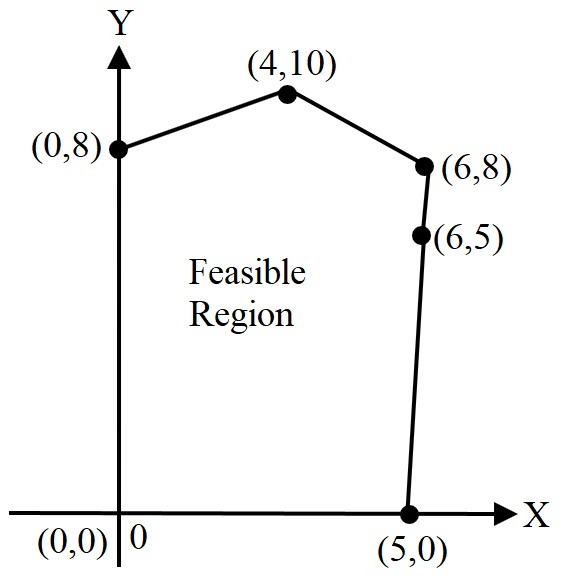
The feasible, region for an LPP is shown shaded in the figure. Let Z = 3x - 4y be the objective function. A minimum of Z occurs at:

  1. (0, 0)
  2. (0, 8)
  3. (5, 0)
  4. (4, 10)
If lines $\frac{{x - 1}}{3} = \frac{{y - 2}}{{ - 1}} = \frac{{z - \lambda }}{2}$ and $\frac{{x + 1}}{{ - 2}} = \frac{y}{{3\lambda }} = \frac{{2z - 7}}{1}$ are coplanar then sum of value $(s)$ of $\lambda $ is
If the shortest between the lines $\frac{x+\sqrt{6}}{2}=\frac{y-\sqrt{6}}{3}=\frac{z-\sqrt{6}}{4}$ and $\frac{x-\lambda}{3}=\frac{y-2 \sqrt{6}}{4}=\frac{z+2 \sqrt{6}}{5}$ is $6$, then the square of sum of all possible values of $\lambda$ is
The sum of squares of all possible values of $k$, for which area of the region bounded by the parabolas $2 \mathrm{y}^2=\mathrm{kx}$ and $\mathrm{ky}^2=2(\mathrm{y}-\mathrm{x})$ is maximum, is equal to :
The value of  $\cot \left( {\sum\limits_{r = 1}^\infty  {{{\tan }^{ - 1}}\left( {\frac{4}{{4{r^2} + 3}}} \right)} } \right)$ is equal to