MCQ
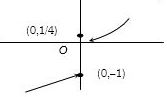
If $f(x) = \left\{ \begin{array}{l}x - 1,\,\,\,x < 0\\\,\,\,\,\,\,\frac{1}{4},\,\,x = 0\\\,\,\,\,\,\,\,{x^2},\,\,x > 0\end{array} \right.$, then
  • A
    $\mathop {\lim }\limits_{x \to 0 + } f(x) = 1$
  • B
    $\mathop {\lim }\limits_{x \to 0 - } f(x) = 1$
  • $f(x)$ is discontinuous at $x = 0$
  • D
    None of these

Answer

Correct option: C.
$f(x)$ is discontinuous at $x = 0$
c
(c) Clearly from curve drawn of the given function $f(x)$ is discontinuous at $x = 0.$

Need a full question paper?

Generate a complete, print-ready paper with questions like this in minutes — across 16+ boards, with answer keys.

Start Generating Free

Similar questions

${d \over {dx}}[{e^{ax}}\cos (bx + c)]=$
Let $f(x)$ be a function satisfying $f(x)+f(\pi-x)=$ $\pi^2, \forall x \in R$. Then $\int \limits_0^\pi f(x) \sin x d x$ is equal to $...........$.
If $f (x) =$ $\left[ \begin{gathered}  {x^2}\,\,\,\,\,\,\,\,\,\,\,\,if\,\,\,\,x \leqslant \,{x_0} \hfill \\   ax + b\,\,\,\,\,if\,\,\,\,x\, > \,{x_0} \hfill \\ \end{gathered}  \right.$ derivable $\forall \,x\, \in \,R\,\,$ then the values of $a$ and $b$ are respectively
The function $F(x) = \int_0^x {\log \left( {\frac{{1 - x}}{{1 + x}}} \right)} \,dx$ is
If $\vec{a}$ is a nonzero vector of magnitude 'a' and $\lambda$ a nonzero scalar, then $\lambda\ \vec{a}$ is unit vector if
If $\int \operatorname{cosec}^5 x d x=\alpha \cot x \operatorname{cosec} x\left(\operatorname{cosec}^2 x+\frac{3}{2}\right)+\beta \log _e\left|\tan \frac{x}{2}\right|+C$ where $\alpha, \beta \in \mathbb{R}$ and $\mathrm{C}$ is constant of integration , then the value of $8(\alpha+\beta)$ equals....................
If $\vec{a}+\vec{b}=\hat{i}$ and $\vec{a}=2 \hat{i}-2 \hat{j}+2 \hat{k}$, then $|\vec{b}|$ equals:
Simplify $ {\cot ^{ - 1}}\frac{1}{{\sqrt {{\text{x}^2} - 1} }} $ for $\text{ x} < - 1$:
Let $\gamma \in R$ be such that the lines $L_1: \frac{x+11}{1}=\frac{y+21}{2}=\frac{z+29}{3}$ and $L_2: \frac{x+16}{3}=\frac{y+11}{2}=\frac{z+4}{\gamma}$ intersect. Let $R_1$ be the point of intersection of $L_1$ and $L_2$. Let $O=(0,0,0)$, and $\hat{n}$ denote a unit normal vector to the plane containing both the lines $L_1$ and $L_2$.

Match each entry in $List-I$ to the correct entry in $List-II$.

$List-I$ $List-II$
($P$) $\gamma$ equals ($1$) $-\hat{i}-\hat{j}+\hat{k}$
($Q$) A possible choice for $\hat{n}$ is ($2$) $\sqrt{\frac{3}{2}}$
($R$) $\overline{O R_1}$ equals ($3$) $1$
($S$) A possible value of $\overline{O R_1} \cdot \hat{n}$ is ($4$) $\frac{1}{\sqrt{6}} \hat{i}-\frac{2}{\sqrt{6}} \hat{j}+\frac{1}{\sqrt{6}} \hat{k}$
  ($5$) $\sqrt{\frac{2}{3}}$

The correct option is

For which value of  $x$ , the function $f(x) = {x^2} - 2x$ is decreasing