MCQ
If $f(x) = max(sinx, sin^{-1}(cosx))$, then
  • $ƒ$ is continuous everywhere
  • B
    $ƒ$ is discontinuous at $1$ point
  • C
    $ƒ$ is discontinuous at $2$ points
  • D
    $ƒ$ is discontinuous at infinitely many

Answer

Correct option: A.
$ƒ$ is continuous everywhere
a
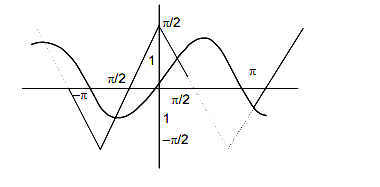
Given, $f(x)=\max \sin x, \sin ^{-1}(\cos x)$

$g(x)=\sin ^{-1}(\cos x)=\left\{\begin{array}{ll}\pi / 2-x & 0

$n(x)=\sin x$

Plotting on graph from graph, it is clear that $f(x)$ is continuous everywhere, Hence, shape points are not differentiable
Need a full question paper?

Generate a complete, print-ready paper with questions like this in minutes — across 16+ boards, with answer keys.

Start Generating Free

Similar questions

Let $\overrightarrow{ a }=2 \hat{ i }-3 \hat{ j }+4 \hat{ k }$ and $\overrightarrow{ b }=7 \hat{ i }+\hat{ j }-6 \hat{ k }$ If $\overrightarrow{ r } \times \overrightarrow{ a }=\overrightarrow{ r } \times \overrightarrow{ b }, \overrightarrow{ r } \cdot(\hat{ i }+2 \hat{ j }+\hat{ k })=-3,$ then $\overrightarrow{ r } \cdot(2 \hat{ i }-3 \hat{ j }+\hat{ k })$ is equal to
The solution of differential equation $\frac{{dy}}{{dx}} + {\sin ^2}y = 0$ is
$\smallint \frac{{2{x^{12}} + 5{x^9}}}{{{{\left( {{x^5} + {x^3} + 1} \right)}^3}}}dx = $
Let the function $f:R \to R$ be defined by $f(x) = 2x + \sin x,\;x \in R$. Then $f$ is
The value of $\sin\big(2\big(\tan^{-1}0.75\big)\big)$ is equal to:
  1. 0.75
  2. 1.5
  3. 0.96
  4. sin-1 1.5
India play two matches each with West indies and Australia. In any match the probability of india getting 0,1 and 2 points are 0.45, 0.05 and 0.50 respectively. Assuming that the outcomes are indepecdent, the probability of india getting at least 7 points is.
  1. 0.0875
  2. $\frac{1}{16}$
  3. 0.1125
  4. None of these.
If A and B are square matrices of order 2, then det (A + B) = 0 is possible only when:
  1. Det (A) = 0 or det (B) = 0
  2. Det (A) + det (B) = 0
  3. Det (A) = 0 and det (B) = 0
  4. A + B = 0
The edge of a cube is of length $‘a’$ then the shortest distance between the diagonal of a cube and an edge skew to it is
The feasible solution of a LPP belongs to:
  1. First and second quadrants
  2. First and third quadrants.
  3. Second quadrant
  4. Only firstquadrant.
For a biased die the probabilities for different faces to turn up are given below

$Face:$ $1$ $2$ $3$ $4$ $5$ $6$
$Probability:$ $0.1$ $0.32$ $0.21$ $0.15$ $0.05$ $0.17$

The die is tossed and you are told that either face $1$ or $2$ has turned up. Then the probability that it is face $1$, is