MCQ
If $\int_{}^{} {\frac{1}{{(1 + x)\sqrt x }}\;dx = f(x) + A} $, where $ A$  is any arbitrary constant, then the function $f(x)$ is
  • A
    $2{\tan ^{ - 1}}x$
  • $2{\tan ^{ - 1}}\sqrt x $
  • C
    $2{\cot ^{ - 1}}\sqrt x $
  • D
    ${\log _e}(1 + x)$

Answer

Correct option: B.
$2{\tan ^{ - 1}}\sqrt x $
b
(b) $I = \int_{}^{} {\frac{{dx}}{{\sqrt x (1 + {{(\sqrt x )}^2})}}} $

Put $\sqrt x = t \Rightarrow \frac{1}{{2\sqrt x }}\,dx = dt$
$I = \int_{}^{} {\frac{{2\,dt}}{{1 + {t^2}}} = 2{{\tan }^{ - 1}}t + A} $
$\therefore \,\,\,I = 2{\tan ^{ - 1}}\sqrt x + A$; $\therefore \,\,\,f(x) = 2{\tan ^{ - 1}}\sqrt x $.

Need a full question paper?

Generate a complete, print-ready paper with questions like this in minutes — across 16+ boards, with answer keys.
Start Generating Free

Similar questions

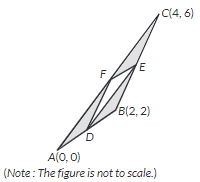
The points $D, E$ and $F$ are the mid-points of $A B, B C$ and $C A$ respectively.
Image
What is the area of the shaded region?
If a curve $y = a\sqrt x + bx$ passes through the point $(1, 2)$ and the area bounded by the curve, line $x = 4$ and $x-$ axis is $8$ sq. unit, then
${\tan ^{ - 1}}\left[ {\cos \left( {2\,{{\tan }^{ - 1}}\frac{3}{4}} \right)\, + \,\sin \,\left( {2\,{{\cot }^{ - 1}}\frac{1}{2}} \right)} \right]$ is
The value of the determinant $\begin{vmatrix}\text{a}-\text{b}&\text{b}+\text{c}&\text{c}\\\text{b}-\text{c}&\text{c}+\text{b}&\text{b}\\\text{c}+\text{a}&\text{a}+\text{b}&\text{c}\end{vmatrix}$ is:
  1. a3 + b3 + c3
  2. 3bc
  3. a3 + b3 + c3 - 3abc
  4. None of these
From a set of 100 cards numbered 1 to 100, one card is drawn at randow. The probability number obtained on the card is divisible by 6 or 8 but not by 24 is
  1. $\frac{6}{25}$
  2. $\frac{1}{4}$
  3. $\frac{1}{6}$
  4. $\frac{2}{6}$
The solution of $y{e^{ - x/y}}dx - (x{e^{ - x/y}} + {y^3})dy = 0$ is
If matrix $A = {\left[ {{a_{ij}}} \right]_{3 \times 3}} , B = {\left[ {{b_{ij}}} \right]_{3 \times 3}}$ , where $a_{ij} + a_{ji} = 0$ and $b_{ij} -b_{ji} = 0\, \forall\, i , j$ then $A^4B^3$ is
A solid hemisphere is mounted on a solid cylinder, both having equal radii. If the whole solid is to have a fixed surface area and the maximum possible volume, then the ratio of the height of the cylinder to the common radius is
Let $\vec{a}=2 \hat{i}-\hat{j}+5 \hat{k}$ and $\vec{b}=\alpha \hat{i}+\beta \hat{j}+2 \hat{k}$. If $((\vec{a} \times \vec{b}) \times \hat{i}) \cdot \hat{k}=\frac{23}{2}$, then $|\vec{b} \times 2 \hat{j}|$ is equal to.
The cost function at American Gadget is $C(x) = x^3 - 6x^2 + 15x$ $(x$ in thousands of units and $x > 0)$ The production level at which average cost is minimum is