MCQ
If $\int_{}^{} {x\sin xdx = - x\cos x + A} $, then $A = $
  • $\sin x + $constant
  • B
    $\cos x + $constant
  • C
    Constant
  • D
    None of these

Answer

Correct option: A.
$\sin x + $constant
a
(a) Since,$\int_{}^{} {x\sin x\,dx} = - x\cos x + A$
$ \Rightarrow - x\cos x + \sin x + {\rm{constant}} = - x\cos x + A$
Equating it, we get $A = \sin x + {\rm{constant}}{\rm{.}}$

Need a full question paper?

Generate a complete, print-ready paper with questions like this in minutes — across 16+ boards, with answer keys.
Start Generating Free

Similar questions

Which of the following is an orthogonal matrix
Let $R$ be a relation on a set $A$ such that $R = {R^{ - 1}}$, then $R$ is
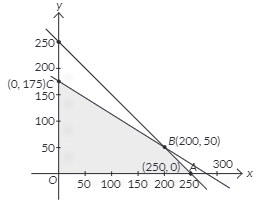
The corner points of the bounded feasible region of an LPP are $O(0,0), A(250,0), B(200,50)$ and $C(0,175)$. If the maximum value of the objective function $Z=2 a x+$ by occurs at the points $A(250,0)$ and $B(200,50)$, then the relation between $a$ and $b$ is:
Image
Let $A$ and $B$ be two independent events such that $\mathrm{P}(\mathrm{A})=\frac{1}{3}$ and $\mathrm{P}(\mathrm{B})=\frac{1}{6} .$ Then, which of the following is TRUE?
Let $f(x)=\frac{x^2-6 x+5}{x^2-5 x+6}$.

Match the conditions / expressions in Column $I$ with statements in Column $II$ and indicate your answers by darkening the appropriate bubbles in $4 \times 4$ matrix given in the $ORS$.

Column $I$ Column $II$
$(A)$ If $-1 < x < 1$, then $f$ ( $x$ ) satisfies $(p)$ $ 0 < $ f (x) $ < 1$
$(B)$ If $1 < x < 2$, then $f(x)$ satisfies $(q)$ $\mathrm{f}(\mathrm{x}) < 0$
$(C)$ If $3 < x < 5$, then $f(x)$ satisfies $(r)$ $ \mathrm{f}(\mathrm{x}) > 0$
$(D)$ If $x > 5$, then $f(x)$ satisfies $(s)$ $ f (\mathrm{x}) < 1$
If the angle between the vectors $\text{x}\hat{\text{i}}+3\hat{\text{j}}-7\hat{\text{k}}$ and $\text{x}\hat{\text{i}}-\text{x}\hat{\text{j}}+4\hat{\text{k}}$ is acute, then x lies in the interval:
  1. (-4, 7)
  2. [-4, 7]
  3. R - [-4, 7]
  4. R - (4, 7)
$2 x^3-6 x+5$ is an increasing function, if
Find values of $\mathrm{k}$ if area of triangle is $4$ square units and vertices are $(-2,0),(0,4),(0, \mathrm{k})$
The image of the point (1, 3, 4) in the plane 2x - y + z + 3 = 0 is:
  1. (3, 5, 2)
  2. (-3, 5, 2)
  3. (3, 5, -2)
  4. (3, -5, 2)
If $y=\tan ^{-1}\left(e^{2 x}\right)$, then $\frac{d y}{d x}$ is equal to