Question
If $|(2 \hat{i}+\hat{j}-\hat{k}) \times(5 \lambda-6 i+j)|=17$ then the value of $\lambda$ is
Answer

self

Need a full question paper?

Generate a complete, print-ready paper with questions like this in minutes — across 16+ boards, with answer keys.

Start Generating Free

Similar questions

The function$\text{f(x)}=1+|\cos\text{x}|$ is:
  1. Continuous no where.
  2. Continuous everywhere.
  3. Not differentiable at x = 0
  4. Not differentiable at $\text{x}=\text{n}\pi,\text{n}\in\text{Z}.$
Choose the correct answer from the given four options.
If $\vec{\text{a}},\vec{\text{b}},\vec{\text{c}}$ are unit vectors such that $\vec{\text{a}}+\vec{\text{b}}+\vec{\text{c}}=0,$ then the value of $\vec{\text{a}}\cdot\vec{\text{b}}+\vec{\text{b}}\cdot\vec{\text{c}}+\vec{\text{c}}\cdot\vec{\text{a}}$ is:
  1. 1.
  2. 3.
  3. $-\frac{3}{2}.$
  4. None of these. 
The optimal value of the objective function is attained at the points:
  1. On X - axis
  2. On Y - axis
  3. Corner points of the feasible region
  4. None of these
Mark the correct alternative in the following question:The probability of guessing correctly at least 8 out of 10 answers of a true false type examination is:
  1. $\frac{7}{64}$
  2. $\frac{7}{128}$
  3. $\frac{45}{1024}$
  4. $\frac{7}{41}$
The value of k which makes $\text{f(x)}=\begin{cases}\sin\frac{1}{\text{x}},&\text{x}\neq0\\\text{k},&\text{x}=0\end{cases}$ continuous at x = 0, is:
  1. 8
  2. 1
  3. -1
  4. none of these
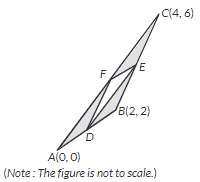
The points $D, E$ and $F$ are the mid-points of $A B, B C$ and $C A$ respectively.
Image
What is the area of the shaded region?
Choose the correct option from given four options:
$\frac{\text{dx}}{\sin(\text{x}-\text{a})\sin(\text{x}-\text{b})}$ is equal to:
  1. $\sin(\text{b}-\text{a)}\log\Big|\frac{\sin(\text{x}-\text{b})}{\sin(\text{x}-\text{a})}\Big|+\text{C}$
  2. $\text{cosec}(\text{b}-\text{a)}\log\Big|\frac{\sin(\text{x}-\text{a})}{\sin(\text{x}-\text{b})}\Big|+\text{C}$
  3. $\text{cosec}(\text{b}-\text{a)}\log\Big|\frac{\sin(\text{x}-\text{b})}{\sin(\text{x}-\text{a})}\Big|+\text{C}$
  4. $\sin(\text{b}-\text{a)}\log\Big|\frac{\sin(\text{x}-\text{b})}{\sin(\text{x}-\text{a})}\Big|+\text{C}$
Choose the correct answer from the given four options.
You are given that A and B are two events such that $\text{P}(\text{B})=\frac{3}{5},\text{P}\Big(\frac{\text{A}}{\text{B}}\Big)=\frac{1}{2}$ and $\text{P}(\text{A}\cup\text{B})=\frac{4}{5},$ then P(A) equals:
  1. $\frac{3}{10}$
  2. $\frac{1}{5}$
  3. $\frac{1}{2}$
  4. $\frac{3}{5}$
A ladder, 5 meter long, standing on a horizontal floor, leans against a vertical wall. If the top of the ladder slides downwards at the rate of 10cm/ sec, then the rate at which the angle between the floor and the ladder is decreasing when lower end of ladder is 2 metres from the wall is:
The corner points of the feasible region determined by the system of linear constraints are (0, 10), (5, 5), (15, 15), (0, 20). Let Z = px + qy, where p, q > 0. Condition on p and q so that the maximum of Z occurs at both the points (15, 15) and (0, 20) is Maximum of Z occurs at:
  1. (5, 0)
  2. (6, 5)
  3. (6, 8)
  4. (4, 10)