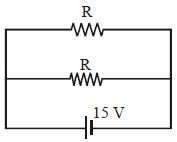
If power dissipated in the circuit is $150\,W,$ then value of $R$ is ............... $\Omega$
Medium
Download our app for free and get started
$150 \mathrm{\,W}$ on two so $75 \mathrm{\,W}$ on one
$\therefore \frac{\mathrm{V}^{2}}{\mathrm{R}}=75 \Rightarrow \mathrm{R}=\frac{15 \times 15}{75}=3 \,\Omega$

Download our appand get started for free
Experience the future of education. Simply download our apps or reach out to us for more information. Let's shape the future of learning together!No signup needed.*
Similar Questions
- 1A student measures the terminal potential difference $(V)$ of a cell $($ of $emf \;\varepsilon $ and internal resistance $r)$ as a function of the current $(I)$ flowing through it. The slope, and intercept, of the graph between $V$ and $I$, then, respectively, equalView Solution
- 2Three light bulbs of $40\, W$, $60\, W$ and $100\, W$ are connected in series with $220\, V$ source. Which one of the bulbs will glow brightest ............ $W$View Solution
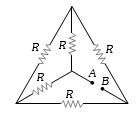
- 3Each of the resistance in the network shown in fig. is equal to $R$. The resistance between the terminals $A$ and $B$ isView Solution
- 4A battery consists of a variable number '$n$' of identical cells having internal resistances connected in series. The terminals of battery are short circuited and the current $i$ is measured. Which of the graph below shows the relation ship between $i$ and $n$View Solution
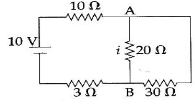
- 5In the electrical circuit shown in the figure, the current $i$ through the side $AB$ isView Solution
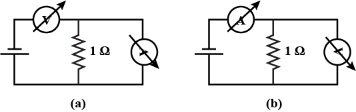
- 6A student uses the resistance of a known resistor $(1 \,\Omega)$ to calibrate a voltmeter and an ammeter using the circuits shown below. The student measures the ratio of the voltage to current to be $1 \times 10^3 \,\Omega$ in circuit $(a)$ and $0.999 \,\Omega$ in circuit $(b)$. From these measurements, the resistance (in $\Omega$ ) of the voltmeter and ammeter are found to be close toView Solution
- 7A $25\, W$, $ 220\, V$ bulb and a $100\, W$, $220\, V$ bulb are connected in parallel across a $440\, V$ lineView Solution
- 8View SolutionTwo heater wires of equal length are first connected in series and then in parallel. The ratio of heat produced in the two cases is
- 9A uniform heating wire of resistance $36\, \Omega$ is connected across a potential difference of $240\, {V}$ The wire is then cut into half and potential difference of $240\, {V}$ is applied across each half separately. The ratio of power dissipation in first case to the total power dissipation in the second case would be $1: {x}$, where ${x}$ is........... .View Solution
- 10A student has $10$ resistors of resistance ‘$r$’. The minimum resistance made by him from given resistors isView Solution