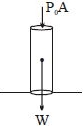
MCQ
If solid will break under pressure greater than $13\  atm$ and that solid has a specific gravity of $4$ , what is the maximum height of a cylinder made from the solid that can be built at the earth's surface ? (Note: $1\ atm$ = $10^5\  Pa$ .) ......... $m$
  • A
    $4$
  • B
    $32.5$
  • C
    $24$
  • $30$

Answer

Correct option: D.
$30$
d
$\mathrm{P}_{0} \mathrm{A}+\mathrm{hA} \rho \mathrm{g}=\mathrm{P}_{1} \mathrm{A}$

$\mathrm{h}=\frac{\mathrm{P}_{1}-\mathrm{P}_{0}}{\rho \mathrm{g}}$

$=\frac{12 \times 10^{5}}{4 \times 10^{3} \times 10}=30 \mathrm{m}$

Need a full question paper?

Generate a complete, print-ready paper with questions like this in minutes — across 16+ boards, with answer keys.

Start Generating Free

Similar questions

A large horizontal surface moves up and down in $SHM$ with an amplitude of $1 \,cm$. If a mass of $10\, kg$ (which is placed on the surface) is to remain continually in contact with it, the maximum frequency of $S.H.M.$ will be ... $Hz$
Suppose you have taken a dilute solution of oleic acid in such a way that its concentration becomes $0.01 \,cm ^{3}$ of oleic acid per $cm ^{3}$ of the solution. Then you make a thin film of this solution (monomolecular thickness) of area $4\, cm ^{2}$ by considering $100$ spherical drops of radius $\left(\frac{3}{40 \pi}\right)^{\frac{1}{3}} \times 10^{-3}\, cm .$ Then the thickness of oleic acid layer will be $x \times 10^{-14} \,m$. Where $x$ is ...... .
In damped oscillations, damping force is directly proportional to speed of oscillator. If amplitude becomes half of its maximum value in $1 \,s$, then after $2 \,s$ amplitude will be $\left(A_0-\right.$ initial amplitude)
The Young's modulus of a wire of length $L$ and radius $r$ is $Y$ $N/m^2$. If the length and radius are reduced to $L/2$ and $r/2,$ then its Young's modulus will be
The extension in a string, obeying Hooke's law, is $x$. The speed of sound in the stretched string is $v$. If the extension in the string is increased to $1.5x$, the speed of sound will be
A solid cylinder $P$ rolls without slipping from rest down an inclined plane attaining a speed $v_p$ at the bottom. Another smooth solid cylinder $Q$ of same mass and dimensions slides without friction from rest down the inclined plane attaining a speed $v_q$ at the bottom. The ratio of the speeds $\frac{v_q}{v_p}$ is
A man is running with constant speed along a circular path of radius $2 \sqrt 2\, m$. He completes $1$ round in $10\, second$. Find instantaneous speed at $2.5 \,sec.$
A stationary source emits sound waves of frequency $500\, Hz$. Two observers moving along a line passing through the source detect sound to be of frequencies $480\, Hz$ and $530\, Hz$. Their respective speeds are, in $m\,s^{-1}$ (Given speed of sound $= 300\, m/s$)
A block slides down on an inclined surface of inclination $30^o$ with the horizontal. Starting from rest it covers $8\, meter$ in the first two seconds. The coefficient of friction is $(g = 10\, ms^{-2})$
A boy is walking away from a wall towards an observer at a speed of $1\, metre/sec$ and blows a whistle whose frequency is $680 Hz.$ The number of beats heard by the observer per second is (Velocity of sound in air $= 340\, metres/sec$)