MCQ
If ${\tan ^{ - 1}}x + {\tan ^{ - 1}}y = \frac{\pi }{4}$ then
  • A
    $x + y - xy = 1$
  • $x + y + xy = 1$
  • C
    $x + y + xy + 1 = 0$
  • D
    $x + y - xy + 1 = 0$

Answer

Correct option: B.
$x + y + xy = 1$
b
${\tan ^{ - 1}}x + {\tan ^{ - 1}}y = \frac{\pi }{4}$;

${\tan ^{ - 1}}\left( {\frac{{x + y}}{{1 - xy}}} \right) = {\tan ^{ - 1}}1$

$\frac{{x + y}}{{1 - xy}} = 1$;

$x + y + xy = 1$.

Need a full question paper?

Generate a complete, print-ready paper with questions like this in minutes — across 16+ boards, with answer keys.

Start Generating Free

Similar questions

Let $\text{f(x)=}\begin{cases}\frac{\text{x}-4}{|\text{x}-4|}+\text{a},&\text{if }\text{ x} < 4\\\text{a}+\text{b},&\text{if }\text{ x} =4\\\frac{\text{x}-4}{|\text{x}-4|}+\text{b},&\text{if }\text{ x} > 4\end{cases}$ Then, f(x) is continus at x = 4 when:
Given $f(x) = b ([x]^2 + [x]) + 1$ for $x \geq -1$ and $= sin (\pi (x+a) )$ for $x < -1$

where $[x]$ denotes the integral part of $x$ ,

then for what values of $a, b$ the function is continuous at $x = -1$ ?

For real numbers x and y, define xRy if $\text{x}-\text{y}+\sqrt{2}$ is an irrational number. Then the relation R is:
 $(i)$  $f (x)$ is continuous and defined for all real numbers

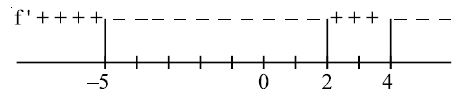
$(ii)$ $f '(-5) = 0 \,; \,f '(2)$ is not defined and $f '(4)  = 0$

$(iii)$ $(-5, 12)$ is a point which lies on the graph of $f (x)$

$(iv)$ $f ''(2)$ is undefined, but $f ''(x)$ is negative everywhere else.

$(v)$ the signs of  $f '(x)$ is given below

On the possible graph of $y = f (x)$ we have  
If $\phi(x)=\frac{1}{\sqrt{x}} \frac{\pi}{4} \int \limits_0^x\left(4 \sqrt{2} \sin t-3 \phi^{\prime}(t)\right) d t, \quad x > 0$ then $\phi^{\prime}\left(\frac{\pi}{4}\right)$ is equal to :
If $\vec{\text{a}}.\hat{\text{i}}=\vec{\text{a}}.\big(\hat{\text{i}}+\hat{\text{j}}\big)=\vec{\text{a}}.\big(\hat{\text{i}}+\hat{\text{j}}+\hat{\text{k}}\big)=1.$then $\vec{\text{a}}=$
Matrix $A =\left[a_{i j}\right]_{3 \times 3}$ defined such that :$ a_{i j}=\left\{\begin{array}{cc} 2 i+3 j, & i < j \\ 5, & i=j \\ 3 i-2 j, & i>j \end{array}\right. $
Number of elements in matrix $A$, having greater from $5$ ?
Let $f (x) =$ $\left| {\begin{array}{*{20}{c}}{1\, + \,{{\sin }^2}x}&{{{\cos }^2}x}&{4\,\sin \,2x}\\{{{\sin }^2}x}&{1\, + \,{{\cos }^2}x}&{4\,\sin \,2x}\\{{{\sin }^2}x}&{{{\cos }^2}x}&{1\, + \,4\,\sin \,2x}\end{array}} \right|$, then the maximum value of $f (x) =$
If the resultant of two forces is of magnitude  $ P$  and equal to one of them and perpendicular to it, then the other force is
If the rate of chage of volume of sphere is equal to the rate of change of its radius, then its radius is equal to: