Question
If the capacitors in the previous question are joined in parallel, the capacitance and the breakdown voltage of the combination will be:
  1. 2C and 2V
  2. C and 2V
  3. 2C and V
  4. C and V

Answer

  1. 2C and V

Explanation:

In a parallel combination of capacitors, the potential difference across the capacitors remain the same, as the right-hand-side plates and the left-hand-side plates of both the capacitors are connected to the same terminals of the battery. Therefore, the potential remains the same, that is, V.

For the parallel combination of capacitors, the capacitance is given by

Ceq = C1 + C2

Here,

C1 = C2 = C

$\therefore$ Ceq = 2C

Need a full question paper?

Generate a complete, print-ready paper with questions like this in minutes — across 16+ boards, with answer keys.

Start Generating Free

Similar questions

Two planets at mean distance ${d_1}$ and ${d_2}$ from the sun and their frequencies are $n_1$ and $ n_2$ respectively then
In S.H.M. maximum acceleration is at
The absolute zero is the temperature at which
A car is moving on a horizontal circular track of radius $0.2 \,km$ with a constant speed. If coefficient of friction between tyres of car and road is $0.45$, then speed of car may be ........ $m / s$ [Take $g=10 \,m / s ^2$ ]
A person in front of a mountain is beating a drum at the rate of $40$ per minute and hears no distinct echo. If the person moves $90 \,m$ closer to the mountain, he has to beat the drum at $60$ per minute to not hear any distinct echo. The speed of sound is .............. $ms^{-1}$
The length of a seconds pendulum is .... $cm$
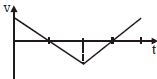
The graph below shows the velocity versus time graph for a body.

Which of the following graphs represents the corresponding acceleration $v/s$ time graph ?
The addition of three masses $1.6 \,g , 7.32 \,g$ and $4.238 \,g$, addressed upto proper decimal places is ....... $g$
The coefficient of friction between the tyres and the road is $0.25$. The maximum speed with which a car can be driven round a curve of radius $40 \,m$ without skidding is ........ $ms^{-1}$ (assume $g = 10 \,ms^{-2}$)
Three observers A, B and C measure the speed of light coming from a source to be vA, 0B and vc. The observer A moves towards the source and C moves away from the source at the same speed. The observer B stays stationary. The surrounding space is vacuum everywhere.

  1. $\text{v}_\text{A}>\text{v}_\text{B}>\text{v}_\text{C}.$

  2. $\text{v}_\text{A}<\text{v}_\text{B}<\text{v}_\text{C}$

  3. $\text{v}_\text{A}=\text{v}_\text{B}=\text{v}_\text{C}$

  4. $\text{v}_\text{B}=\frac{1}{2}(\text{v}_\text{A}+\text{v}_\text{C})$