MCQ
If the current is doubled, the deflection is also doubled in
  • A
    A tangent galvanometer
  • A moving coil galvanometer
  • C
    Both (a) and (b)
  • D
    None of these

Answer

Correct option: B.
A moving coil galvanometer

Need a full question paper?

Generate a complete, print-ready paper with questions like this in minutes — across 16+ boards, with answer keys.
Start Generating Free

Similar questions

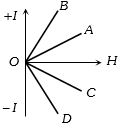
The variation of the intensity of magnetisation $(I)$ with respect to the magnetising field $(H)$  in a diamagnetic substance is described by the graph
A diver looking up through the water sees the outside world contained in a circular horizon. The refractive index of water is $\frac{4}{3}$,  and the diver's eyes are $15\, cm$ below the surface of water. Then the radius of the circle is
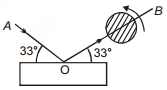
A beam of light $A O$ is incident on a glass slab $(m=1.54)$ in a direction as shown in the diagram. The reflected ray $O B$ is passed through a polariod. On viewing through the polariod, we find that on rotating the polariod $\left(\right.$ Given $\left.\tan 57^{\circ}=1.54\right)$
A ray passes through a prism of angle $60^o$ in minimum deviation position and suffers a deviation of $30^o $. What is the angle of incidence on the prism......$^o$
There is an electric field $E$ in $X$-direction. If the work done on moving a charge $0.2\,C$ through a distance of $2\,m$ along a line making an angle $60^\circ $ with the $X$-axis is $4.0\;J$, what is the value of $E$........ $N/C$
When a $PN $ junction diode is reverse biased
Electron volt is a unit of
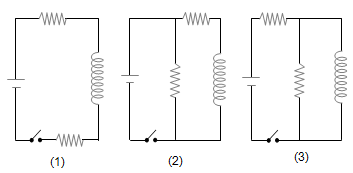
The figure shows three circuits with identical batteries, inductors, and resistors. Rank the circuits according to the current through the battery (i) just after the switch is closed and (ii) a long time later, greatest first

 
Given below are two statements: one is labelled as Assertion $A$ and the other is labelled as Reason $R$.

Assertion $A$: The potential ( $V$ ) at any axial point, at $2 \mathrm{~m}$ distance ( $r$ ) from the centre of the dipole of dipole moment vector $\vec{P}$ of magnitude, $4 \times 10^{-6} \mathrm{C} \mathrm{m}$, is $\pm 9 \times 10^3 \mathrm{~V}$.

(Take $\frac{1}{4 \pi \in_0}=9 \times 10^9 \mathrm{Sl}$ units)

Reason $R$: $V= \pm \frac{2 P}{4 \pi \in_0 r^2}$, where $r$ is the distance of any axial point, situated at $2 \mathrm{~m}$ from the centre of the dipole.

In the light of the above statements, choose the correct answer from the options given below:

Gauss’s law is true for.