MCQ
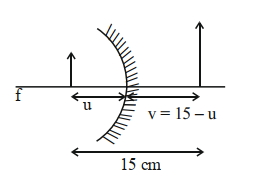
If the distance between object and its two times magnified virtual image produced by a curved mirror is $15 \mathrm{~cm}$, the focal length of the mirror must be :
  • A
     $15 \mathrm{~cm}$
  • B
    $-12 \mathrm{~cm}$
  •  $-10 \mathrm{~cm}$
  • D
    $10 / 3 \mathrm{~cm}$

Answer

Correct option: C.
 $-10 \mathrm{~cm}$
c
$ \mathrm{m}=2=\frac{-\mathrm{v}}{\mathrm{u}} $

$ 2=\frac{-(15-\mathrm{u})}{-\mathrm{u}} $

$ 2 \mathrm{u}=15-\mathrm{u} $

$ 3 \mathrm{u}=15 \Rightarrow \mathrm{u}=5 \mathrm{~cm} $

$ \mathrm{v}=15-\mathrm{u}=15-5=10 \mathrm{~cm} $

$ \frac{1}{\mathrm{f}}=\frac{1}{\mathrm{v}}+\frac{1}{\mathrm{u}} $

$ =\frac{1}{10}+\frac{1}{(-5)}=\frac{1-2}{10}=\frac{-1}{10} $

$ \mathrm{f}=-10 \mathrm{~cm}$

Need a full question paper?

Generate a complete, print-ready paper with questions like this in minutes — across 16+ boards, with answer keys.

Start Generating Free

Similar questions

An object $5cm$ tall is placed $1m$ from a concave spherical mirror which has a radius of curvature of $20cm$ The size of the image is......$cm$
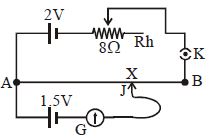
In a potentiometer experiment shown here, for the position $X$ of the jockey $J,$ there occurs a null deflection in the galvanometer. Then the potential difference between points $A$ and $X$ is  ................ $V$
The area of the plates of a parallel plate capacitor is $A$ and the gap between them is $d$. The gap is filled with a non-homogeneous dielectric whose dielectric constant varies with the distance $‘y’$ from one plate as : $K = \lambda \ sec(\pi y/2d)$, where $\lambda $ is a dimensionless constant. The capacitance of this capacitor is
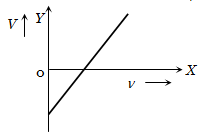
The stopping potential V for photoelectric emission from a metal surface is plotted along Y-axis and frequency n of incident light along X-axis. A straight line is obtained as shown. Planck's constant is given by
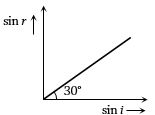
A medium shows relation between $i $ and $r$ as shown. If speed of light in the medium is $nc$ then value of $n $ is
Assertion : Neutrons penetrate matter more readily as compared to protons.
Reason : Neutrons are slightly more massive than protons.
The surface with a constant value of potential at all points on the surface is called as:
The charge on proton is:
A  radiation of energy $'E'$ falls normally on a perfectly reflecting surface. The momentum transferred to the surface is $( C =$ Velocity of light $)$
If a wire of resistance $R$ is melted and recasted to half of its length, then the new resistance of the wire will be