Question
If the horizontal force needed for the turn in the previous problem is to be supplied by the normal force by the road, what should be the proper angle of banking?

$\text{R}\cos\theta=\text{mg}\ \dots(1)$
$\text{R}\sin\theta=\frac{\text{mv}^2}{\text{r}}\ \dots(2)$
Dividing equation (1) with equation (2),$\tan\theta=\frac{\text{mv}^2}{\text{rmg}}=\frac{\text{v}^2}{\text{rg}}$
$\text{v}=36\text{km}/\text{hr}=10\text{m}/\text{sec},\text{r}=30\text{m}$
$\tan\theta=\frac{\text{v}^2}{\text{rg}}$
$=\frac{100}{30\times10}=\frac{1}{3}$
$\Rightarrow\theta=\tan^{-1}\Big(\frac{1}{3}\Big)$
Generate a complete, print-ready paper with questions like this in minutes — across 16+ boards, with answer keys.
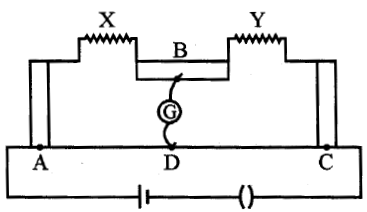

The figure shows experimental set up of a meter bridge. When the two unknown resistances X and Y are inserted, the null point D is obtained 40 cm from the end A. When a resistance of 10 Ω is connected in series with X, the null point shifts by 10 cm. Find the position of the null point when the 10 Ω resistance is instead connected in series with resistance ‘Y’. Determine the values of the resistances X and Y.