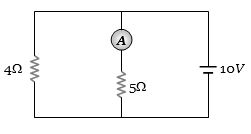
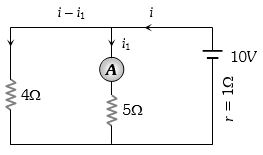
if the internal resistance of the battery is $1\, ohm$, then what is the reading of ammeter
Medium


Download our appand get started for free
Experience the future of education. Simply download our apps or reach out to us for more information. Let's shape the future of learning together!No signup needed.*
Similar Questions
- 1When two resistance are connected in parallel then the equivalent resistance is $\frac {6}{5}\Omega $ . When one of the resistance is removed then the effective resistance is $2\, \Omega $. The resistance of the wire removed will be ................ $\Omega$View Solution
- 2View SolutionAssertion : Kirchoff 's junction rule follows from conservation of charge.
Reason : Kirchoff 's loop rule follows from conservation of momentum.
- 3An electric bulb is rated $60\,W$, $220\,V$. The resistance of its filament is ............. $\Omega$View Solution
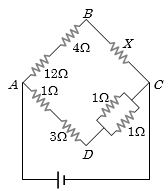
- 4In the circuit shown in the adjoining figure, the current between $B$ and $D$ is zero, the unknown resistance is of ................ $\Omega$View Solution
- 5The potential difference in open circuit for a cell is $2.2\, volts$. When a $4\, ohm$ resistor is connected between its two electrodes the potential difference becomes $2\, volts$. The internal resistance of the cell will be .............. $ohm$View Solution
- 6The potential gradient along the length of a uniform wire is $10\,volt/metre$. $B$ and $C$ are the two points at $30\,cm$ and $60\,cm$ point on a meter scale fitted along the wire. The potential difference between $B$ and $C$ will be ............. $volt$View Solution
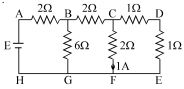
- 7The figure shows a network of resistors and $a$ battery. If $1\,A$ current flowsthrough the branch $CF$, then answer the following questions The current throughView Solution
- 8$20\,\mu A$ current flows for $30$ seconds in a wire, transfer of charge will beView Solution
- 9One end of a Nichrome wire of length $2\,L$ and cross-sectional area $A$ is attatched to an end of another Nichrome wire of length $L$ and cross-sectional area $2\,A$. If the free end of the longer wire is at an electric potential of $8.0$ $\mathrm{volts}$, and the free end of the shorter wire is at an electric potential of $1.0$ $\mathrm{volt}$, the potential at the junction of the two wires is equal to ............. $V$View Solution
- 10What is the number density of donor atoms which must be added to a pure germanium semiconductor to make $n-$ type semiconductor of conductivity $6.4\ {\Omega ^{ - 1}}\,c{m^{ - 1}}$? The mobility of electr ons in $n-$ type germanium is $4 \times {10^3}\ cm^2\ V^{-1}\ s^{-1}$. Neglect the contribution of holes to conductivityView Solution