Question
If the radius of a copper wire is doubled, will its specific resistance increase, decrease or remain same?

Answer

The specific resistance of a wire depends only on the material (at a given temperature).
Therefore by changing the radius, the specific resistance of copper remains unchanged.

Need a full question paper?

Generate a complete, print-ready paper with questions like this in minutes — across 16+ boards, with answer keys.
Start Generating Free

Similar questions

On the basis of electric field lines, in space, how does the intensity ( $\vec{E}$ ) of electric field of a point charge depend on distance $r$ ? - explain.
###
How do electric field lines depend on area or the solid angle subtended by area element?
An electric bulb marked 220V, 100W will get fused if it is made to consume 150W or more. What voltage fluctuation will the bulb withstand?
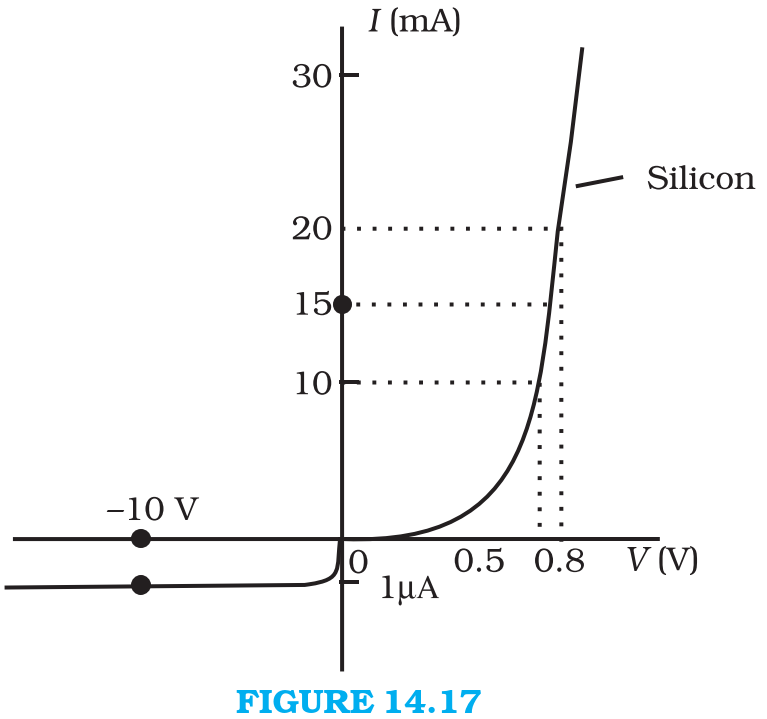
The $V-I$ characteristic of a silicon diode is shown in the Fig. 14.17. Calculate the resistance of the diode at (a) $I_D=15 mA$ and (b) $V_D=-10 V$.
Image
A parallel plate capacitor is charged with a potential difference 50 V . Thereafter it is discharged by a resistor for 2 sec , due to which its potential decreases by 10 V . Calculate the portion of energy stored in the capacitor.
The battery discussed in the previous question is suddenly disconnected. Is a current induced in the other loop? If yes, when does it start and when does it end? Do the loops attract each other or repel?
A charged particle oscillates about its mean (equilibrium) position with a frequency of 109Hz. What is the frequency of the electromagnetic waves produced by the oscillator?
In an electrolyte, the positive ions move from left to right and the negative ions from right to left. Is there a net current? If yes, in what direction?
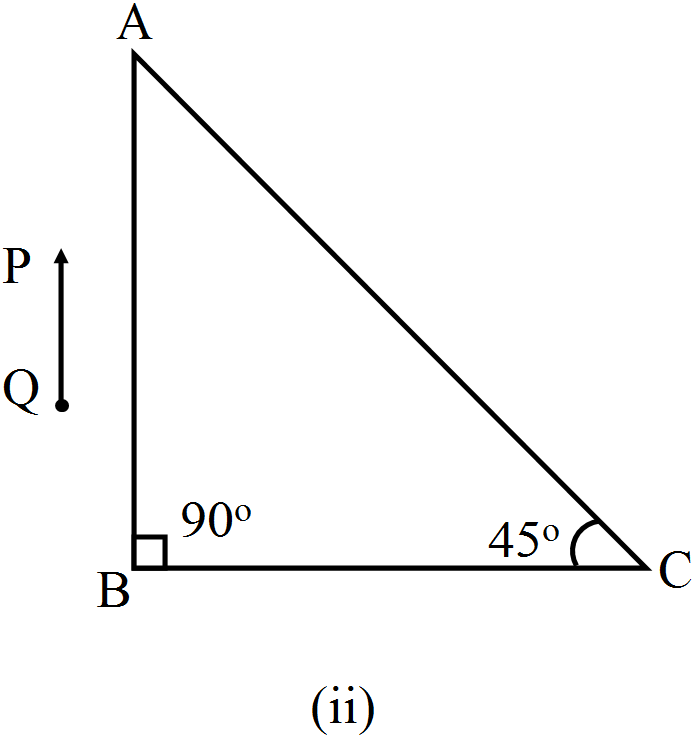
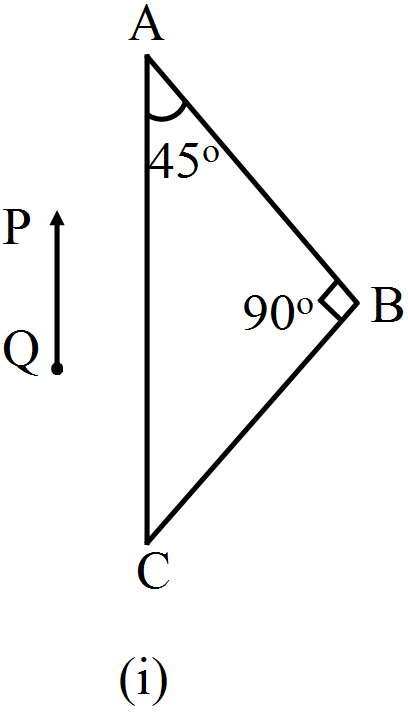
A right-angled crown glass prism with critical angle 41° is placed before an object, PQ in two positions as shown in the figures (i) and (ii). Trace the paths of the rays from P and Q passing through the prisms in the two cases.

Explain emission lines and absorption lines.
A Rowland ring of mean radius 15 cm has 3500 turns of wire wound on a ferromagnetic core of relative permeability 800. What is the magnetic field B in the core for a magnetising current of 1.2 A?