Question
If the shortest distance between the lines

$ \mathrm{L}_1: \overrightarrow{\mathrm{r}}=(2+\lambda) \hat{\mathrm{i}}+(1-3 \lambda) \hat{\mathrm{j}}+(3+4 \lambda) \hat{\mathrm{k}}, \lambda \in \mathbb{R} $

$ \mathrm{L}_2: \overrightarrow{\mathrm{r}}=2(1+\mu) \hat{\mathrm{i}}+3(1+\mu) \hat{\mathrm{j}}+(5+\mu) \hat{k}, \mu \in \mathbb{R}$

is $\frac{\mathrm{m}}{\sqrt{\mathrm{n}}}$, where $\operatorname{gcd}(\mathrm{m}, \mathrm{n})=1$, then the value of $\mathrm{m}+\mathrm{n}$ equals.
Answer

b
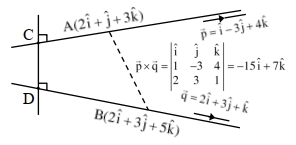
Shortes distance $(\mathrm{CD})=\left|\frac{\overline{\mathrm{AB}} \cdot \overrightarrow{\mathrm{p}} \times \overrightarrow{\mathrm{q}}}{|\overrightarrow{\mathrm{p}} \times \overrightarrow{\mathrm{q}}|}\right|$

$=\left|\frac{(0 \hat{i}+2 \hat{j}+2 \hat{k}) \cdot(-15 \hat{i}+7 \hat{j}+9 \hat{k})}{\sqrt{355}}\right|$

$=\frac{0+14+18}{\sqrt{355}}=\frac{32}{\sqrt{355}}$

$\therefore \mathrm{m}+\mathrm{n}=32+355=387$

Need a full question paper?

Generate a complete, print-ready paper with questions like this in minutes — across 16+ boards, with answer keys.

Start Generating Free

Similar questions

Consider the function $f:(0, \infty) \rightarrow R$ defined by $f(x)=e^{-\left|\log _e x\right|}$. If $m$ and $n$ be respectively the number of points at which $f$ is not continuous and $f$ is not differentiable, then $\mathrm{m}+\mathrm{n}$ is
Let the point, on the line passing through the points $P(1,-2,3)$ and $Q(5,-4,7)$, farther from the origin and at a distance of $9$ units from the point $\mathrm{P}$, be $(\alpha, \beta, \gamma)$. Then $\alpha^2+\beta^2+\gamma^2$ is equal to :
If the area of an equilateral triangle inscribed in the circle, $x^2 + y^2 + 10x + 12y + c = 0$ is $27\sqrt 3 \,sq.\,units$ then $c$ is equal to
The number of triples $(x, y, z)$ of real numbers satisfying the equation $x^4+y^4+z^4+1=4 x y z$ is
Find the value of $\frac{{({{18}^3} + {7^3} + 3.18.7.25)}}{{{3^6} + 6.243.2 + 15.81.4 + 20.27.8 + 15.9.16 + 6.3.32 + 64}}$
If the function $f$ given by $f\,(x)\, = \,{x^3} - 3(a - 2){x^2} + 3ax\, + 7,$ for some $a\in R$ is increasing in $(0, 1]$ and decreasing in $[1, 5),$ then a root of the equation, $\frac{{f(x) - 14}}{{{{(x - 1)}^2}}} = 0\,(x\, \ne 1)$ is
The value of ${d \over {dx}}[|x - 1| + |x - 5|]$ at $x = 3$ is
If $\sum_{ r =0}^5 \frac{{ }^{11} C _{2 r+1}}{2 r +2}=\frac{ m }{ n }, \operatorname{gcd}( m , n )=1$, then $m - n$ is equal to $\qquad$ .
Number of values of $x$ satisfying the equation

$\int\limits_{ - \,1}^x {\,\left( {8{t^2} + \frac{{28}}{3}t + 4} \right)\,dt} $ $=$ $\frac{{\left( {{\textstyle{3 \over 2}}} \right)x + 1}}{{{{\log }_{(x + 1)}}\sqrt {x + 1} }}$ , is

The sum of all the elements in the set $\{\mathrm{n} \in\{1,2, \ldots \ldots ., 100\} \mid$ $H.C.F.$ of $n$ and $2040$ is $1\,\}$ is equal to $.....$