MCQ
If the telescope is reversed i.e. seen from the objective side
  • Object will appear very small
  • B
    Object will appear very large
  • C
    There will be no effect on the image formed by the telescope
  • D
    lmage will be slightly greater than the earlier one

Answer

Correct option: A.
Object will appear very small
Because magnification in this case becomes reciprocal of initial magnification.

Need a full question paper?

Generate a complete, print-ready paper with questions like this in minutes — across 16+ boards, with answer keys.
Start Generating Free

Similar questions

In an industrial process $10 \mathrm{~kg}$ of water per hour is to be heated from $20^{\circ} \mathrm{C}$ to $80^{\circ} \mathrm{C}$. To do this steam at $150^{\circ} \mathrm{C}$ is passed from a boiler into a copper coil immersed in water. The steam condenses in the coil and is returned to the boiler as water at $90^{\circ} \mathrm{C}$. how many $\mathrm{kg}$ of steam is required per hour.(Specific heat of steam $=1$ calorie per $g^P C$, Latent heat of vaporisation $=540 \mathrm{cal} / \mathrm{gm}$ )
The direction of induced e.m.f. during electromagnetic induction is given by
A body of mass $m$ moving with velocity $v$ makes a head-on collision with another body of mass $2 \mathrm{~m}$ which is initially at rest. The loss of kinetic energy of the colliding body (mass $m$ ) is
Which of the following is not a property of light
Number of base $Sl$ units is
If $x=a t+b t^2$, where $x$ is the distance travelled by the body in kilometres while $t$ is the time in seconds, then the units of $b$ are
A beam of monochromatic blue light of wavelength $4200 \mathring A$ in air travels in water $(\mu=4 / 3)$. Its wavelength in water will be
What is the time taken (in seconds) to cross a glass of thickness $4\ mm$ and $\mu=3$ by light
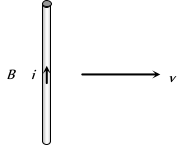
A conducting wire is moving towards right in a magnetic field $B$. The direction of induced current in the wire is shown in the figure. The direction of magnetic field will be
Image
A ball is thrown upwards and it returns to ground describing a parabolic path. Which of the following remains constant