MCQ
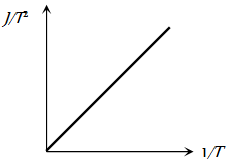
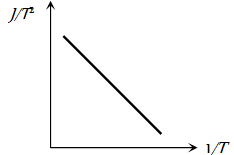
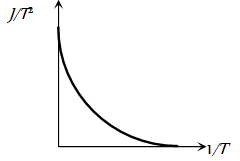
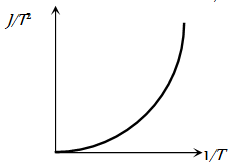
If the thermionic current density is $J$ and emitter temperature is $T$ then the curve between ${\frac{J}{T^2}}$  and $\frac{1}{T}$ will $b$ 
  • A
  • B
     
  • D
     

Answer

Correct option: C.

Need a full question paper?

Generate a complete, print-ready paper with questions like this in minutes — across 16+ boards, with answer keys.
Start Generating Free

Similar questions

A) Line spectra is due to atoms in gaseous state:
B) Band spectra is due to molecules:
An electron is travelling along the x-direction. It encounters a magnetic field in the y-direction. Its subsequent motion will be(a) Straight line along the x-direction(b) A circle in the xz-plane(c) A circle in the yz-plane(d) A circle in the xy-plane
   
   
The magnetic induction at any point due to a long straight wire carrying a current is(a) Proportional to the distance from the wire(b) Inversely proportional to the distance from wire(c) Inversely proportional to the square of the distance from the wire(d) Does not depend on distance


Two sources give interference pattern which is observed on a screen, D distance apart from the sources. The fringe width is 2w. If the distance D is now doubled, the fringe width will(a) Become w/2(b) Remain the same(c) Become w(d) Become 4w
       
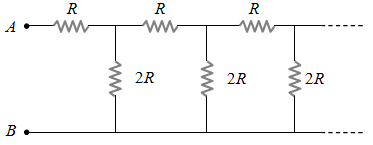
An infinite ladder network is arranged with resistances $R$ and $2 R$ as shown.  The effective resistance between terminals $A$ and $B$ is
The path executed by a charged particle whose motion is perpendicular to magnetic field i(a) A straight line(b) An ellipse(c) A circle(d) A helix
       
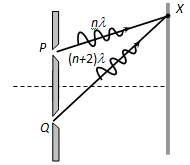
The figure shows a double slit experiment $P$ and $Q$ are the slits. The path lengths $PX$ and $QX$ are $n\lambda$ and$ (n+2)\lambda$ respectively, where $n$ is a whole number and $\lambda$ is the wavelength. Taking the central fringe as zero, what is formed at $X$
A source of electromotive force (emf) is a:
The ratio of amplitude of a magnetic field to the amplitude of electric field for an electromagnetic wave propagating in vacuum is equal to:
How should people wearing spectacles work with a microscope?