If two bulbs of wattage $25$ and $30$, each rated at $220\, volts$, are connected in series with a $440$ $volt$ supply, which bulb will fuse
Easy
Download our app for free and get started
(a) In series, ${P_{Consumed}} \propto \frac{1}{{{P_{Rated}}}} \propto {V_{Applied}}$
i.e. more voltage appears on smaller wattage bulb, so $25\, W$ bulb will fuse

Download our appand get started for free
Experience the future of education. Simply download our apps or reach out to us for more information. Let's shape the future of learning together!No signup needed.*
Similar Questions
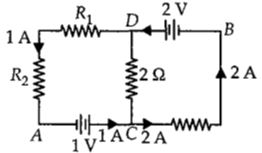
- 1In the circuit shown in the figure, if the potential at point $A$ is taken to be zero, the potential at point $B$ is ................ $V$View Solution
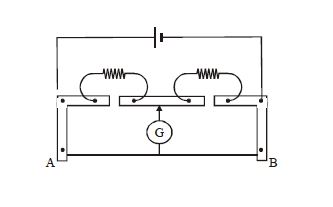
- 2A meter bridge set up as shown to determine end correction at $A$ and $B$. When a resistance of $15\ \Omega$ is used in left gap and of $20\ \Omega$ in right gap, then null point comes at a distance $42\ cm$ from $A$. When these resistances are interchanged null point comes at a distance $57\ cm$ from $A$. Values of end corrections areView Solution
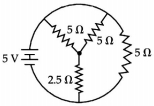
- 3The total current supplied to the circuit as shown in figure by the $5 V$ battery is $A$View Solution
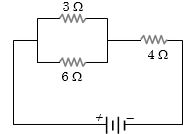
- 4In the figure, current through the $3\,\Omega $ resistor is $0.8\, ampere$, then potential drop through $4\,\Omega $ resistor is ........... $V$View Solution
- 5In a hydrogen discharge tube it is observed that through a given cross-section $3.13 \times {10^{15}}$ electrons are moving from right to left and $3.12 \times {10^{15}}$ protons are moving from left to right. What is the electric current in the discharge tube and what is its directionView Solution
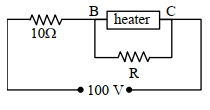
- 6A heater is designed to operate with a power of $1000 \mathrm{~W}$ in a $100 \mathrm{~V}$ line. It is connected in combination with a resistance of $10 \Omega$ and a resistance $R$, to a $100 \mathrm{~V}$ mains as shown in figure. For the heater to operate at $62.5 \mathrm{~W}$, the value of $\mathrm{R}$ should be .................. $\Omega$.View Solution
- 7When three identical bulbs of $60 \;W, 200\;V$ rating are connected in series to a $200 \;V$ supply, the power drawn by them will be ....... $Watt$View Solution
- 8A storage cell is charged by $5\, amp$ $D.C.$ for $18$ hours. Its strength after charging will be .............. $AH$View Solution
- 9View SolutionAs the temperature of a conductor increases, its resistivity and conductivity change. The ratio of resistivity to conductivity
- 10An aluminium wire is stretched to make its length, $0.4 \,\%$ larger. Then percentage change in resistance is $.....\,\%$View Solution