MCQ
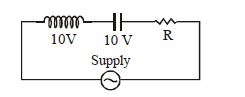
If value of  $R$  is changed then
  • A
    voltage across $L$ remains same
  • B
    voltage across $C$  remains same
  • voltage across  $L-C$  combination remains same
  • D
    voltage across  $L-C$  combination changes

Answer

Correct option: C.
voltage across  $L-C$  combination remains same
c
$\therefore \mathrm{V}_{\mathrm{L}}=\mathrm{V}_{\mathrm{C}} \Rightarrow \mathrm{IX}_{\mathrm{L}}=\mathrm{IX}_{\mathrm{C}}$

$\Rightarrow \mathrm{X}_{\mathrm{L}}=\mathrm{X}_{\mathrm{C}}$

Voltage across $\mathrm{LC}$ combination $=\mathrm{I}\left(\mathrm{X}_{\mathrm{L}}-\mathrm{X}_{\mathrm{C}}\right)=0$

$\therefore \mathrm{X}_{\mathrm{L}}-\mathrm{X}_{\mathrm{C}}=0$

$\Rightarrow$ Voltage across $\mathrm{LC}$ combination is always $0 .$

Need a full question paper?

Generate a complete, print-ready paper with questions like this in minutes — across 16+ boards, with answer keys.
Start Generating Free

Similar questions

The radius of the trajectory of a charged particle in a uniform magnetic field is proportional to the:
Period of revolution increases in the order of
The electric field intensity at a point in vacuum is equal to
In a hydrogen atom, an electron moves in a circular orbit of radius $5.2\times 10^{-11}$m  and produces a magnetic induction of 12.56 T at its nucleus. The current produced by the motion of the electron will be (Given $\mu_0=4\pi\times 10^{-7}$Wb/A-m) 
A compound microscope has two lenses. The magnifying power of one is $5$ and the combined magnifying power is $100$. The magnifying power of the other lens is
Young's double slit experiment is performed with monochromatic light. A thin film is introduced in front of one of the slits
The difference between threshold wavelengths for two metal surfaces $A$ and $B$ having work function $\phi_A=9\,eV$ and $\phi_{ B }=4.5\,eV$ in $nm$ is:(Given, $hc =1242\,eV\,nm$)
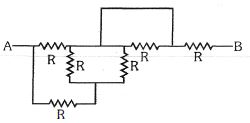
What is the equivalent resistance between  $A$ and $B$
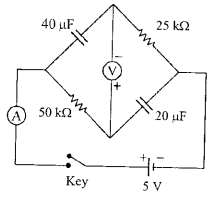
In the circuit shown below, the key is pressed at time $t=0$. Which of the following statement(s) is(are) true?

($A$) The voltmeter displays $-5 \mathrm{~V}$ as soon as the key is pressed, znd displays $+5 \mathrm{~V}$ after a long time

($B$) The voltmeter will display $0 \mathrm{~V}$ at time $t=\ln 2$ seconds

($C$) The current in the ammeter becomes $1 / e$ of the initial value after $1$ second

($D$) The current in the ammeter becomes zero after a long time
The sensitivity of a galvanometer of resistance $406\, ohm$ is decreased by $30\, times$. The shunt used is .................. $\Omega$