Question
If $\vec{\text{a}}\text{ and }\vec{\text{b}}$ are two non-collinear vectors having the same initial point. What are the vectors represented by $\vec{\text{a}}+\vec{\text{b}}\text{ and }\vec{\text{a}}-\vec{\text{b}}$.

Answer

Here, it is given that $\vec{\text{a}}\text{ and }\vec{\text{b}}$ are two non-collinear vectors having the same initial point.Let $\vec{\text{a}}=\overrightarrow{\text{AB}}\text{ and }\vec{\text{b}}=\overrightarrow{\text{AD}}$, So we can draw a parallelogram ABCD as above.
By the properties of parallelogram
$\overrightarrow{\text{BC}}=\vec{\text{b}}\text{ and }\overrightarrow{\text{DC}}=\vec{\text{a}}$
In $\triangle\text{ABC}$,
Using triangle law,
$\overrightarrow{\text{AB}}+\overrightarrow{\text{BC}}=\overrightarrow{\text{AC}}$
$\vec{\text{a}}+\vec{\text{b}}=\overrightarrow{\text{AC}}\ \dots(\text{i})$
In $\triangle\text{ABD}$
$\overrightarrow{\text{AD}}+\overrightarrow{\text{DB}}=\overrightarrow{\text{AB}}$
$\vec{\text{b}}+\overrightarrow{\text{DB}}=\vec{\text{a}}$
$\overrightarrow{\text{DB}}=\vec{\text{a}}-\vec{\text{b}}\ \dots(\text{ii})$
From (i) and (ii), we get that
$\vec{\text{a}}+\vec{\text{b}}\text{ and }\vec{\text{a}}-\vec{\text{b}}$ are diagonals of a parallelogram whose adjacent sides are $\vec{\text{a}}\text{ and }\vec{\text{b}}$

Need a full question paper?

Generate a complete, print-ready paper with questions like this in minutes — across 16+ boards, with answer keys.
Start Generating Free

Similar questions

Without expanding, show that the values of the following determinant are zero:
$\begin{vmatrix}0&\text{x}&\text{y}\\-\text{x}&0&\text{z}\\-\text{y}&-\text{z}&0\end{vmatrix}$
If $\text{A}=\begin{bmatrix}\text{ab}&\text{b}^2\\-\text{a}^2&-\text{ab}\end{bmatrix},$ show that $A^2 = 0$
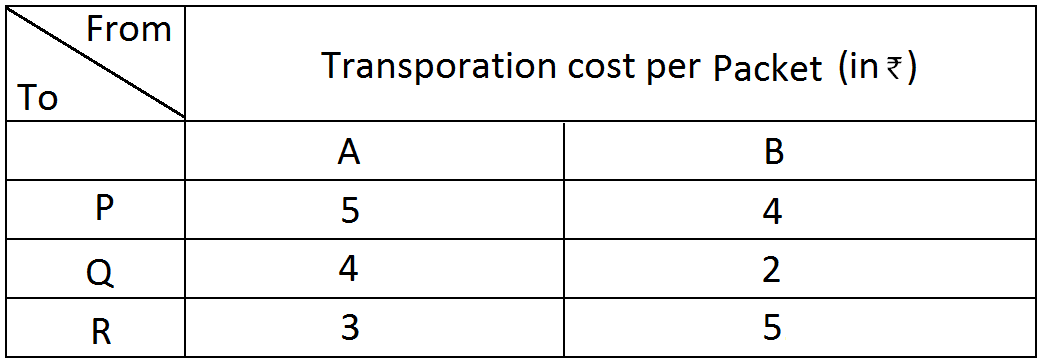
A medical company has factories at two places, A and B. From these places, supply is made to each of its three agencies situated at P, Q and R. The monthly requirements of the agencies are respectively 40, 40 and 50 packets of the medicines, while the production capacity of the factories, A and B, are 60 and 70 packets respectively. The transportation cost per packet from the factories to the agencies are given below:

How many packets from each factory be transported to each agency so that the cost of transportation is minimum? Also find the minimum cost?
Evaluate the following integrals:
$\int\frac{\text{x}^2\sin^{-1}\text{x}}{(1-\text{x}^2)^{\frac{3}{2}}}\text{dx}$
Evaluate: $\int\limits_0^{\pi/2} 2 \sin x \cos x \tan^{-1}(\sin x) dx.$
Prove that: $\big(\vec{\text{a}}-\vec{\text{b}}\big).\big\{\big(\vec{\text{b}}-\vec{\text{c}}\big)\big\}=0$
Find the angle between the vectors whose direction cosines are proportional to 2, 3, -6 and 3, -4, 5.
Find one-parameter families of solution curves of the following differential equation: (or solve the following differential equation)$\frac{\text{dy}}{\text{dx}}\cos^2\text{x}=\tan\text{x}-\text{y}$
If function $f: R \rightarrow R , f(x)=x^2+2$ and $g: R \rightarrow R$ $g(x)=\frac{x}{x-1}, x \neq 1$ then find $f o g$ and $g o f$ and also find $( fog )(2)$ and $( gof )(-3)$ ?
Find the area bounded by the lines y = 4x + 5, y 5 - x and 4y = x + 5.