Question
If Young's double slit experiment is performed in water:
  1. The fringe width will decrease.
  2. The fringe width will increase.
  3. The fringe width will remain unchanged.
  4. There will be no fringe.

Answer

  1. The fringe width will decrease.

Explanation:

As fringe width is proportional to the wavelength and wavelength of light is inversely proportional to the refractive index of the medium,

Here,

$\lambda_\text{M}=\frac{\lambda}{\eta}$

$\lambda_\text{M}$ = wavelength in medium

$\lambda$ = wavelength in vacuum

$\eta$ = refractive index of medium

Hence, fringe width decreases when Young's double slit experiment is performed under water.

Need a full question paper?

Generate a complete, print-ready paper with questions like this in minutes — across 16+ boards, with answer keys.

Start Generating Free

Similar questions

The two ends of a rod of length $L$ and a uniform cross-sectional area $A$ are kept at two temperatures $T_1$ and $T_2 (T_1 > T_2)$. The rate of heat transfer,$\frac{ dQ }{dt}$, through the rod in a steady state is given by
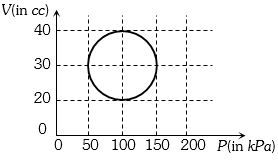
A system is taken through a cyclic process represented by a circle as shown. The heat absorbed by the system is
A string in musical instrument is $50 cm$ long and its fundamental frequency is $800 Hz.$ If a frequency of $1000 Hz$ is to be produced, then required length of string is ..... $cm$
A projectile is fired from level ground at an angle $\theta $ above the horizontal. The elevation angle $\phi $ of the highest point as seen from the launch point is related to $\theta $ by the relation
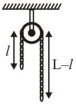
A uniform metal chain of mass $m$ and length ' $L$ ' passes over a massless and frictionless pulley. It is released from rest with a part of its length ' $l$ ' is hanging on one side and rest of its length ' $L -l$ ' is hanging on the other side of the pulley. At a certain point of time, when $l=\frac{L}{x}$, the acceleration of the chain is $\frac{g}{2}$. The value of $x$ is ........
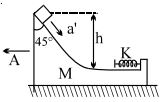
$A$ small block of mass $m$ is placed on $a$ wedge of mass $M$ as shown, which is initially at rest. All the surfaces are frictionless . The spring attached to the other end of wedge has force constant $k$. If $a'$ is the acceleration of $m$ relative to the wedge as it starts coming down and $A$ is the acceleration acquired by the wedge as the block starts coming down, then 
In the three states of matter, the elastic coefficient can be
Match List$-I$ With List$-II$

$(a)$ Gravitational constant $(G)$ $(i)$ $\left[ L ^{2} T ^{-2}\right]$
$(b)$ Gravitational potential energy $(ii)$ $\left[ M ^{-1} L ^{3} T ^{-2}\right]$
$(c)$ Gravitational potential $(iii)$ $\left[ LT ^{-2}\right]$
$(d)$ Gravitational intensity $(iv)$ $\left[ ML ^{2} T ^{-2}\right]$

Choose the correct answer from the options given below:

A particle moves along a circle with a constant angular speed $\omega$ Its displacement,with respect to this position of the particle at time $t = 0$ is plotted against time. The graph would look like
A Newtonian fluid fills the clearance between a shaft and a sleeve. When a force of $800$ $N$ is applied to the shaft, parallel to the sleeve, the shaft attains a speed of $1.5$ $cm/sec$. If a force of $2.4$ $kN$ is applied instead, the shaft would move with a speed of ......... $ cm/sec$