MCQ
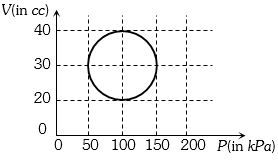
A system is taken through a cyclic process represented by a circle as shown. The heat absorbed by the system is
  • A
    $\pi \times {10^3}J$
  • $\frac{\pi }{2}J$
  • C
    $4\pi \times {10^2}J$
  • D
    $\pi \,J$

Answer

Correct option: B.
$\frac{\pi }{2}J$
b
(b) In cyclic process $\Delta  Q =$ Work done = Area inside the closed curve.

Treat the circle as an ellipse of area $ = \frac{\pi }{4}({P_2} - {P_1})\,({V_2} - {V_1})$

$\Rightarrow \Delta Q = \frac{\pi }{4}\{ (150 - 50) \times {10^3}\} = \frac{\pi }{2}J$

Need a full question paper?

Generate a complete, print-ready paper with questions like this in minutes — across 16+ boards, with answer keys.
Start Generating Free

Similar questions

A source and an observer move away from each other with a velocity of $10\; m/s$ with respect to ground. If the observer finds the frequency of sound coming from the source as $1950 \;Hz$, then actual frequency of the source is .... $Hz$ (velocity of sound in air = $340\; m/s$)
In rotational motion of a rigid body, all particle move with
The longitudinal strain is only possible in
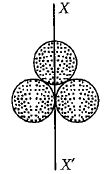
Three identical spherical shells, each of mass $m$ and radius $r$ are placed as shown in figure. Consider an axis $XX'$ which is touching to two shells and passing through diameter of third shell. Moment of inertia of the system consisting of these three spherical shells about $XX'$ axis is
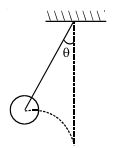
A ball is held in the position shown with string of length $1\,\, m$ just taut & then projected horizontally with a velocity of $3 \,\,m/s$. If the string becomes taut again when it is vertical, angle $\theta$ is given by  ........ $^o$
Consider a vector $\overrightarrow F = 4\hat i - 3\hat j.$ Another vector that is perpendicular to $\overrightarrow F $ is
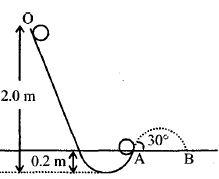
A tennis ball (treated as hollow spherical shell) starting from $O$ rolls down a hill. At point $A$ the ball becomes air borne leaving at an angle of $30^o$ with the horizontal. The ball strikes the ground at $B$. What is the value of the distance $AB$ ? (Moment of inertia of a spherical shell of mass $m$ and radius $R$ about its diameter .......... $m$. $= \frac {2}{3}\,mR^2$)
A rubber ball is dropped from a height of $5 \,m$ on a planet where the acceleration due to gravity is not known. On bouncing, it rises to $1.8\, m$. The ball loses its velocity on bouncing by a factor of
The angular frequency of motion whose equation is $4\frac{{{d^2}y}}{{d{t^2}}} + 9y = 0$ is ($y =$ displacement and $t =$ time)
If the volume of the given mass of a gas is increased four times, the temperature is raised from $27°C$ to $127°C.$ The elasticity will become