Question
Illustrate how interest on drawings will be calculated under various situations.

Answer

When a partner withdraws any amount, either in cash or in any other form, from the firm for his/ her personal use, then it is termed as drawings. The interest charged by the firm on the amount of drawings is termed as interest on drawings. The method of calculating interest on drawings depends on the information available for time and frequency of the drawings made by the partner. The following different situations of drawings made illustrate the calculation of interest charged on drawings. Situation I: When all the information regarding amount, date and rate of interest on drawings is given When a partner withdrew ₹ 10,000 on July 01 and interest on drawings is charged at 12% pa and the firm closed its books on December 31 every year then interest on drawings amount to Rs 600. Interest on drawing $=\text{Total Amount Drawn}\times\frac{\text{Rate of Interest}}{100}\times\frac{\text{Period}}{12}$ Interest on drawings $=10000\times\frac{12}{100}\times\frac{6}{12}=₹\ 600$ Situation II: When information regarding amount, rate of interest on drawings is given:Case I Sometimes amount and rate of interest on drawings (per annum) is given but date is not mentioned in this case when the details regarding the amount of drawings and rate of interest on drawings (pa) is given but the date of drawings is not given then interest will be charged on average basis and the period of drawings will be taken as 6 months,
Interest on drawings $=10,000\times\frac{12}{100}\times\frac{6}{12}=₹\ 600$
Case II Sometimes the amount and rate of is interest on drawings is given but the date and per anum rate of interest is not mentioned.
In this case when the date and the rate of interest aim given but per annum is not specified, then annual interest is charged.
e.g., if a partner withdraws ₹ 10 000 and interest rate is 12%, then the interest on drawings amounts to ₹ 12, 000.
Interest on drawing $=\text{Total Amount withdraw}\times\frac{\text{Rate}}{100}$
Interest on drawings $=10000\times\frac{12}{100}=₹\ 1,200$
Situation III: When a fixed amount is withdrawn at regular intervalCase I Sometimes a fixed amount is withdrawn at the beginning of each month and the rate of interest is given then the interest is calculated for 6-5 months.
e.g. If a partner withdraws ₹ 1,000 in the beginning of every month and the rate of interest is 12% pa, then the interest on drawings amount to Rs 780.
Interest on drawings $=12,000\times\frac{12}{100}\times\frac{65}{12}=₹\ 780$
Total amount of drawings = (1,000 × 12) = ₹ 12,000
Case II Sometimes a fixed amount is withdrawn at the end of each month and the rate of interest is given then the interest is calculated for 5.5 months.
e.g..if a partner withdraws ₹ 1.000 at the end of each month arid rate of interest is 12% pa then the interest on drawings amount to ₹ 660.
Interest on drawings $=\text{Total amount of drawings}\times\frac{\text{Rate}}{100}\times\frac{5.5}{12}$
Interest on drawings $=12,000\times\frac{12}{100}\times\frac{5.5}{12}=₹\ 660$
Case III Sometimes a fixed amount is withdrawn at the mid of each month and the rate of interest is given then the interest is calculated for 6 months.
e g. if a partner.withdraws ₹ 1,000 on 15th of every month and the rate of in’crest is 12% pa then the interest on drawings amount to ₹ 720.
Interest on drawings $=\text{Total amount of drawings}\times\frac{\text{Rate}}{100}\times\frac{6}{12}$
Interest on drawings $=12,000\times\frac{12}{100}\times\frac{6}{12}=₹\ 720$
Case IV If a fixed amount is withdrawn in the beginning of every quarter then the interest is calculated for 7.5 months.
e.g. If a partner withdraws ₹ 5,000 in the beginning of every quarter and the rate of interest is 12% pa then the interest on drawings amount to ₹ 1,800.
Interest on drawings $=\text{Total amount of drawings}\times\frac{\text{Rate}}{100}\times\frac{7.5}{12}$
Interest on drawings $=20,000\times\frac{12}{100}\times\frac{7.5}{12}=₹\ 1,800$
Total amount of drawings = 5000 × 4 = ₹ 20,000
Case V If a fixed amount is withdrawn at the end of every quarter, then the interest is calculated for 4.5 months.
e.g., If a partner withdraws ₹ 5,000 at the end of every quarter and the rate of interest is 12% pa then the interest on drawings amounts to ₹ 900.
Interest on drawings $=\text{Total amount of drawings}\times\frac{\text{Rate}}{100}\times\frac{4.5}{12}$
Interest on drawings $=20,000\times\frac{12}{100}\times\frac{4.5}{12}=₹\ 900$
Total amount of drawings = 5000 × 4 = ₹ 20,000
Situation IV: When different amount is at different intervals
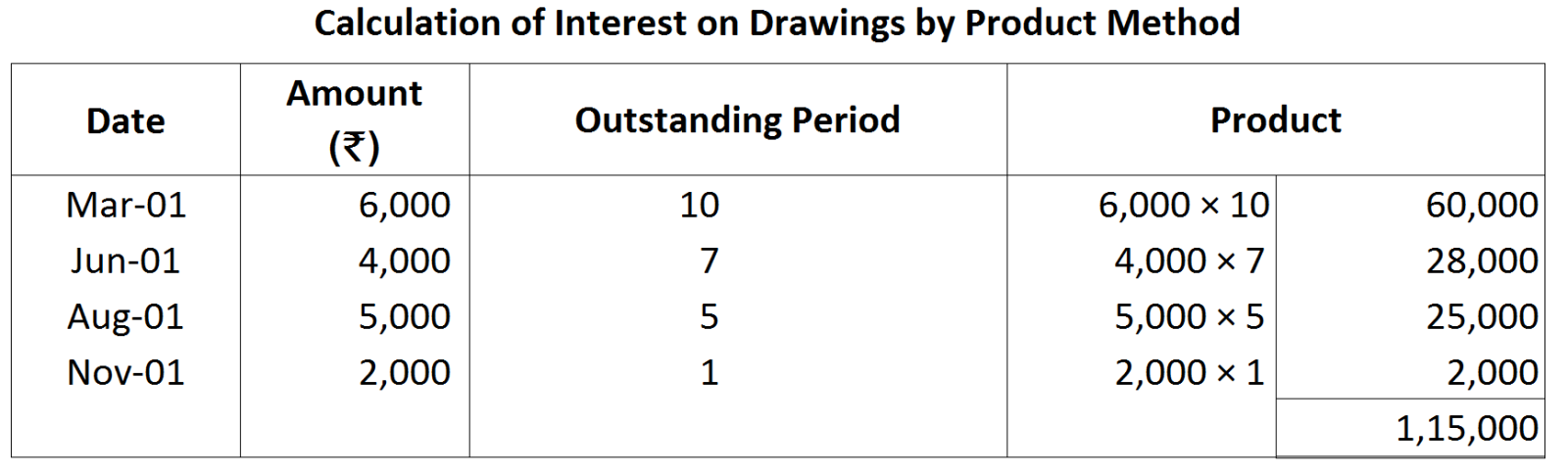
When different amount is withdrawn by a partner at different dates then the interest is calculated by product method. The period of drawings is calculated from the date of withdrawal to the last date of the accounting year,
e.g., A partner withdraws? 6,000 on March 01, ₹ 4,000 on June 01, ₹ 5,000 on Aug 30 and ₹ 2,000 on Nov 30 and the rate of interest on drawings is 12% pa. The firm closes its book on December 31.

Interest on drawings $=\text{Sum of product}\times\frac{\text{Rate}}{100}\times\frac{1}{2}$ Interest on drawings $=1,15,000\times\frac{12}{100}\times\frac{1}{12}=₹\ 1,150$

Need a full question paper?

Generate a complete, print-ready paper with questions like this in minutes — across 16+ boards, with answer keys.

Start Generating Free

Similar questions

P Ltd. issued 6,000 12% Debentures of ₹ 100 each at a discount of 6% to be redeemed as follows:
1st year: Nil; 2nd year: Nil; 3rd year: ₹ 4,00,000; 4th year: ₹ 2,00,000. Show the Discount on Issue of Debentures Account for the period of 4 years in the books of the Company.
Supriya Ltd. issued 80 Lakh 9% debentures of ₹ 100 each at a discount of 6% on April 1, 2007. Debentures are repayable in five equal instalments starting from the end of sixth year. The securities premium account showed a balance of ₹ 1.6 crores on the above date. Compute the amount of discount to be written off and pass journal entries to record these transactions in the books of Supriya Ltd.
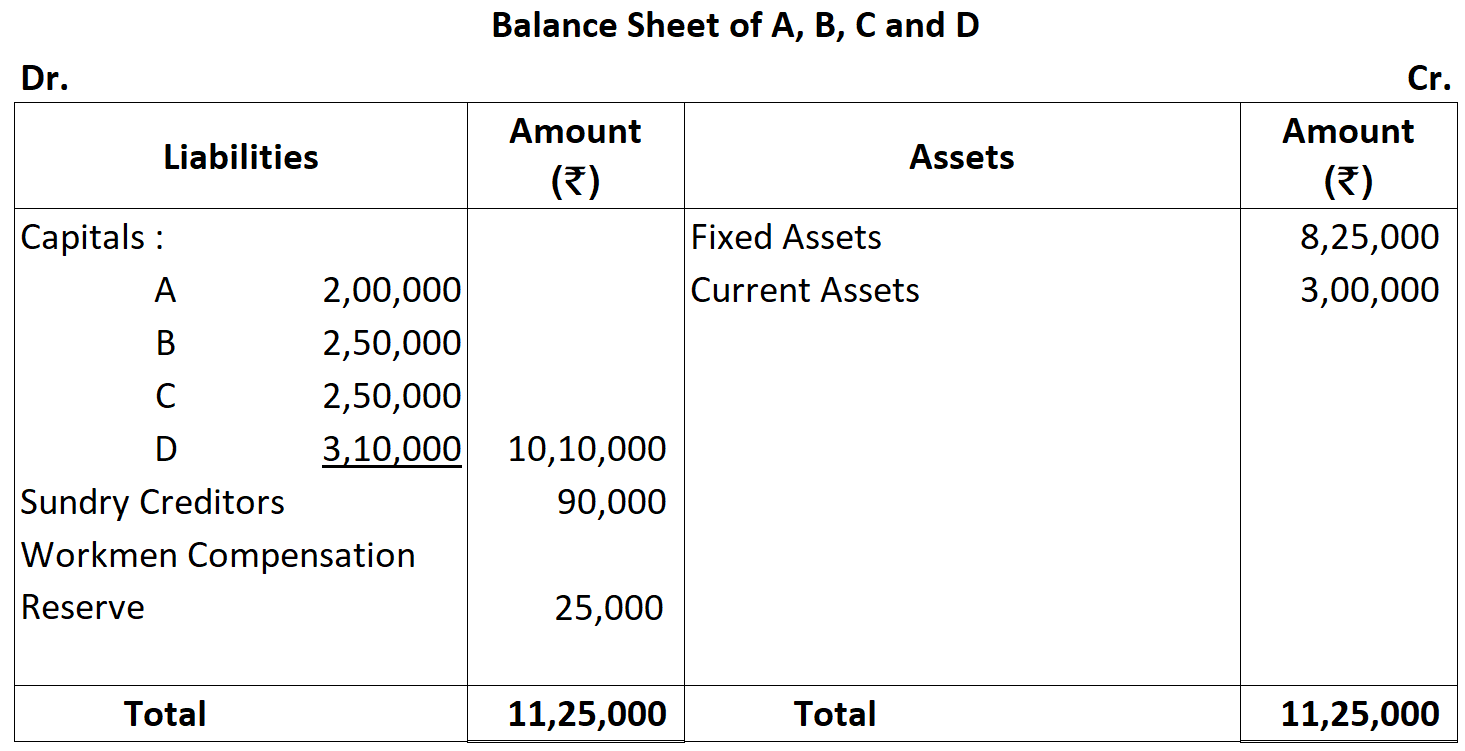
A, B, C and D were partners in a firm sharing profits in the ratio of 3 : 2 : 3 : 2. On 1.4.2016, their Balance Sheet was as follows:

From the above date the partners decided to share the future profits in the ratio of 4 : 3 : 2 : 1. For this purpose the goodwill of the firm was valued at ₹ 2,70,000. It was also considered that:
  1. The claim against Workmen Compensation Reserve has been estimated at ₹ 30,000 and fixed assets will be depreciated by ₹ 25,000.
  2. Adjust the capitals of the partners according to the new profit sharing ratio by opening Current Accounts of the partners.
Prepare Revaluation Account, Partners’ Capital Account and the Balance Sheet of the reconstituted firm.
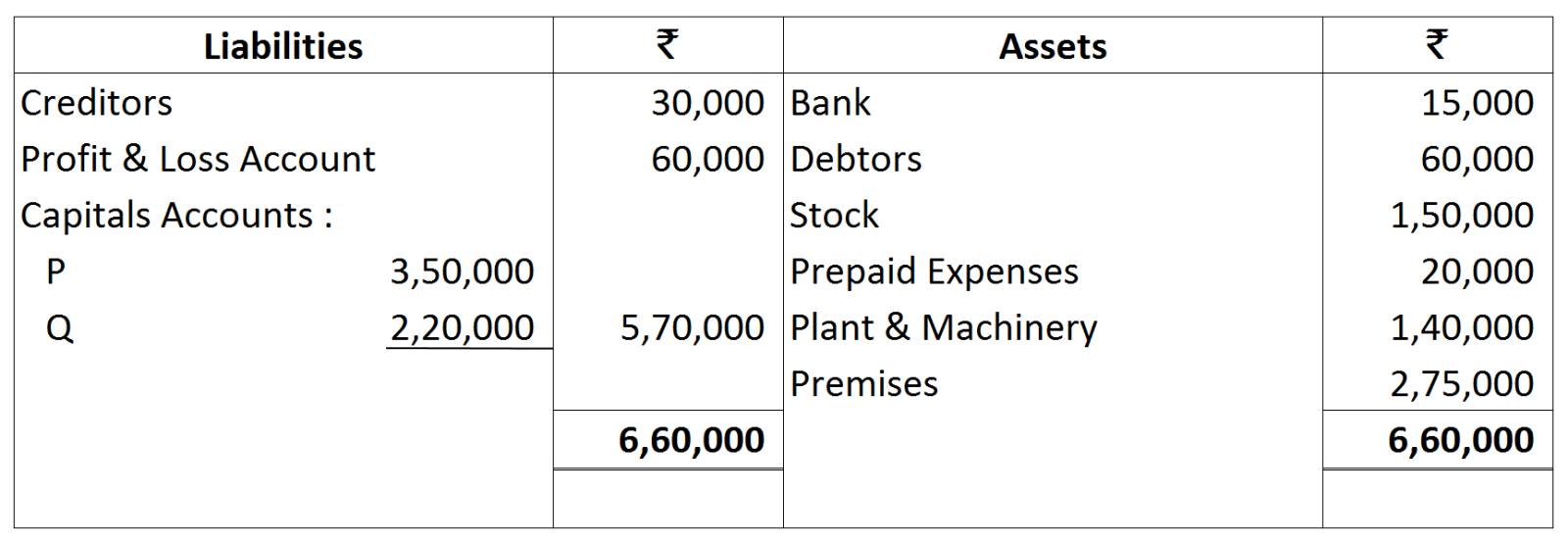
P and Q are partners sharing profits in 3 : 1. R is admitted and the partners decide to share the future profits in the ratio of 2 : 1 : 1. The Balance sheet of P and Q as at 31st March, 2018 was as under:

It was decided that:
  1. Part of the stock which has been included at a cost of ₹ 8,000 had been badly damaged in storage and could realise only ₹ 2,000.
  2. A bill for ₹ 7,000 for electric charges has been omitted to be recorded.
  3. Plant & Machinery was found overvalued by ₹ 20,000. Premises be appreciated to ₹ 3,00,000.
  4. Prepaid expenses be brought down to 40%.
  5. R's share of goodwill is valued at ₹ 20,000 but he is unable to bring it in cash.
  6. R brings in capital proportionate to his share of profit in the firm.
Prepare Revaluation A/c, Capital A/cs and the opening Balance Sheet.
Ajay, Binay and Chetan were partners sharing profits in the ratio of 3 : 3 : 2. The Partnership Deed provided for the following:
  1. Salary of ₹ 2,000 per quarter to Ajay and Binay.
  2. Chetan was entitled to a commission of ₹ 8,000
  3. Binay was guaranteed a pofit of ₹ 50,000 p.a.
The profit of the firm for the year ended 31st March, 2015 was ₹ 1,50,000 which was distributed among Ajay, Binay and Chetan in the ratio of 2 : 2 : 1, without taking into consideration the provisions of Partnership Deed. Pass necessary rectifying entry for the above adjustments in the books of the firm. Show your workings clearly.
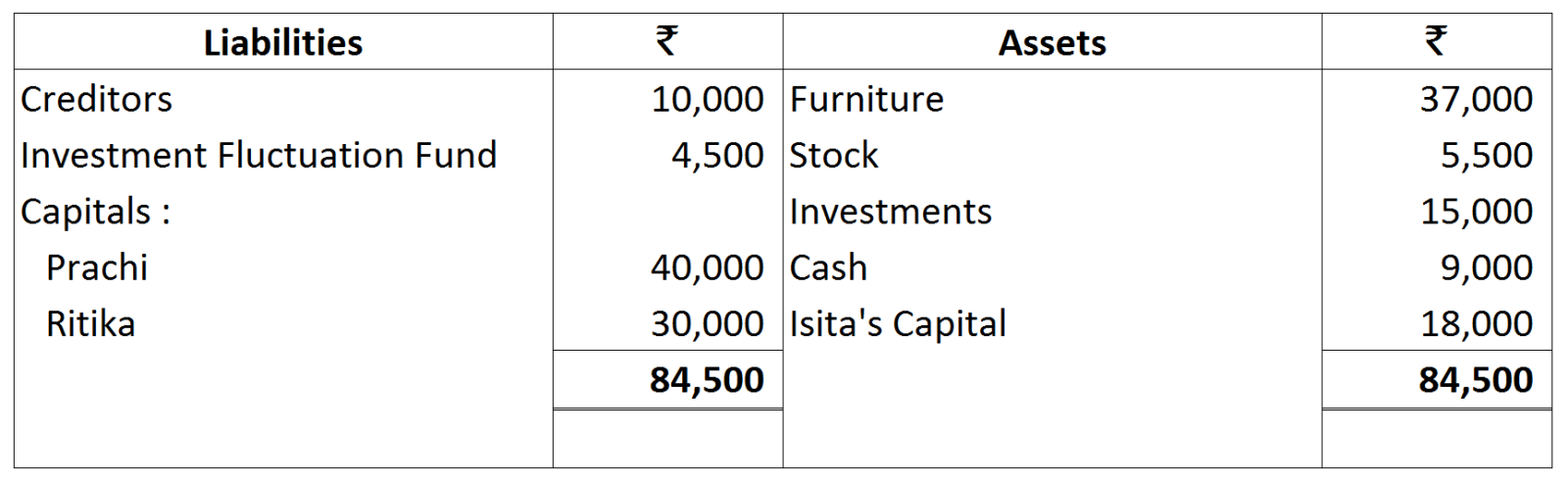
(Value Based) Prachi, Ritika and Ishita were partners in a firm sharing profits and losses in the ratio of $5 : 3 : 2$. Inspite of repeated reminders by the authorities they kept dumping hazardous material into a nearby river. The court ordered for the dissolution of their partnership firm on $31^{st}$ March $2012$. prachi was deputed to realise the assets and pay the liabilities. She was paid $₹ 1,000$ as commission for her services. The financial position of the firm was as follows:

Following was agreed upon:
Prachi took over investments for $₹ 12,500$. Stock and furniture realized $₹ 41,500$. There was old furniture which has been written off completely from the books. Ritika agreed to take away the same at the price of $₹ 3,000$. Compensation paid to the employees amounted to $₹ 8,000$. This liability was not provided in the above Balance Sheet. Realisation expenses amounted to $₹ 1,000$. Prepare Realisation Account, Partners' Capital Accounts and Cash A/c to close the books of the firm.
Also identify the value being conveyed in the question.
M, N and O were partners in a firm sharing profits and losses equally. Their Balance Sheet as at 31st March, 2015 was as follows:
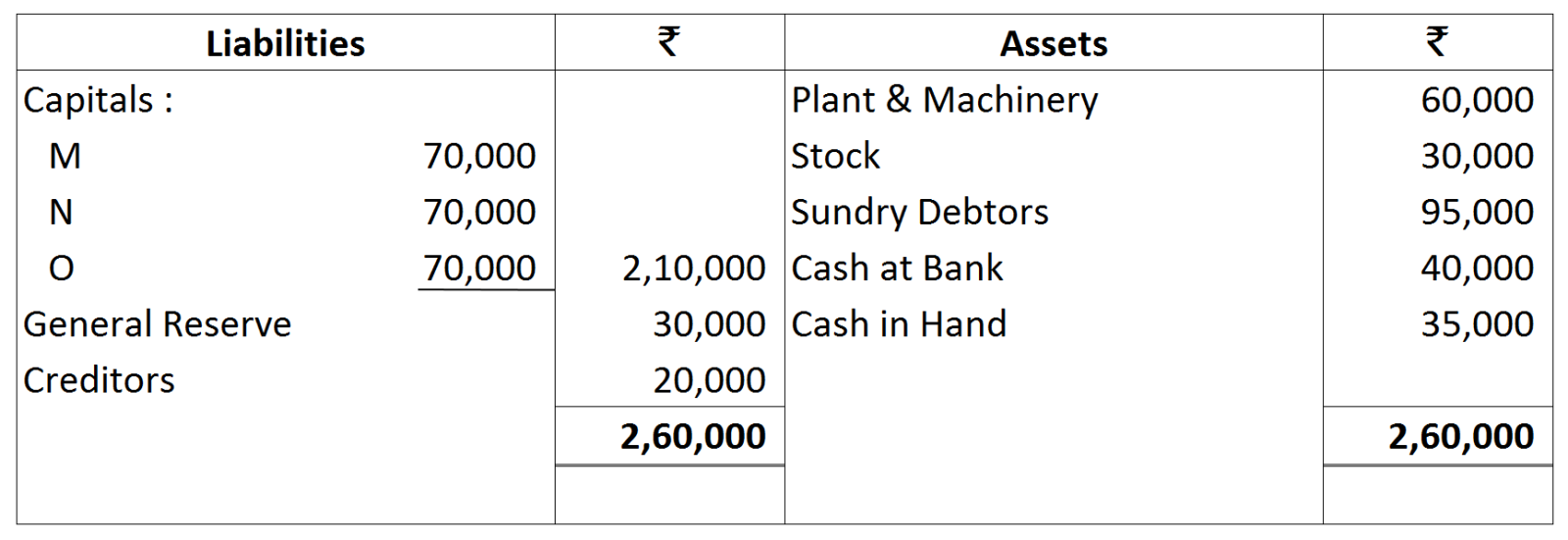
N died on 12th June, 2015 According to the Partnership Deed, executors of the deceased partner are entitled to:
  1. Balance of partner's capital account.
  2. Interest on Capital @5% p.a.
  3. Share of goodwill calculated on the basis of twice the average of past three year's profits.
  4. Share of profits from the closure of the last accounting year till the date of death on the basis of twice the average of three completed year's profits before death.
  5. As per N's Will, ₹ 50,000 is to be donated to 'Prime Ministers' Clean Ganga Project.
Profits for the years ended 31st March 2013, 2014 and 2015 were ₹ 80,000, ₹ 90,000 and ₹ 1,00,000 respectively. Show the working for deceased partner's share of goodwill and profits till the date of his death. Pass the necessary journal entries and prepare N's Capital Account to be rendered to his executors. Also mention the values in the question.
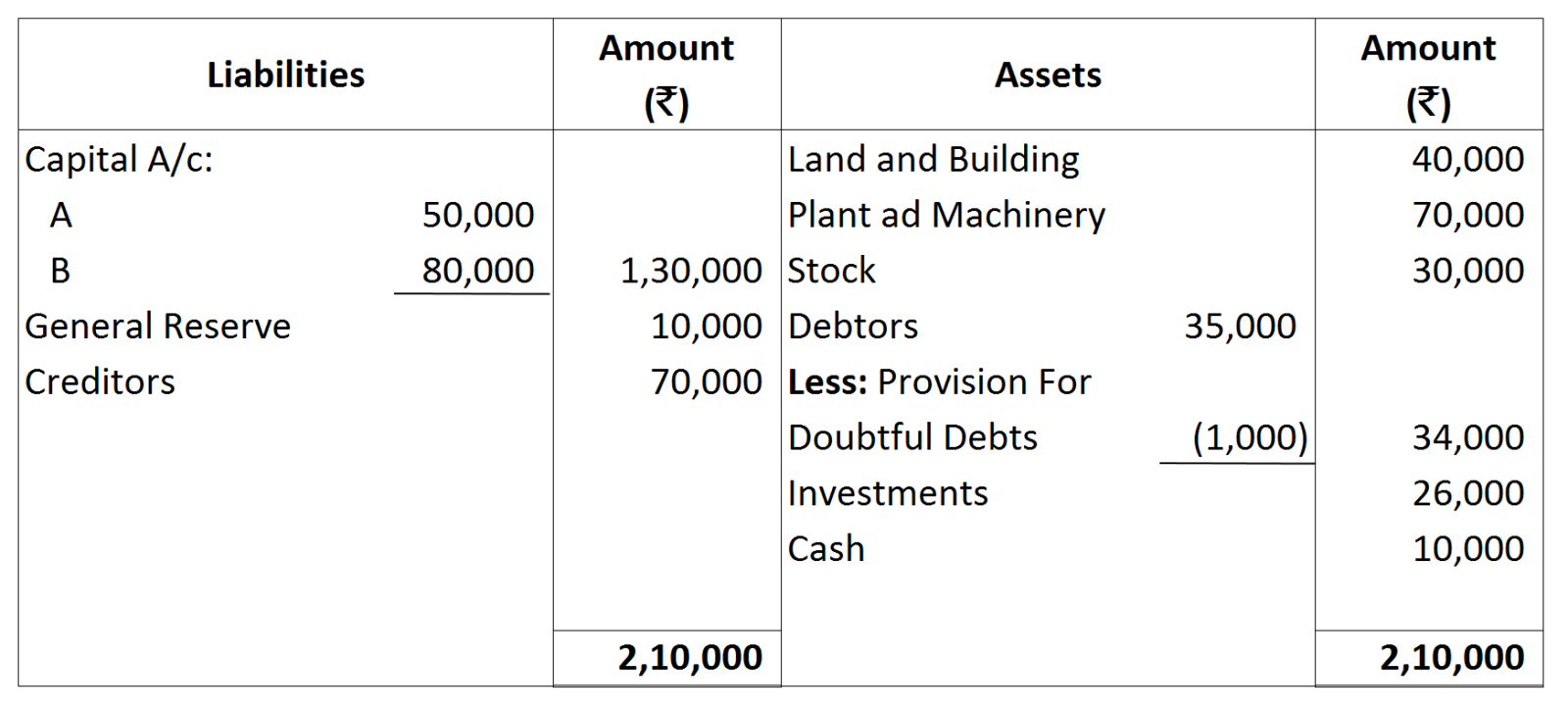
A and B were partners in a firm sharing profits in 3 : 1 ratio. They admitted C as a partner for $\frac{1}{4}\text{th}$ share in the future profit. C was to bring ₹ 60,000 for his capital. The Balance Sheet of A and B as at 1st April, 2018, the date on which C was admitted, was:
The other terms agreed upon were:
  1. Goodwill of the firm was valued at ₹ 24,000.
  2. Land and Building were valued at ₹ 65,000 and Plant and Machinery at ₹ 60,000.
  3. Provision for Doubtful Debts was found in excess by ₹ 400.
  4. A liability of ₹ 1,200 included in Sundry Creditors was not likely to arise.
  5. The capitals of the partners be adjusted on the basis of C's contribution of capital to the firm.
  6. Excess of shortfall, if any, be transferred to Current Accounts.
Prepare Revaluation Account, Partners' Capital Accounts and Balance Sheet of the new firm.
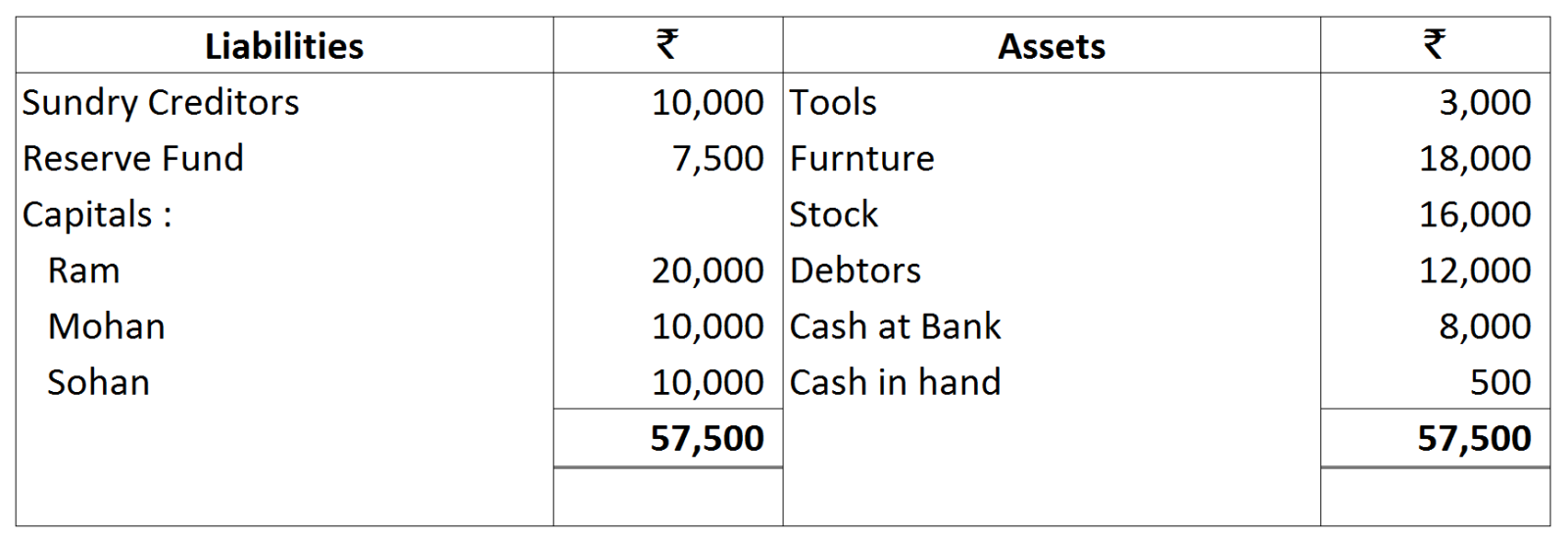
The following is the Balance Sheet of Ram Mohan and Sohan as at 31st march 2017:

Ram, Mohan and Sohan shared profits and losses in the ratio of 2 : 2 : 1. Sohan died on 30th june, 2017. Under the partnership agreement the executor of Sohan was entitled to:
  1. Amount standing to the credit of his Capital Account.
  2. Interest on Capital which amounted to ₹ 150.
  3. His share of goodwill ₹ 5,000.
  4. His share of profit from the closing of the last financial year to the date of death which amounted to ₹ 750.
Sohan's executors was paid ₹ 1,775 on july, 2017 and the balance in four equal yearly instalment starting from 30th june, 2018 with interest @ 6% p.a.
Pass necessary Journal entries and draw up Sohan' s Account to be rendered to his executor and Sohan' s Executor's Account till it is finally paid.
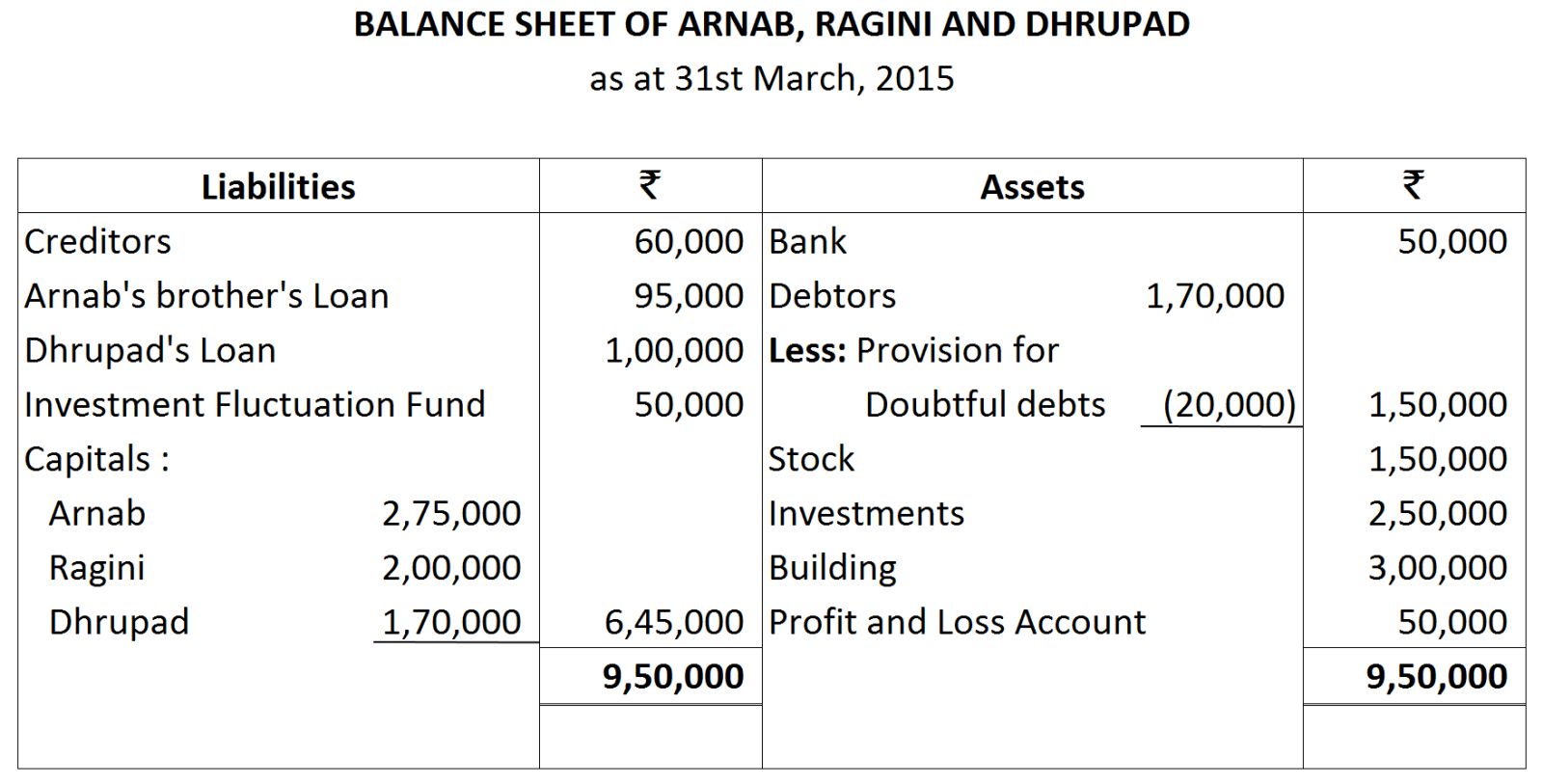
Arnab, Ragini and Dhrupad were partners sharing profits in the ratio of $3 : 1 : 1$. On $31^{st}$ March, $2015$, they decided to dissolve their firm. On that date their Balance Sheet was as under:

The assets were realised and the liabilities were paid as under:
  1. Arnab agreed to pay his brother's loan.
  2. Investments realised $20\%$ less.
  3. Creditors were paid at $10\%$ less.
  4. Building was auctioned for ₹ $3,35,000$. Commission on auction was ₹ $5,000$.
  5. $50\%$ of the stock was taken over by Ragini at market price which was $20\%$ less than the book value and the remaining was sold at market price.
  6. Dissolution expenses were ₹ $8,000$. ₹ $3,000$ were to be borne by the firm and the balance by Dhrupad. The expenses were paid by him.
Prepare Realisation Account, Bank Account and Partner's Capital Accounts.