Question 16 Marks
Rajeev, Sanjeev and Jatin were partners in a firm manufacturing blankets. They were sharing profits in the ratio of $5 : 3 : 2.$ Their capitals on $1^{st}$ April, $2012$ were ₹ $1,00,000$, ₹ $2,00,000$ and ₹ $4,00,000$ respectively. After the flood in Uttarakhand, all partners decided to help the flood victims personally.
For this Rajeev withdrew ₹ $10,000$ from the firm on $1^{st}$ October, $2012$. Sanjeev instead of withdrawing cash from the firm took blankets amounting to ₹ $14,000$ from the firm and distributed those to the flood victims. On the other hand, Jatin withdrew ₹ $1,50,000$ from his capital on $31^{st}$ December, $2012$ and set up a centre to provide medical facilities in the flood affected area.
The partnership deed provides for charging interest on drawings $@ 6\%$ p.a. After the final accounts were prepared it was discovered that interest on drawings had not been charged. Give the necessary adjusting journal entry and show the working notes clearly. Also state any two values which the partners wanted to communicate to the society.
Answer
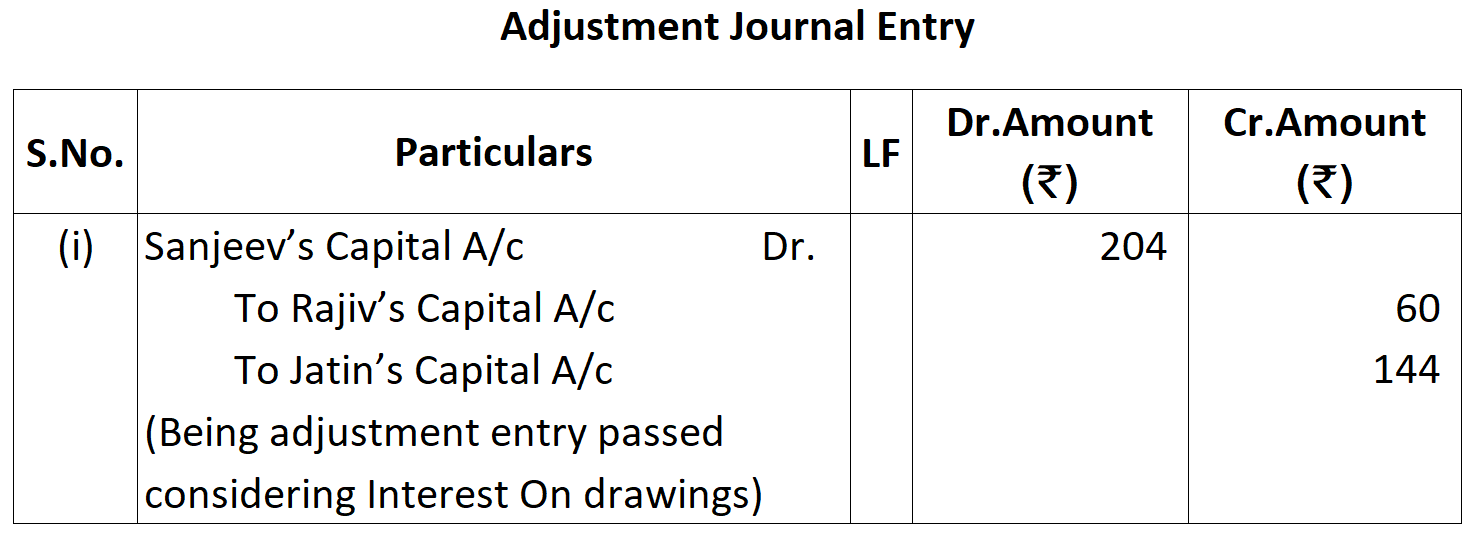
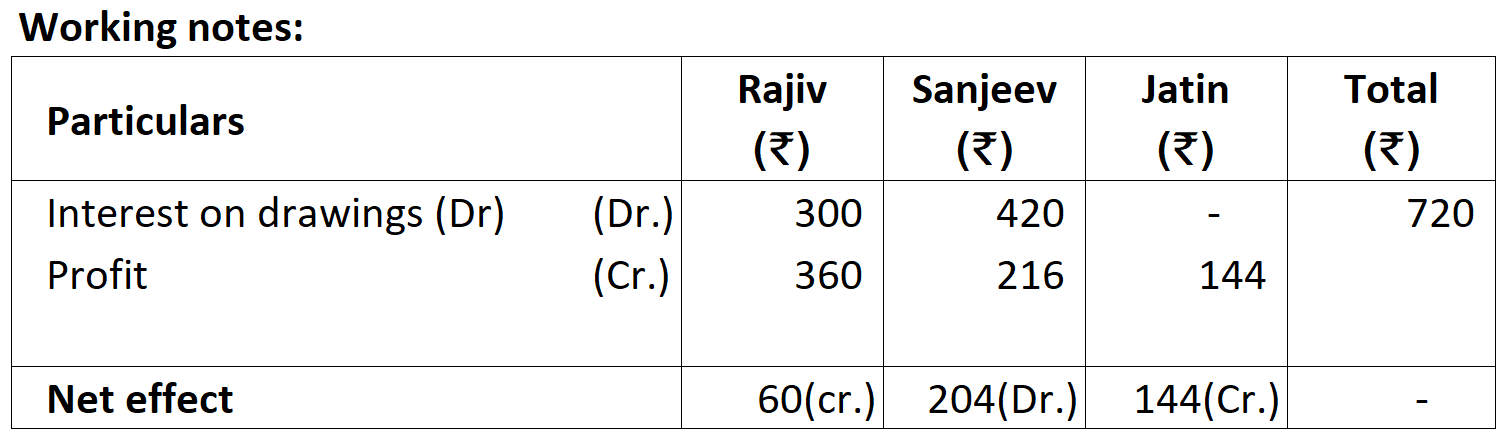 Alternate Answer
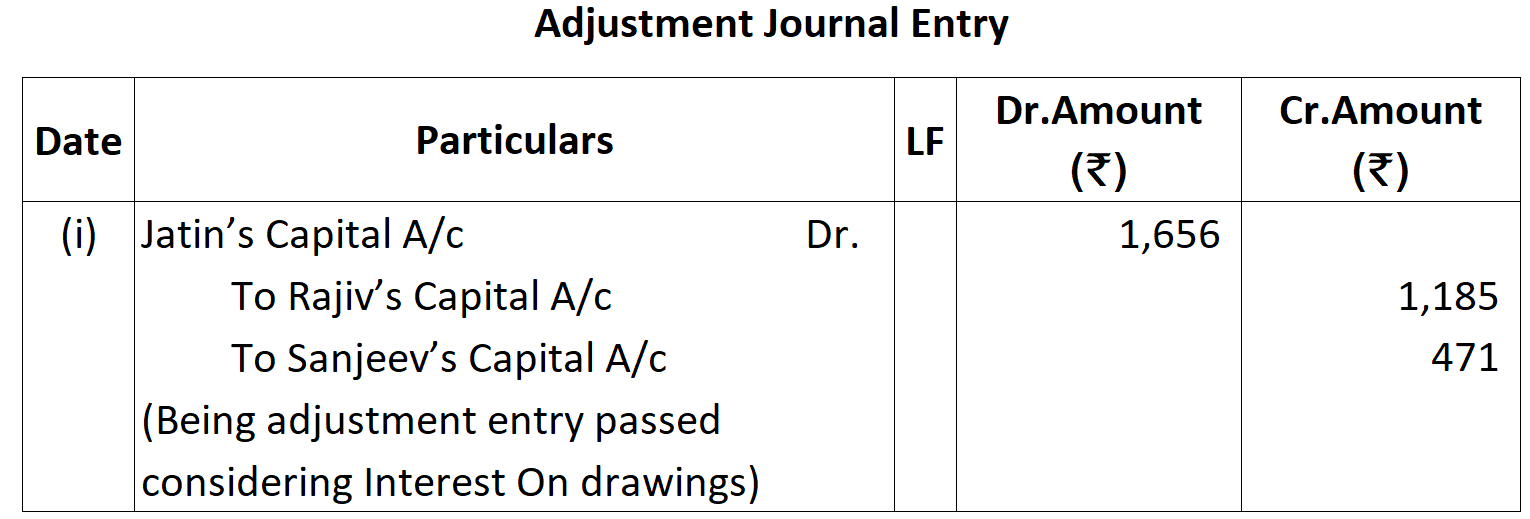
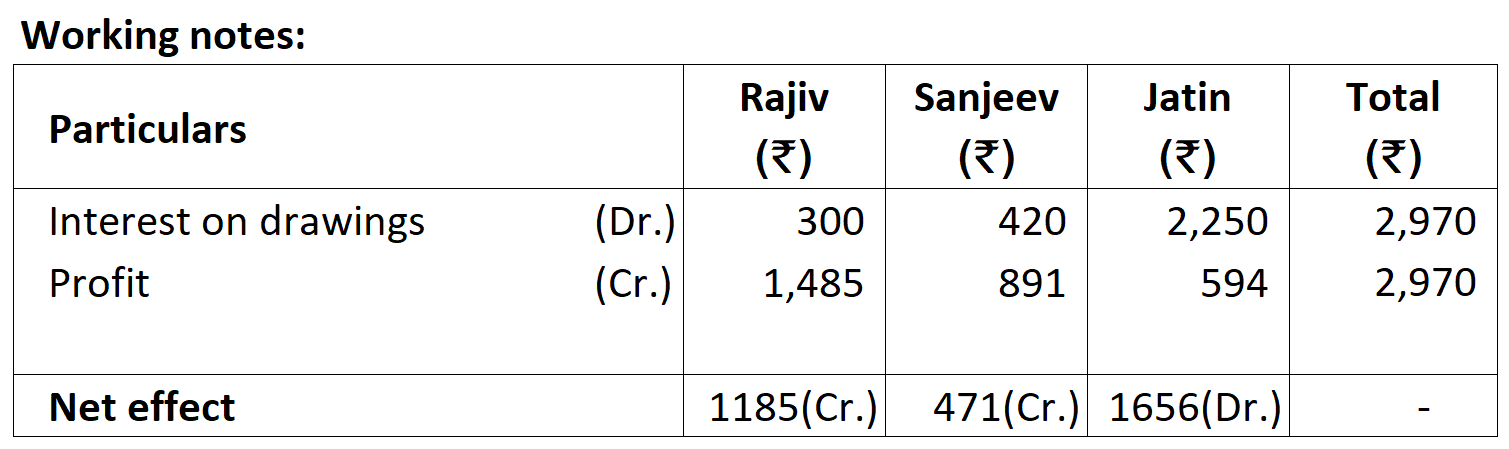 Value:
- Help towards needy flood victims.
- Medical Aid in flood affected areas.
View full question & answer→Question 26 Marks
Anju, Manju and Ruchi were partners in a firm trading in medicines. They were sharing profits in the ratio of $5: 3: 2$.
Their capitals on $1^{\text {st }}$ April, $2012$ were ₹ $3,00,000$, ₹ $5,00,000$ and ₹ $7,00,000$ respectively.
After the flood in Uttarakhand, all partners decided to help the flood victims personally.
For this Anju withdrew ₹ $30,000$ from the firm on $1^{\text {st }}$ August, $2012$. Manju instead of withdrawing cash from the firm took medicines amounting to ₹ $25,000$ from the firm and distributed those to the flood victims. On the other hand, Ruchi withdrew ₹ $1,50,000$ from her capital on $1^{\text {st }}$ December, $2012$ and provided the necessary items of daily use in the flood affected area.
The partnership deed provides for charging interest on drawings @ 6\% p.a. After the final accounts were prepared it was discovered that interest on drawings had not been charged. Give the necessary adjusting journal entry and show the working notes clearly. Also state any two values which the partners wanted to communicate to the society.
Answer
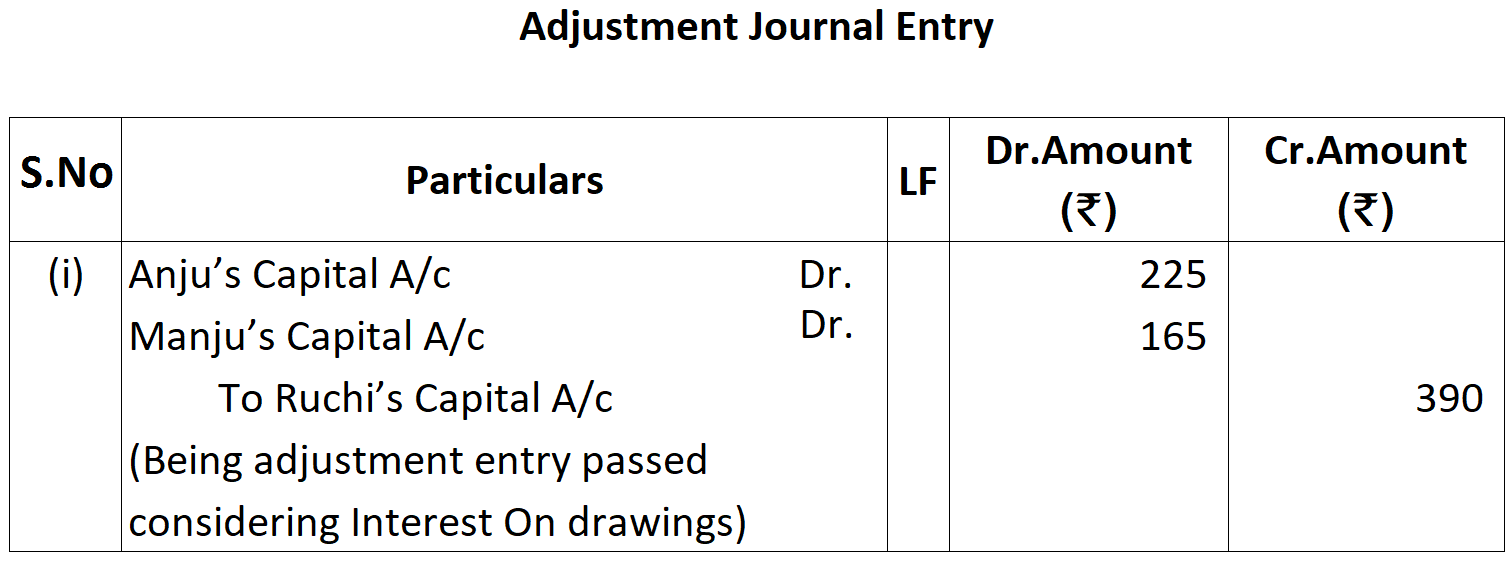
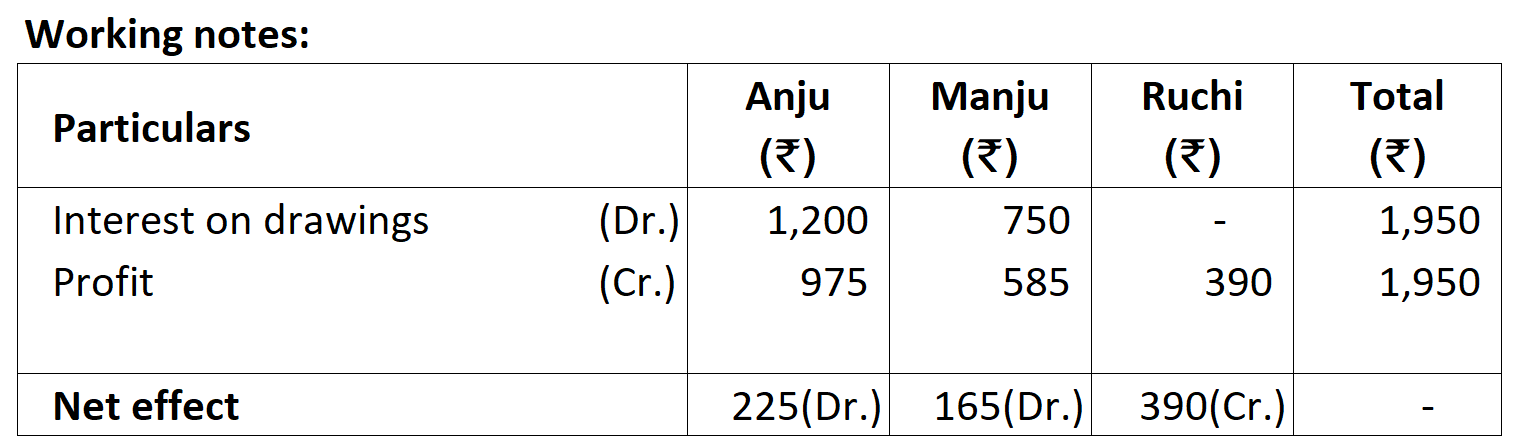 Alternate Answer
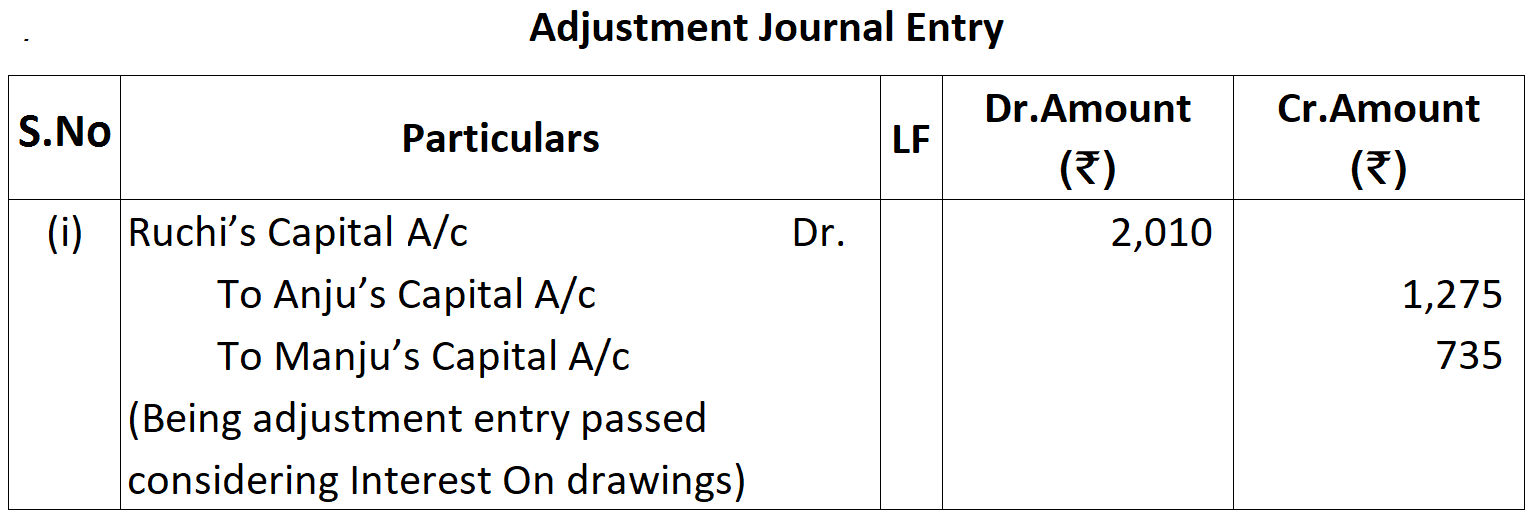
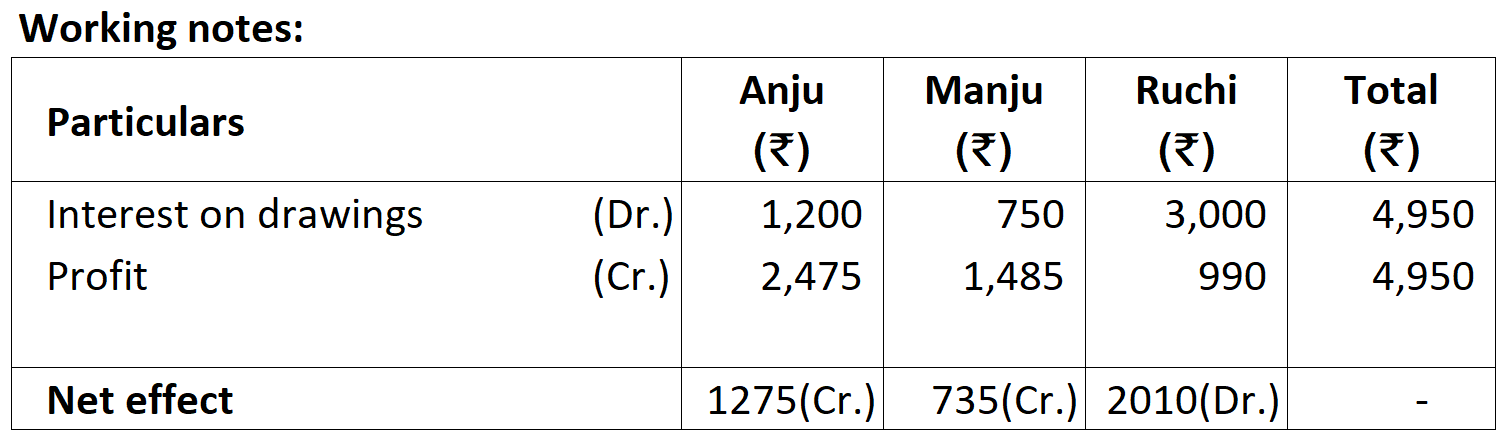 Value:
- Help towards needy flood victims.
- Medical Aid in flood affected areas.
View full question & answer→Question 36 Marks
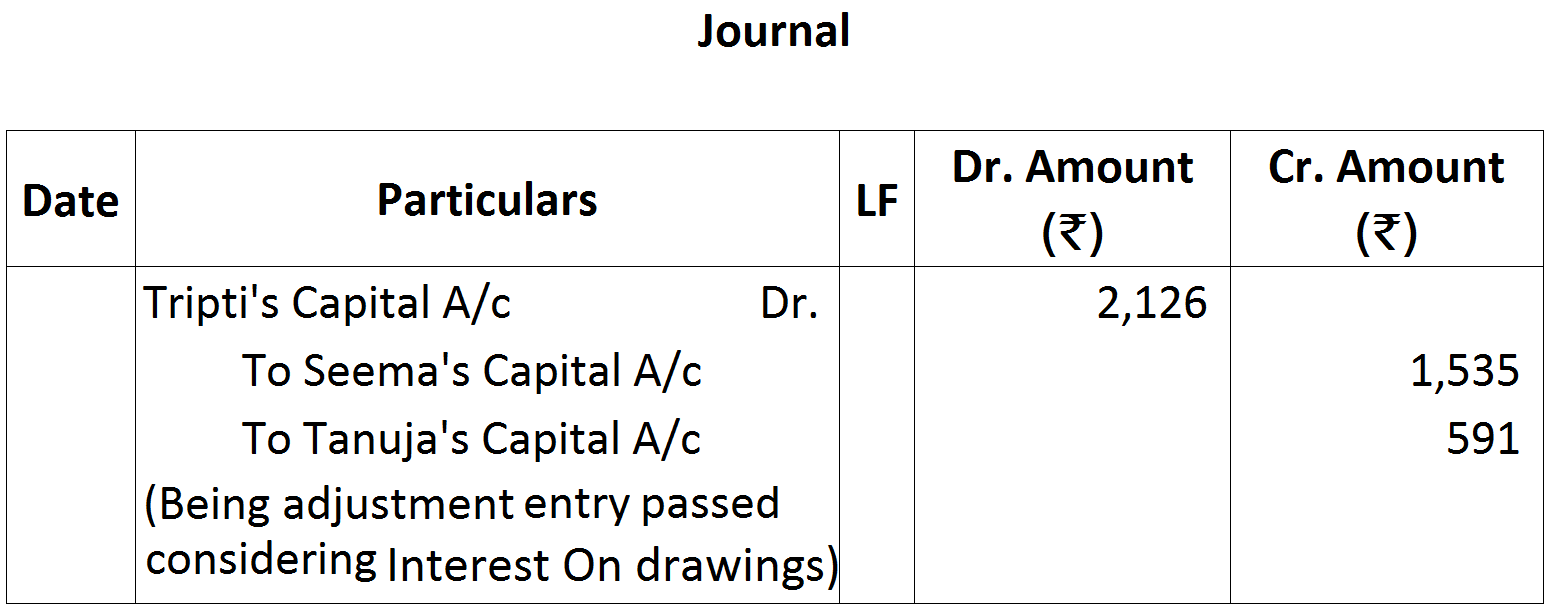
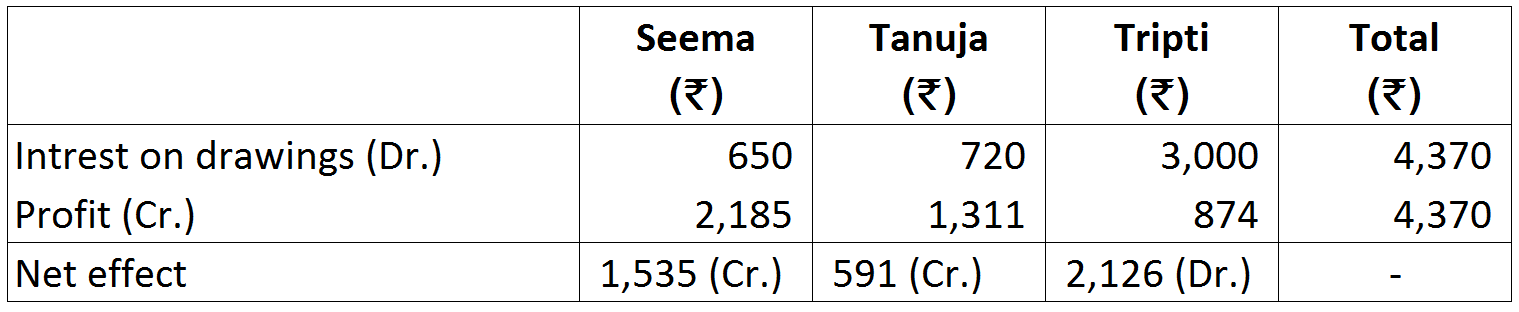
Seema, Tanuja and Tripti were partners in a firm trading in garments. They were sharing profits in the ratio of $5: 3: 2$. Their capitals on $1^{\text {st }}$ April, $2012$ were ₹ $3,00,000$, ₹ $4,00,000$ and ₹ $8,00,000$ respectively. After the flood in Uttarakhand, all partners decided to help the flood victims personally.
For this Seema withdrew ₹ $20,000$ from the firm on $15^{\text {th }}$ September, $2012$. Tanuja instead of withdrawing cash from the firm took garments amounting to ₹ $24,000$ from the firm and distributed those to the flood victims. On the other hand, Tripti withdrew ₹ $2,00,000$ from her capital on $1^{\text {st }}$ January, $2013$ and provided a mobile medical van in the flood affected area.
The partnership deed provides for charging interest on drawings @ $6\%$ p.a. After the final accounts were prepared it was discovered that interest on drawings had not been charged. Give the necessary adjusting journal entry and show the working notes clearly. Also state any two values which the partners wanted to communicate to the society.
Answer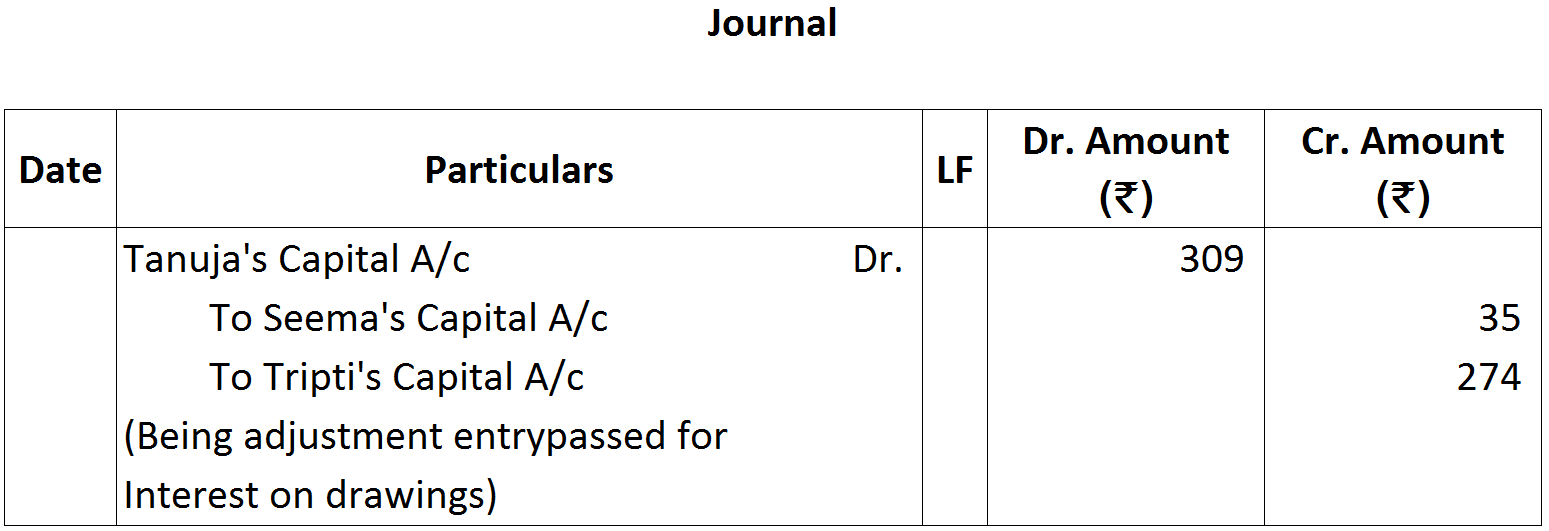 Working notes
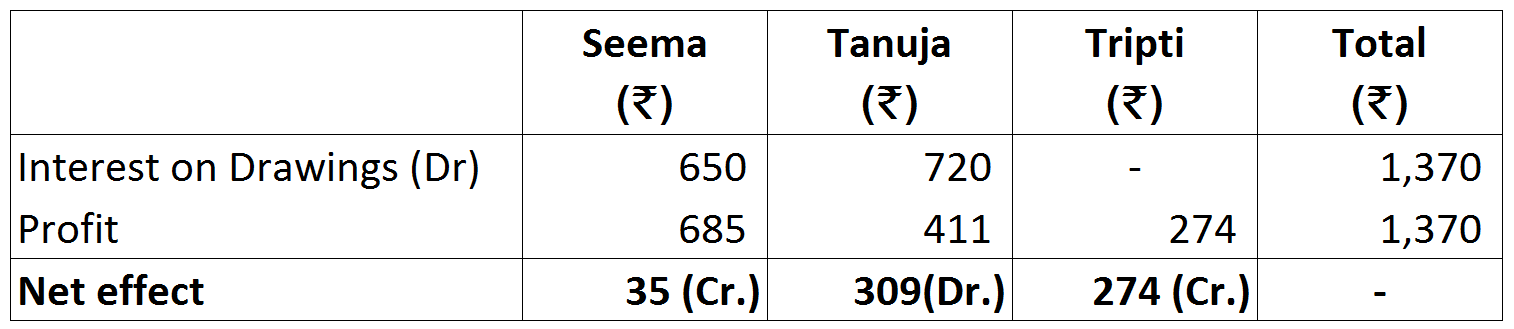 Alternate Answer
 Working notes
 Value:
- Help towards needy flood Victims.
- Medical Aid in flood affected areas.
View full question & answer→Question 46 Marks
Ahmad, Bheem and Daniel are partners in a firm. On $1^{\text {st }}$ April $2011$ the balance in their capital accounts stood at $₹$ $8,00,000$, ₹ $6,00,000$ and $₹ 4,00,000$ respectively. They shared profits in the proportion of $5: 3: 2$ respectively. Partners are entitled to interest on capital $@5\%$ per annum and salary to Bheem @ ₹ $3,000$ per month and a commission of ₹ $12,000$ to Daniel as per the provisions of the partnership deed.
Ahmad's share of profit, excluding interest on capital, is guaranteed at not less than, ₹ $25,000$ p.a, Bheem's share of profit, including interest on capital but excluding salary, is guaranteed at not less than ₹ $55,000$ p.a. Any deficiency arising on that account shall be met by Daniel. The profits of the firm for the year ended $31^{\text {st }}$ March $2012$ amounted to ₹ $2,16,000$. Prepare 'Profit and Loss Appropriation Account' for the year ended 31 ${ }^{\text {st. }}$ March $2012$.
Answer
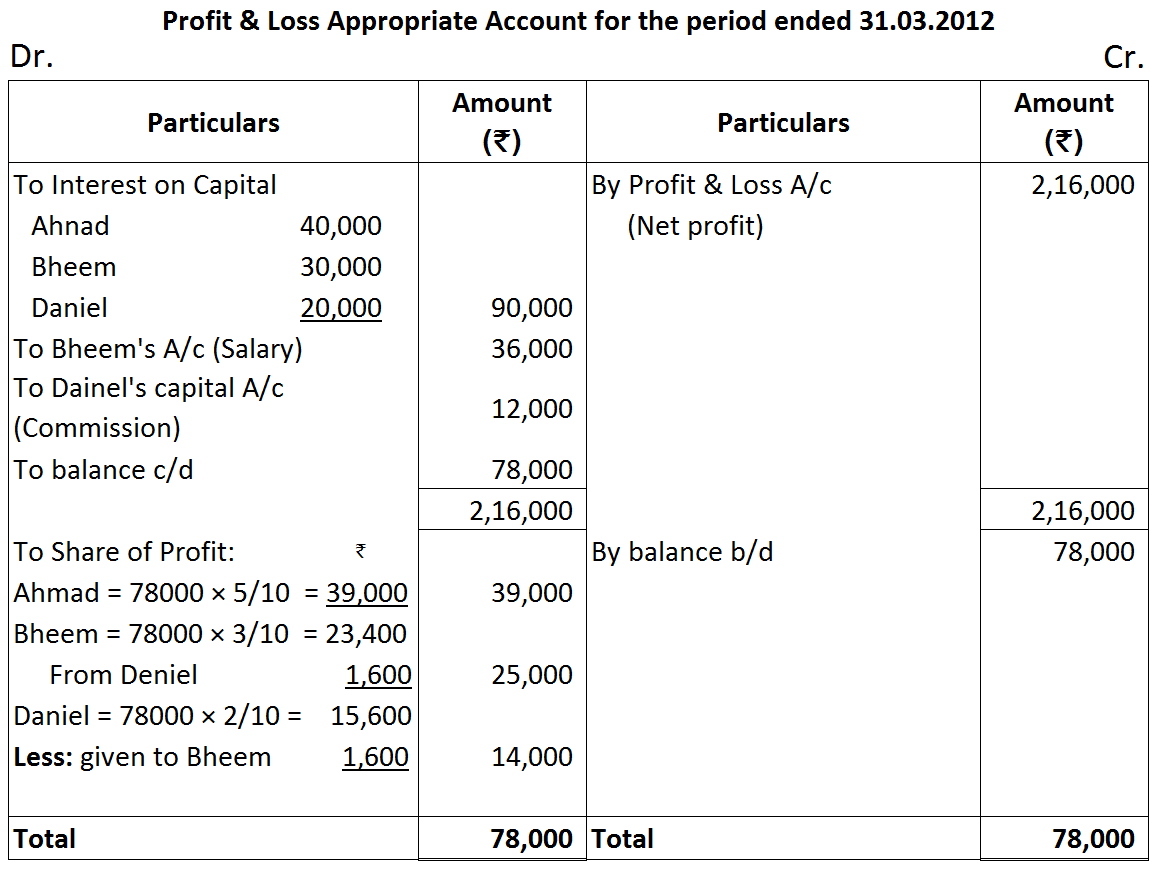 Working Note:
|
1.
|
|
|
(a)
|
Bheem Share of profit
Add : Interest on Capital
|
= ₹ 23,400
= ₹ 30,000
|
|
(b)
|
Guaranteed Profit
|
= ₹ 53,000
|
|
(c)
|
Deficiency to be done by Daniel
|
= ₹ 55,000 - ₹ 53,400
= ₹ 1600
|
|
2.
|
Ahmad's Share of Profit
|
= ₹ 39,000; which is more than guaranteed profit.
|
View full question & answer→Question 56 Marks
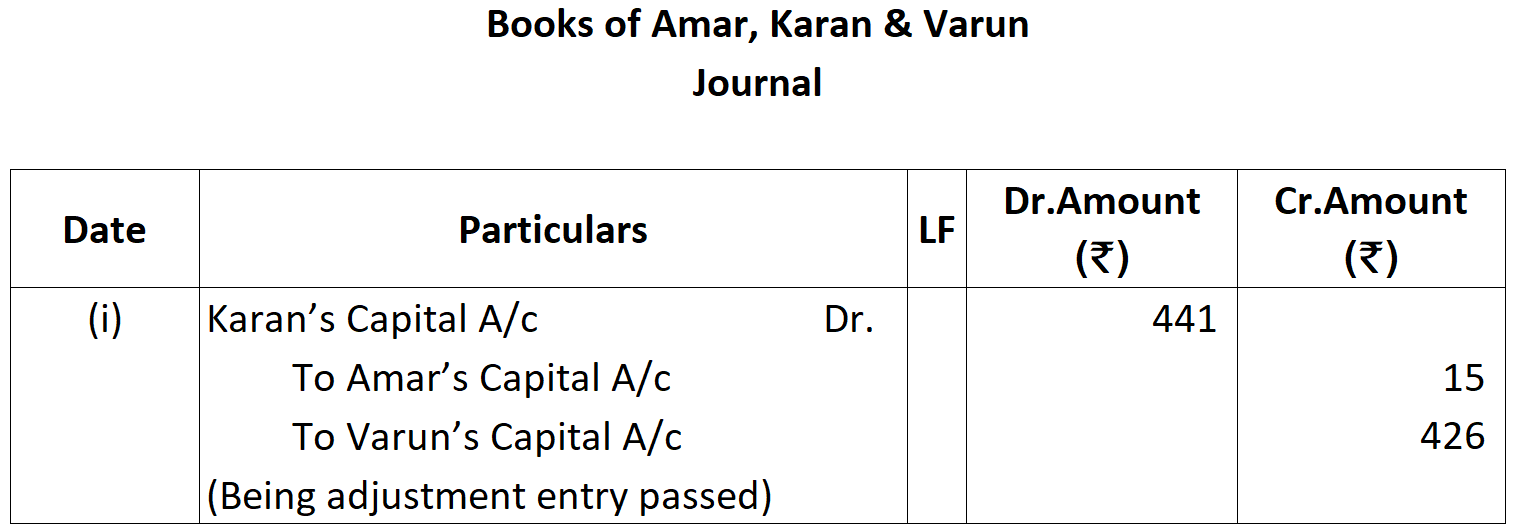
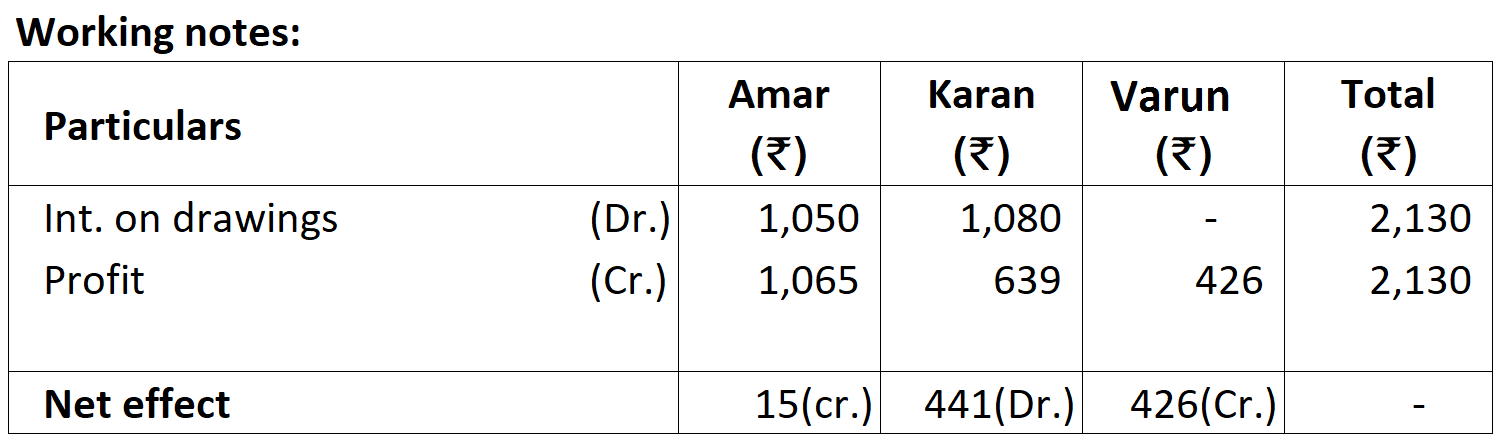
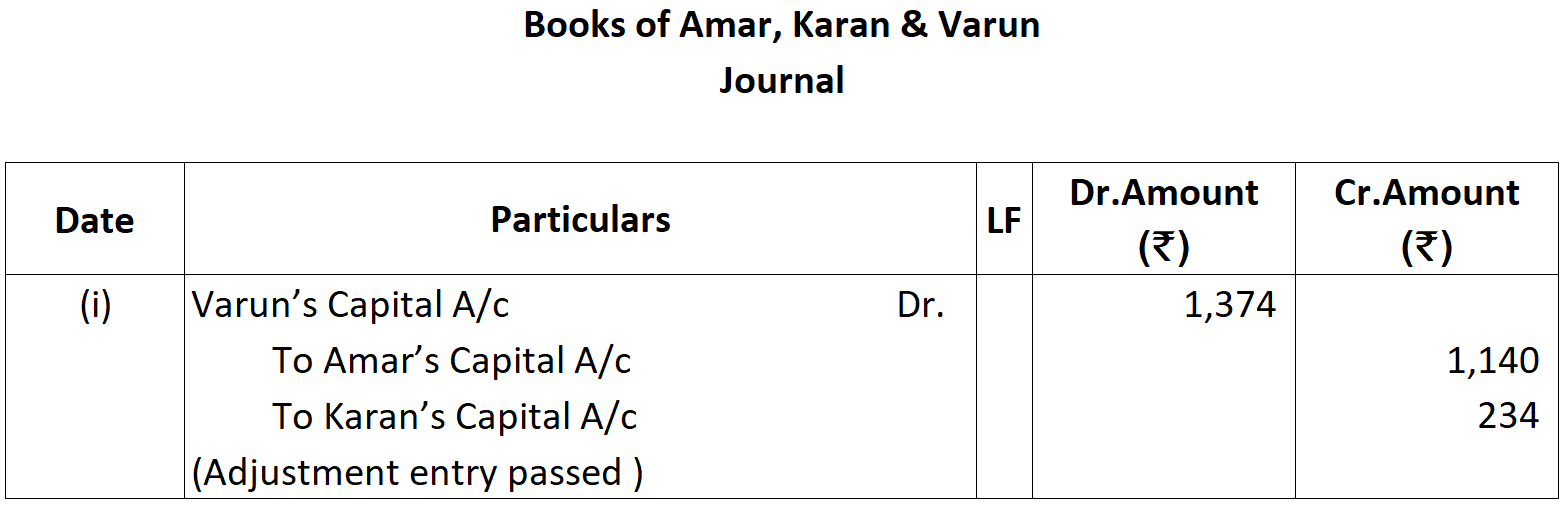
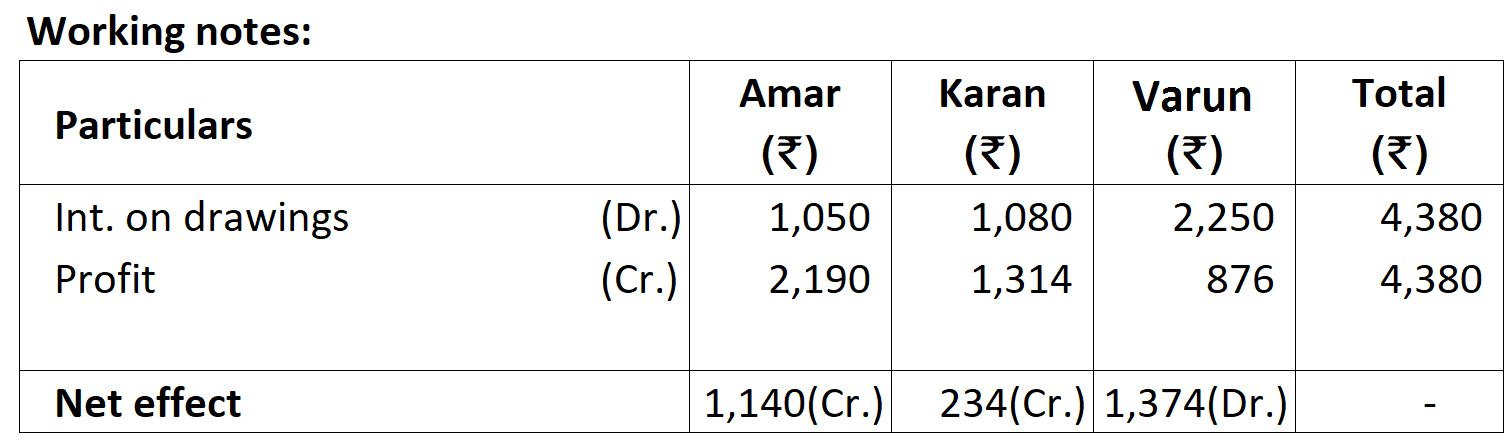
Amar, Karan and Varun were partners in a firm manufacturing garments. They were sharing profits in the ratio of $5: 3$ :2. On $1^{\text {st }}$ April, $2012$ their capitals were ₹ $3,00,000$, ₹ $4,00,000$ and ₹ $5,00,000$ respectively. After the flood in Uuaranchal, all partners decide to personally help the flood victims. For this Amar withdrew ₹ $30,000$ from the firm on $1^{\text {st }}$ september $2012$, Karan, instead of withdrawing cash from the flrm took garments amounting to ₹ $36,000$ from the frm and distributed to the flood victims. on the other hand, varun withdrew ₹ $1,50,000$ from his capital on $1^{\text {st }}$ January, $2013$ and started a school to provide elementary education in the flood affected area.
The partnership deed provides for charging interest on drawing $@ 6\%$ p.a. After the Final Accounts were prepared, it was discovered that interest on drawings had not been charged.
Give the necessary adjusting joumal entry and show the working notes clearly. Also state any two values that the partners wanted to communicate to the society.
Answer
 Alternate Answer
 Values:
- Help towards needy flood victims.
- Medical Aid in flood affected areas.
View full question & answer→Question 66 Marks
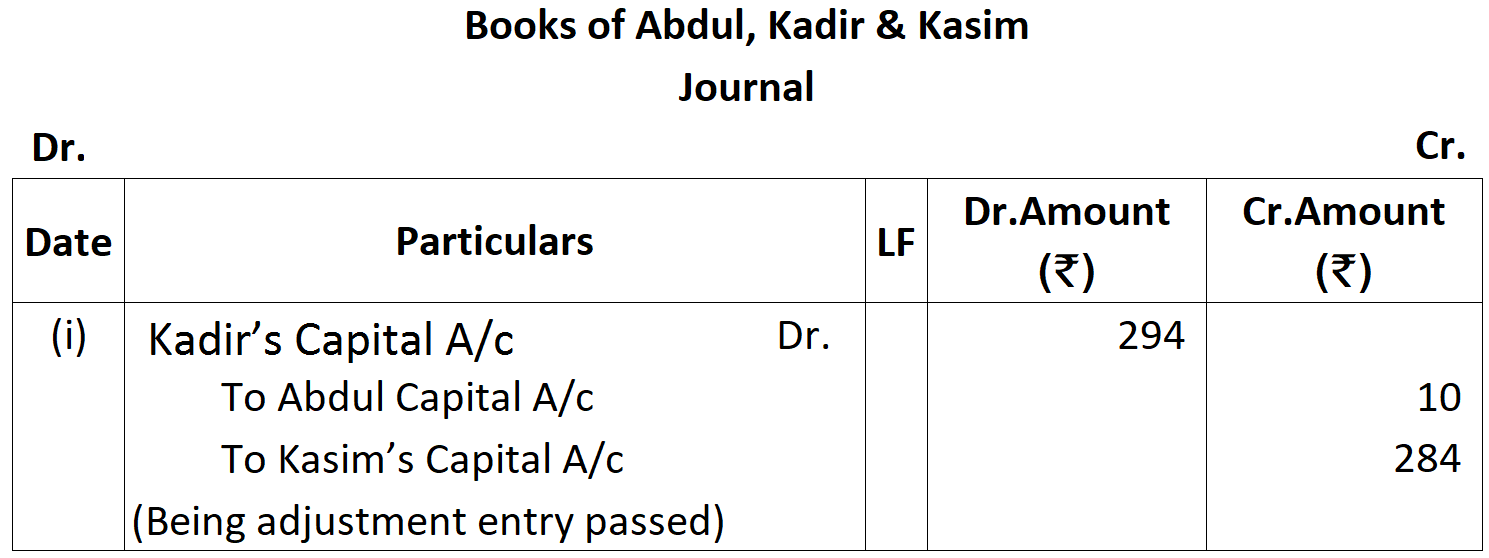
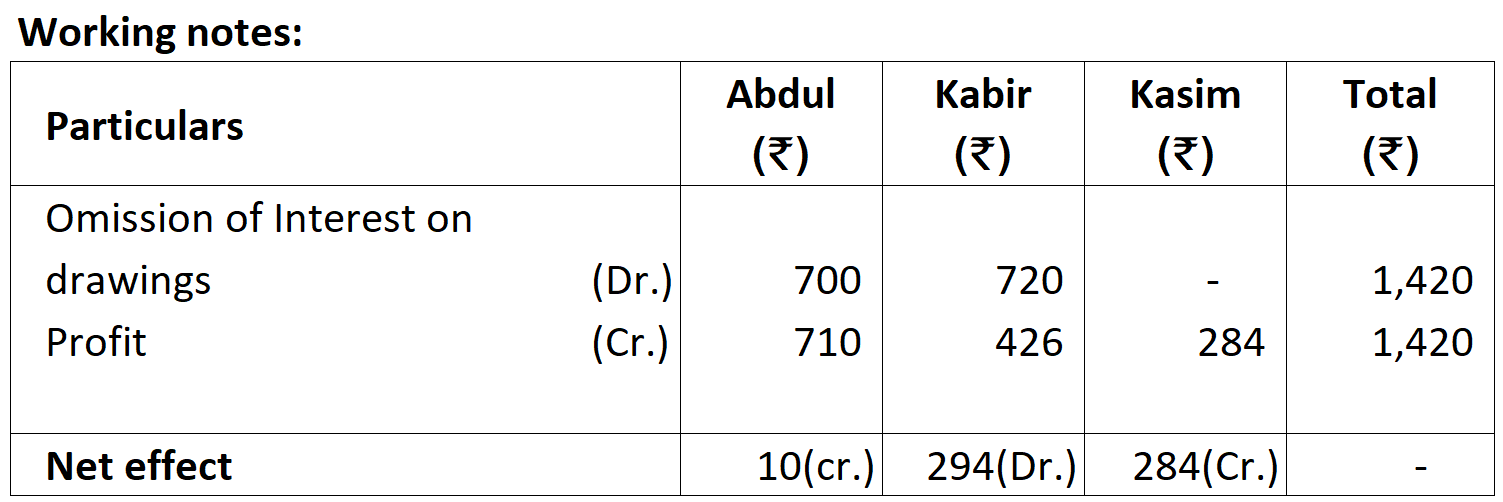
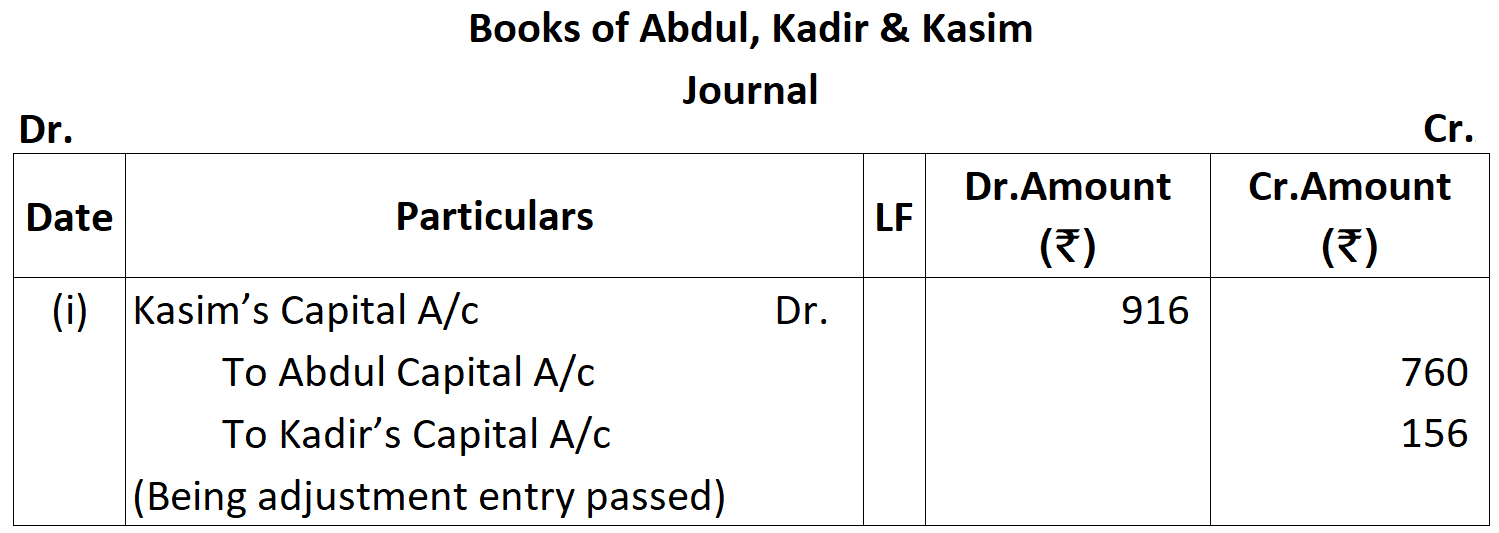
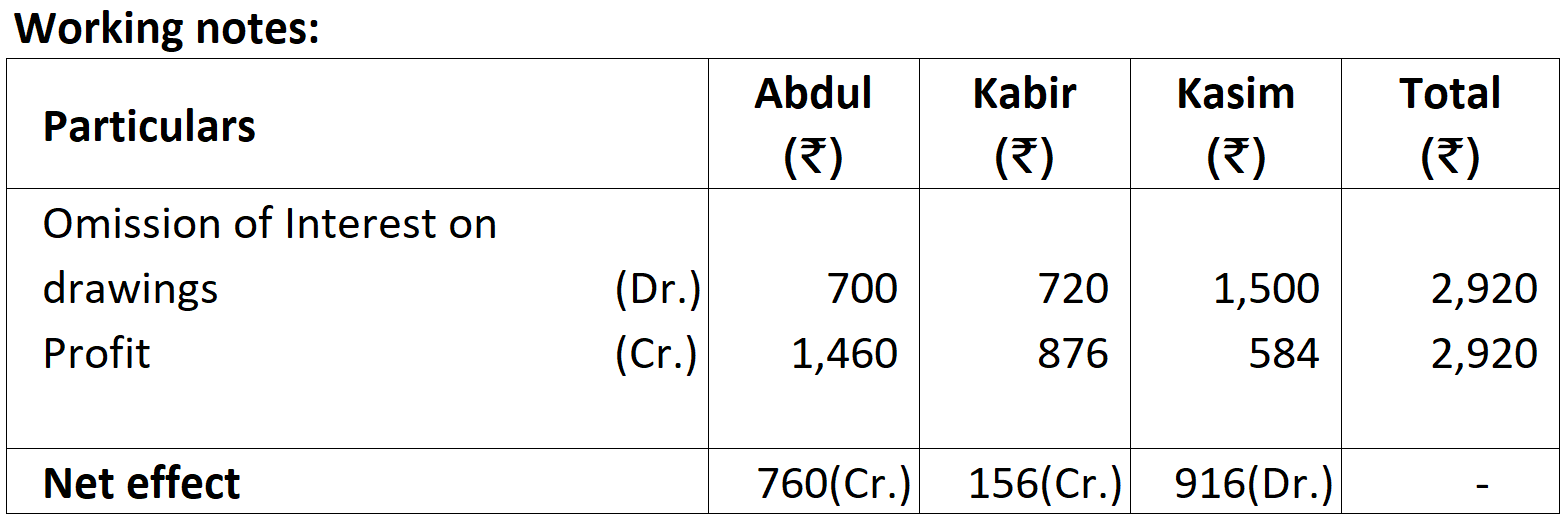
Abdul, Kadir and Kasim were partners in a firm supplying food items. They were sharing profits in the ratio of $5: 3$ :
$2$. Their capitals on $1^{\text {st }}$ April, 2012 were $₹ 1,00,000$, $₹ 1,50,000$ and $₹ 3,00,000$ respectively. After the floods in Uttaranchal, all partners decide to personally help the flood victims.
For this Abdul withdrew ₹ $20,000$ from the firm on $1^{\text {st }}$ September, $2012$, Kadir instead of withdrawing cash from the firm took some food items amounting to ₹ $24,000$ from the firm and distributed to the flood victims. On the other hand, Kasim withdrew ₹ $1,00,000$ from his capital on $1^{\text {st }}$ January, $2013$ and provided a Mobile Medical Van for medical facilities in the flood affected area.
The partnership deed provides for charging interest on drawings $@ 6\%$ p.a. After the Final Accounts were prepared, it was discovered that interest on drawings had not been charged.
Give the necessary adjusting journal entry and show the working notes clearly. Also state any two values that the partners wanted to communicate to the society.
Answer
 Alternate Answer
 Values:
- Help towards needy flood victims.
- Medical Aid in flood affected areas.
View full question & answer→Question 76 Marks
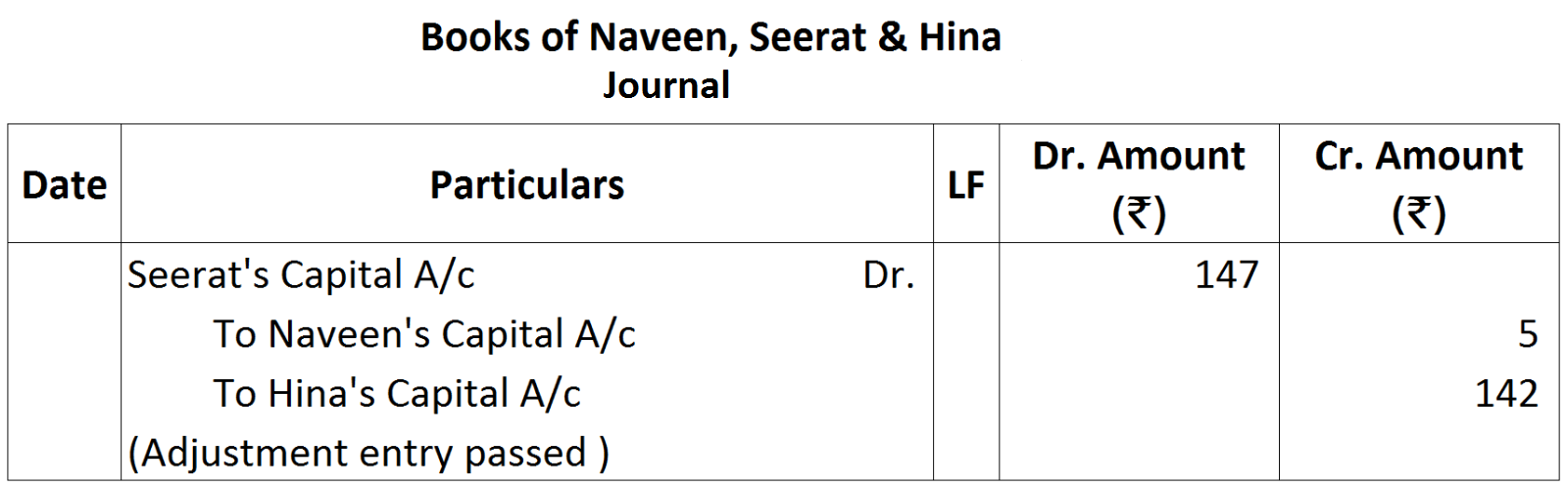
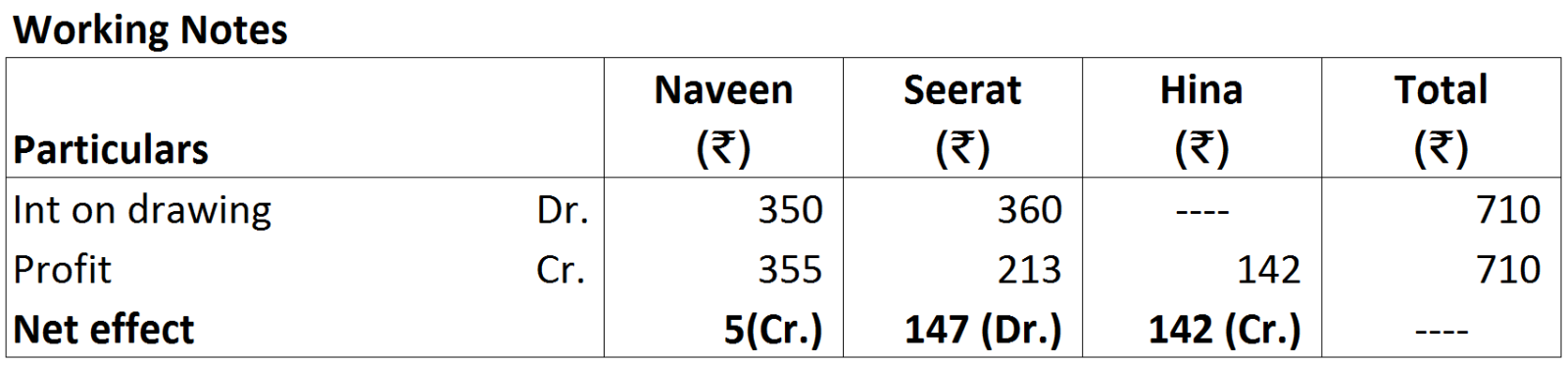
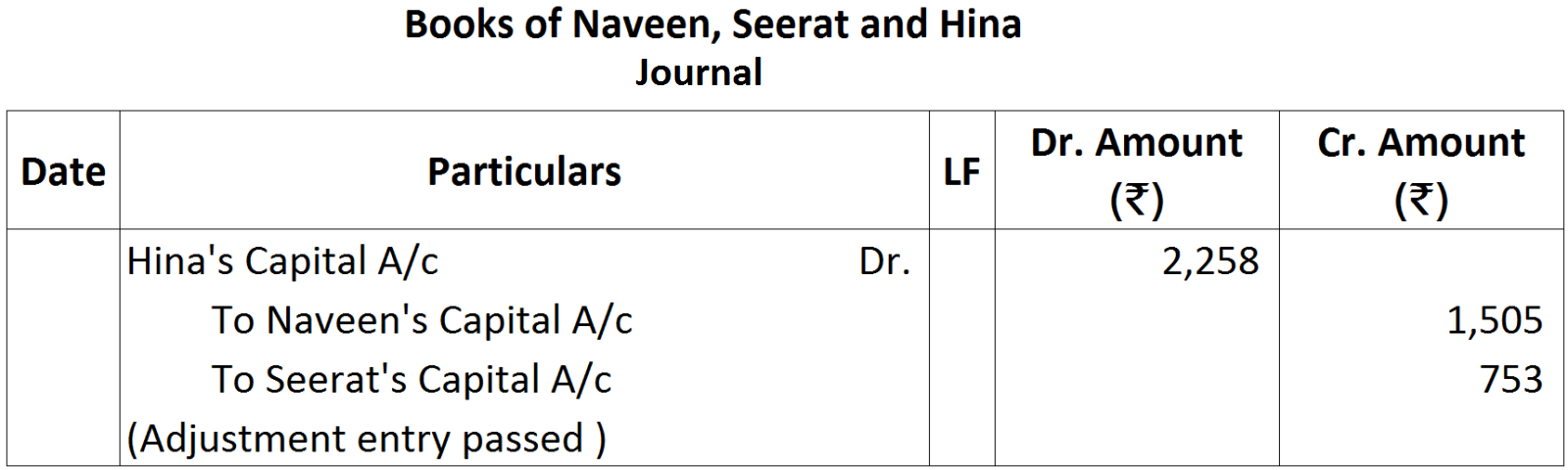
Naveen, Seerat and Hina were partners in a firm manufacturing blankets. They were sharing profits in the ratio of $5 :$
$3: 2$. Their capitals on $1^{\text {st }}$ April, 2012 were $₹ 2,00,000 ; ₹ 3,00,000$ and $₹ 6,00,000$ respectively. After the floods in Uttaranchal, all partners decided to help the flood victims personally.
For this Naveen withdrew ₹ $10,000$ from the firm on $1^{\text {th }}$ September, $2012$. Seerat, instead of withdrawing cash from the firm took blankets amounting to ₹ $12,000$ from the firm and distributed to the flood victims. On the other hand, Hina withdrew ₹ $2,00,000$ from her capital on $1^{\text {st }}$ January, $2013$ and set up a centre to provide medical facilities in the flood affected area.
The partnership deed provides for charging interest on drawings $@ 6\%$ p.a. After the Final Accounts were prepared, it was discovered that interest on drawings had not been charged. Give the necessary adjusting journal entry and show the working notes clearly. Also state any two values that the partners wanted to communicate to the society.
Answer
 Alternate Answer
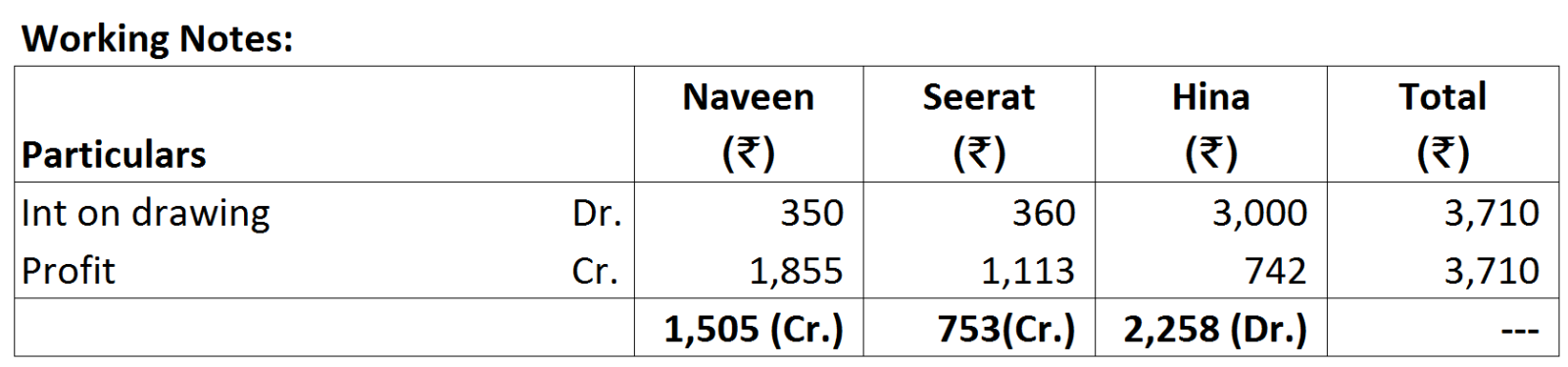 Values:
- Help towards needy flood victims.
- Medical Aid in flood affected areas.
View full question & answer→Question 86 Marks
Ali, Bimal and Deepak are partners in a firm. On $1^{\text {st }}$ April, $2011$ their capital accounts stood at $₹ $4,00,000$, ₹ 3,00,000$ and ₹ $2,00,000$ respectively. They shared profits and losses in the proportion of $5: 3: 2$. Partners are entitled to interest on capital $@ 10\%$ per annum and salary to Bimal and Deepak: @ ₹ $2,000$ per month and ₹ $3,000$ per quarter respectively as per the provisions of the partnership deed.
Bimal's share of profit (excluding interest on capital but including salary) is guaranteed at a minimum of ₹ $50,000$ p.a. Any deficiency arising on that account shall be met by Deepak. The profits of the firm for the year ended $31^{\text {st }}$ March, $2012$ amounted to ₹ $2,00,000$. Prepare Profit \& Loss Appropriation Account for the year ended on $31^{\text {st }}$ March, $2012$
Answer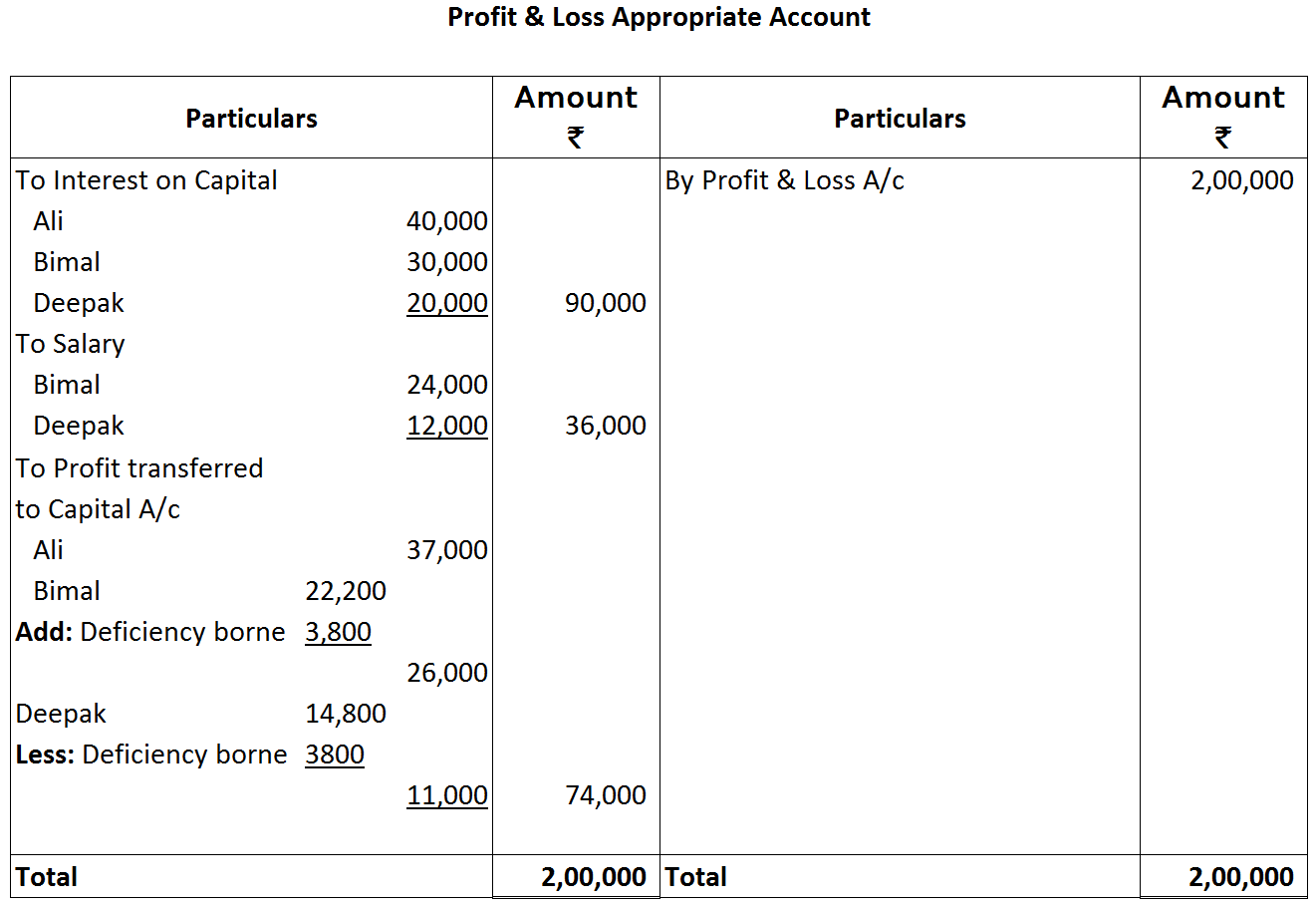 Calculation:-
Deficiency = Guaranteed amount – (amount received)
$= ₹ 50,000 - ( ₹ 24,000 + ₹ 22,200) = ₹ 50,000 – ₹ 46,200 = ₹ 3,800.$
View full question & answer→Question 96 Marks
Moli, Bhola and Raj were partners in a firm sharing profits and losses in the ratio of 3 : 3 : 4. Their partnership deed provided for the following:
- Interest on capital @ 5% p.a.
- Interest on drawing @ 12% p.a.
- Interest on partners’ loan @ 6% p.a.
- Moli was allowed an annual salary of ₹ 4,000; Bhola was allowed a commission of 10% of net profit as shown by Profit and Loss Account and Raj was guaranteed a profit of ₹ 1,50,000 after making all the adjustments as provided in the partnership agreement.
Their fixed capitals were Moli: ₹ 5,00,000; Bhola: ₹ 8,00,000 and Raj: ₹ 4,00,000. On 1st April, 2016 Bhola extended a loan of ₹ 1,00,000 to the firm. The net profit of the firm for the year ended 31st March, 2017 before interest on Bhola’s loan was ₹ 3,06,000.
Prepare Profit and Loss Appropriation Account of Moli, Bhola and Raj for the year ended 31st March, 2017 and their Current Accounts assuming that Bhola withdrew ₹ 5,000 at the end of each month, Moli withdrew ₹ 10,000 at the end of each quarter and Raj withdrew ₹ 40,000 at the end of each half year.
Question 106 Marks
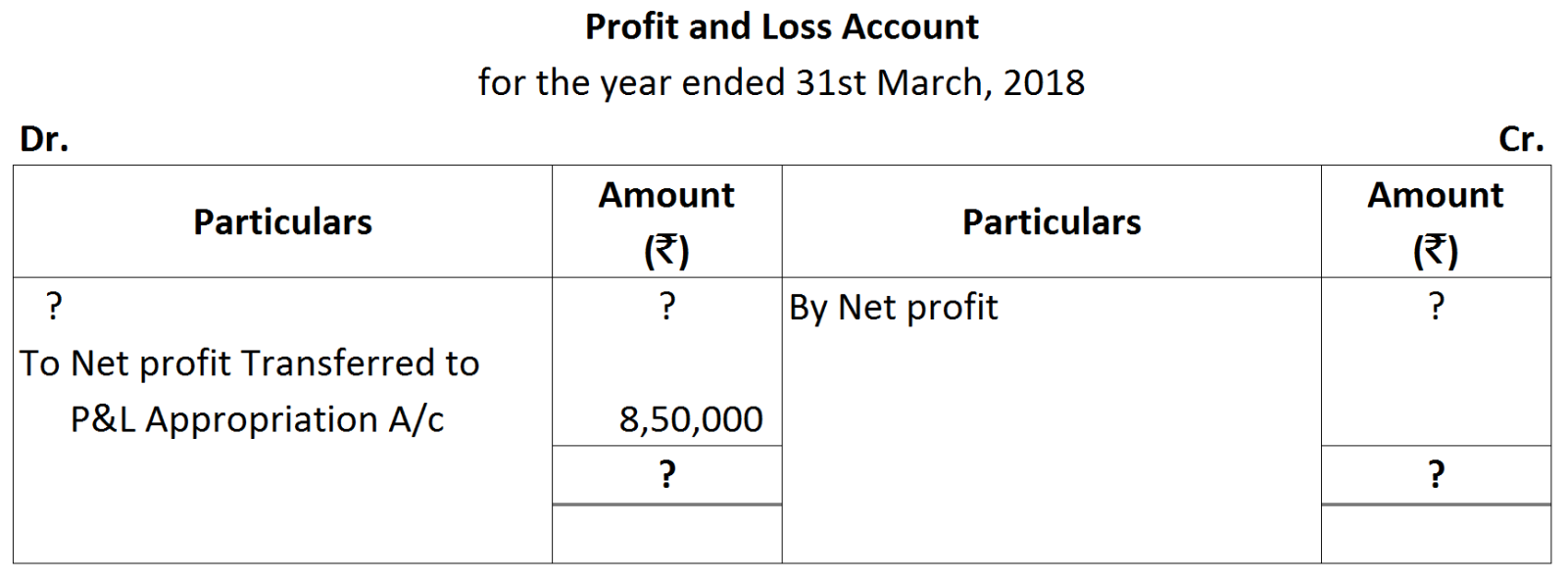
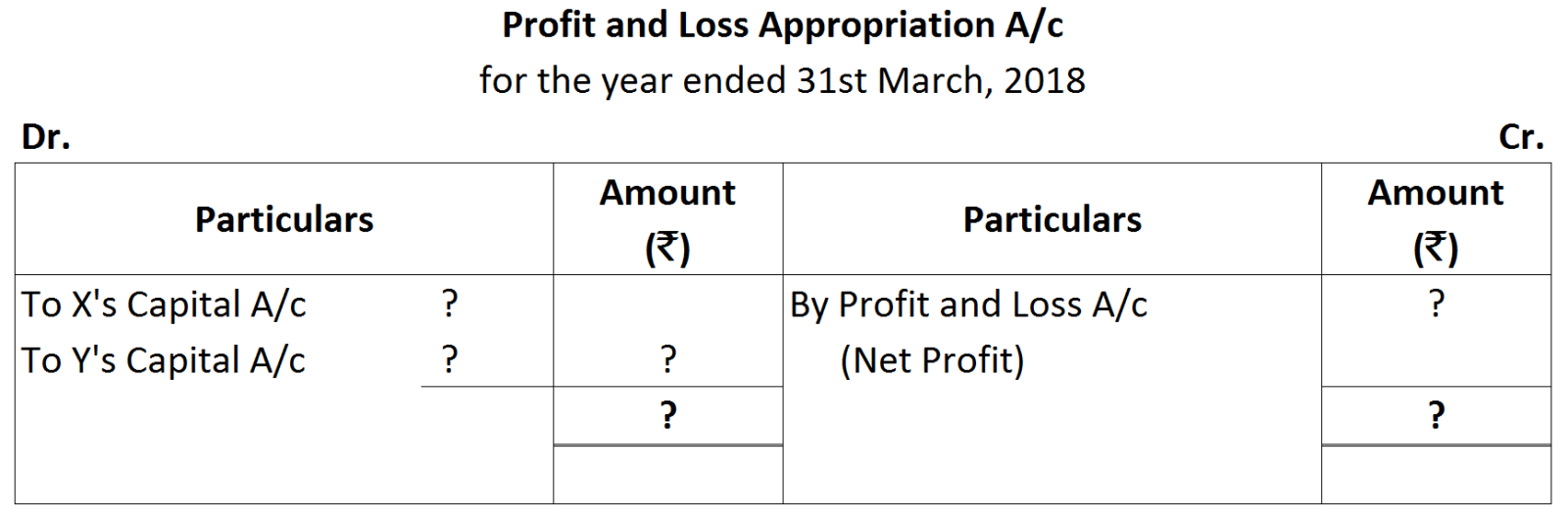
Sonu and Rajat started a partnership firm on April $1, 2017$. They contributed $₹ 8,00,000$ and $₹ 6,00,000$ respectively as their capitals and decided to share profits and losses in the ratio of $3: 2$.
The partnership deed provided that Sonu was to be paid a salary of $₹ 20,000$ per month and Rajat a commission of $5 \%$ on turnover. It also provided that interest on capital be allowed @ $8 \%$ p.a. Sonu withdrew ₹ $20,000$ on $1^{\text {st }}$ December, $2017$ and Rajat withdrew ₹ $5,000$ at the end of each month. Interest on drawings was charged $@ 6\%$ p.a. The net profit as per Profit and Loss Account for the year ended 31st March, $2018$ was ₹ $4,89,950$. The turnover of the firm for the year ended $31^{\text {st }}$ March, $2018$ amounted to ₹ $20,00,000$. Pass necessary journal entries for the above transactions in the books of Sonu and Rajat.
Answer
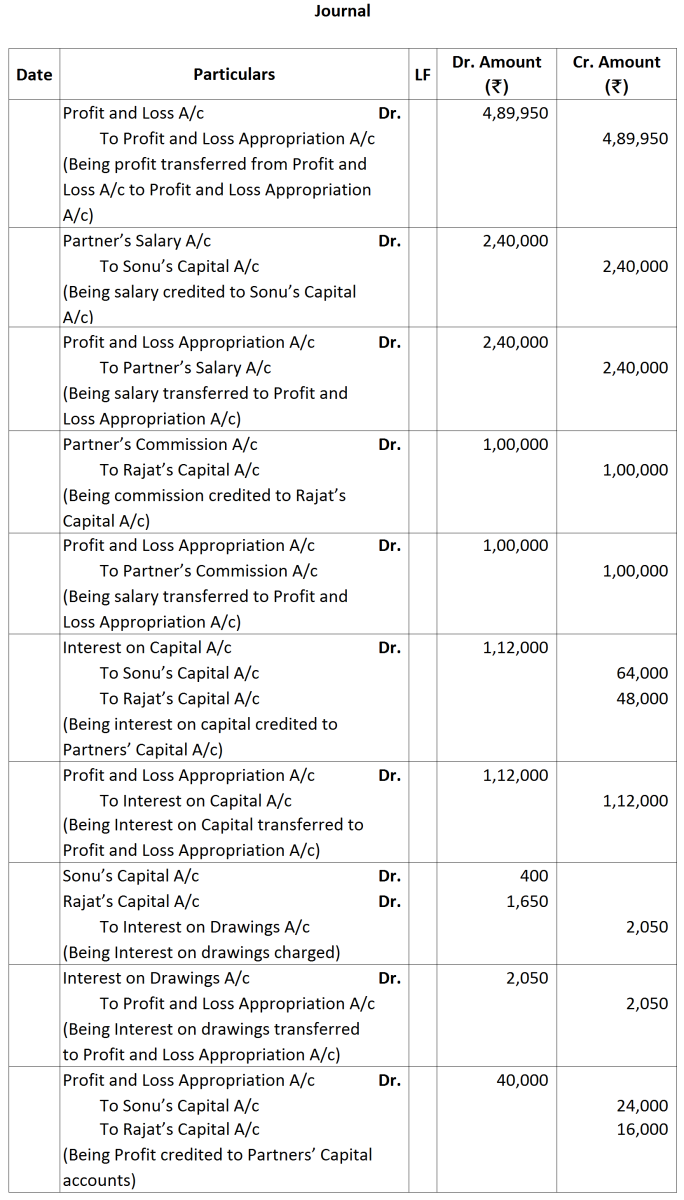 Working Notes:
- Computation of interest on drawings of partners:
Drawings of sonu = 20,000
Drawings of Rajat = 12 × 5,000 = 60,000
Interest on Sonu's drawings $=20,000\times\frac{6}{100}\times\frac{4}{12}=400$
Interest on Rajat's drawings $=60,000\times\frac{6}{100}\times\frac{5.5}{12}=1,650$
- Computation of divisible profit and its distribution between partners:
Profit as per the profit and Loss Account = 4,89,950
Divisible profit = Net profit + Interest on Drawings - Interest on Capital - Salary to Sonu - Commission to Rajat
Divisible Profit = 4,89,950 + 2,050 - 1,12,000 - 2,40,000 - 1,00,000 = 40,000
Sonu's share in divisible profit $=40,000\times\frac{3}{5}=24,000$
Rajat's share in divisible profit $=40,000\times\frac{2}{5}=16,000$ View full question & answer→Question 116 Marks
Jay, Vijay and Karan were partners of an architect firm sharing profits in the ratio of $2: 2: 1$. Their partnership deed provided the following:
i. A monthly salary of ₹ $15,000$ each to Jay and Vijay.
ii. Karan was guaranteed a profit of ₹ $5,00,000$ and Jay guaranteed that he will earn an annual fee of ₹ $2,00,000$. Any deficiency arising because of guarantee to Karan will be borne by Jay and Vijay in the ratio of $3: 2$. During the year ended $31^{\text {st }}$ March, $2018$ Jay earned fee of ₹ $1,75,000$ and the profits of the firm amounted to ₹ $15,00,000.$
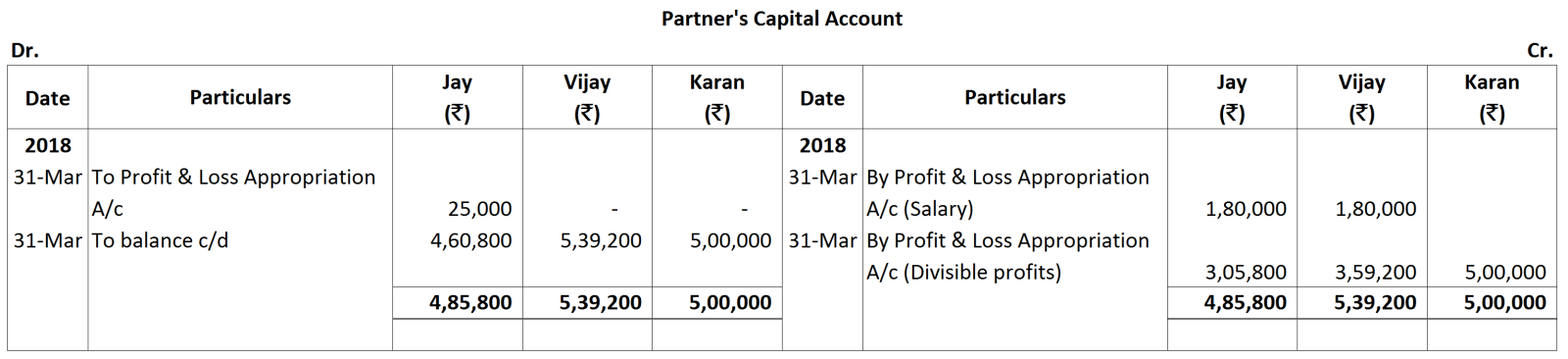
Showing your workings clearly prepare Profit and Loss Appropriation Account and the Capital Account of Jay, Vijay and Karan for the year ended $31^{\text {st }}$ March, $2018.$
Answer
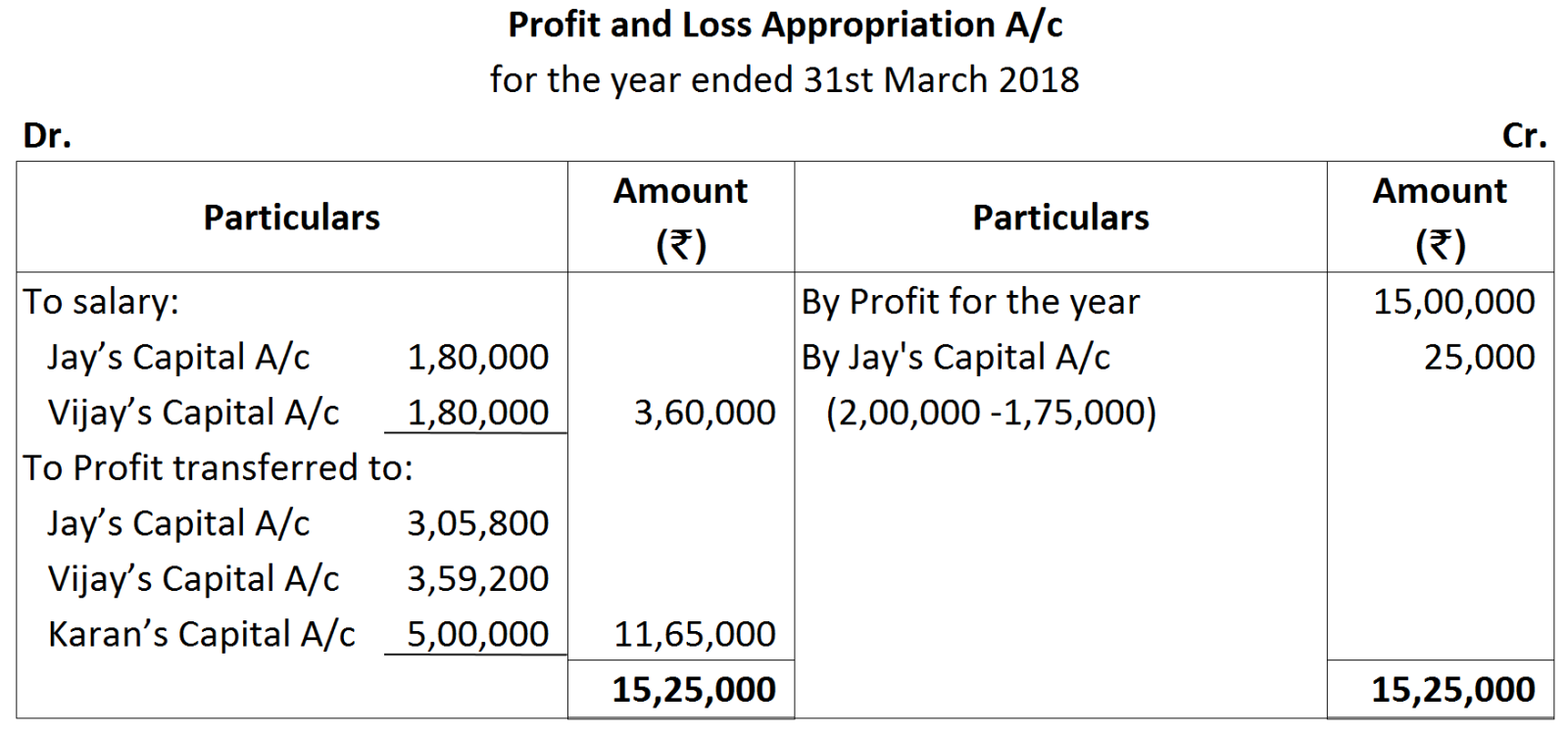 Working Note:
Computation of divisible profit and its distribution between partners:
Divisible profit = 11,65,000
Jay's share in divisible profit $=11,65,000\times\frac{2}{5}=4,66,000$
Vijay's share in divisible profit $=11,65,000\times\frac{2}{5}=4,66,000$
Karan's share in divisible profit $=11,65,000\times\frac{1}{5}=2,33,000$
Profit share guaranteed to Karan $= 5,00,000$
Deficiency to Karan's share in profit $= 5,00,000 - 2,33,000 = 2,67,000$
Deficiency to be borne by Jay $=2,67,000\times\frac{3}{5}=1,60,200$
Deficiency to be borne by Vijay $=2,67,000\times\frac{2}{5}=1,06,800$
Final Share in Divisible Profit for:
Jay $= 4,66,000 - 1,60,200 = 3,05,800$
Vijay $= 4,66,000 - 1,06,800 = 3,59,200$
Karan $= 2,33,000 + 1,60,200 + 1,06,800 = 5,00,000$
View full question & answer→Question 126 Marks
On 1st April, 2017 the balances of A and B were as follows:
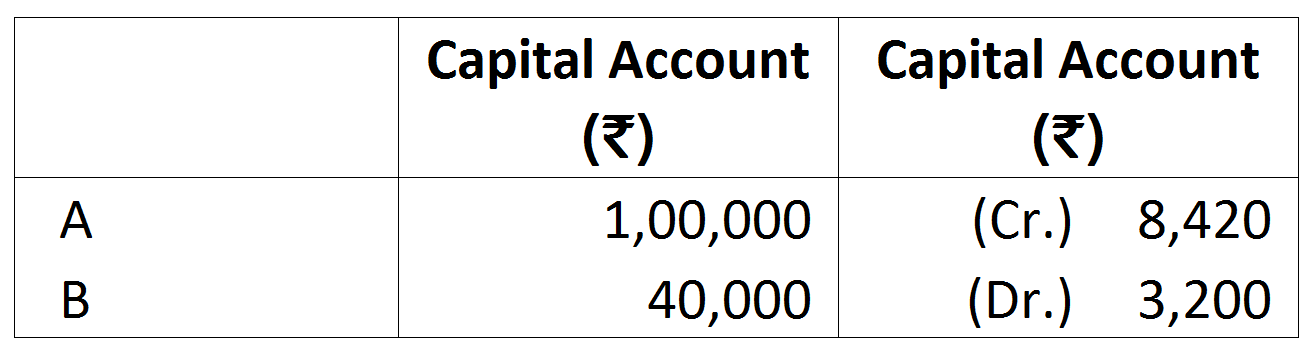
On 1st July, 2017 A withdrew ₹ 20,000 from his capital and B introduced ₹ 10,000 as further capital on the same date. According to the deed, interest on capitals is to be allowed at 8% p.a. but no interest is to be allowed or charged on current account is entitled to a commission of 10% of the profit before any adjustment is made according to the deed. For the year ended 31st March, 2018, the profit was ₹ 40,000 and the drawings of A and B were ₹ 12,000 and ₹ 10,000 respectively. Prepare the P & L Appropriation A/c Capital Accounts and Current Accounts.
Answer
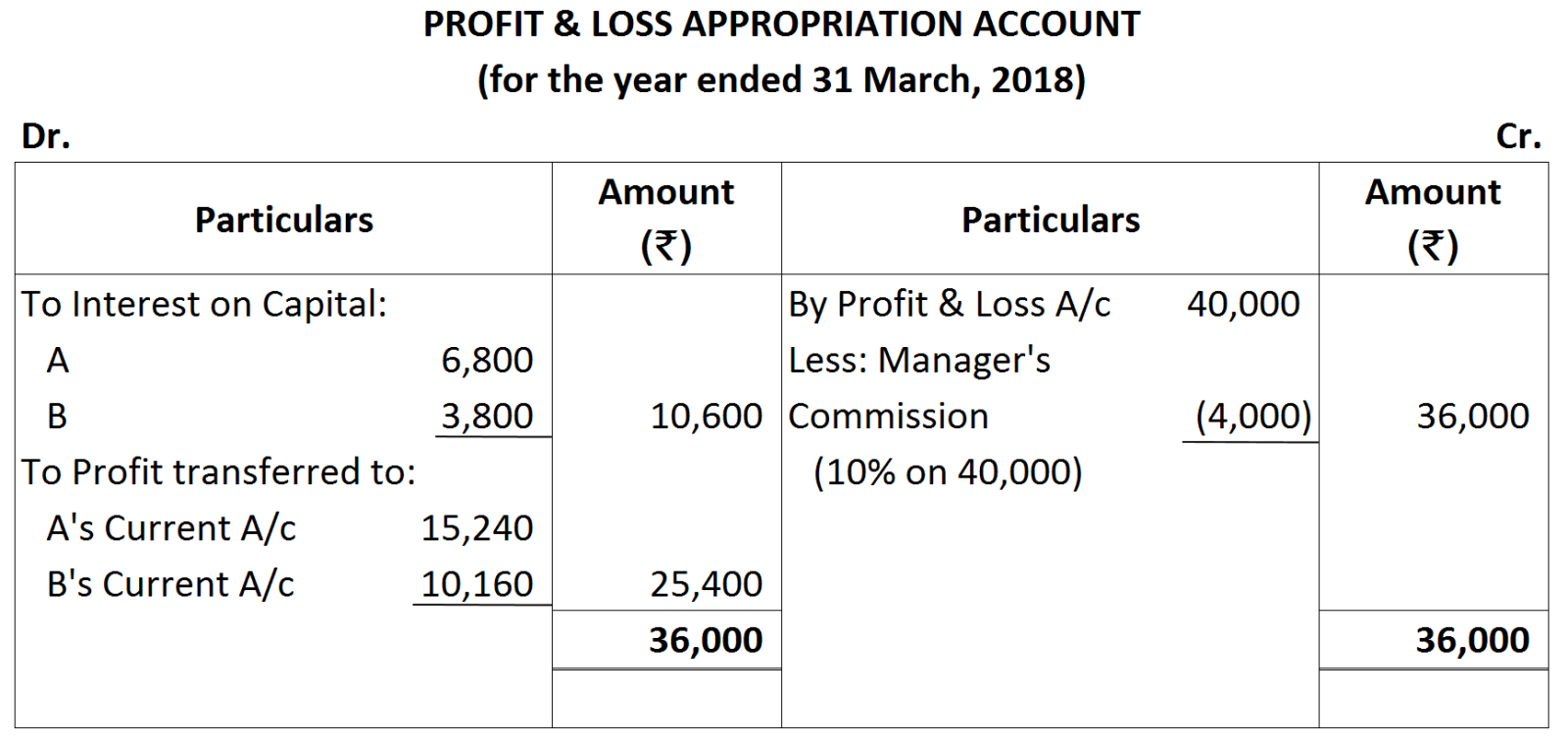
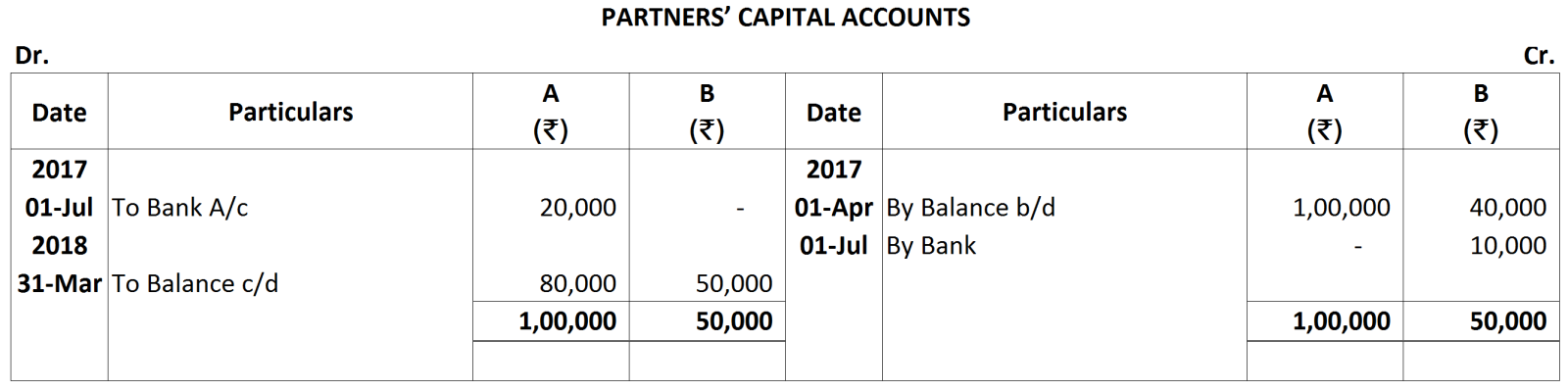
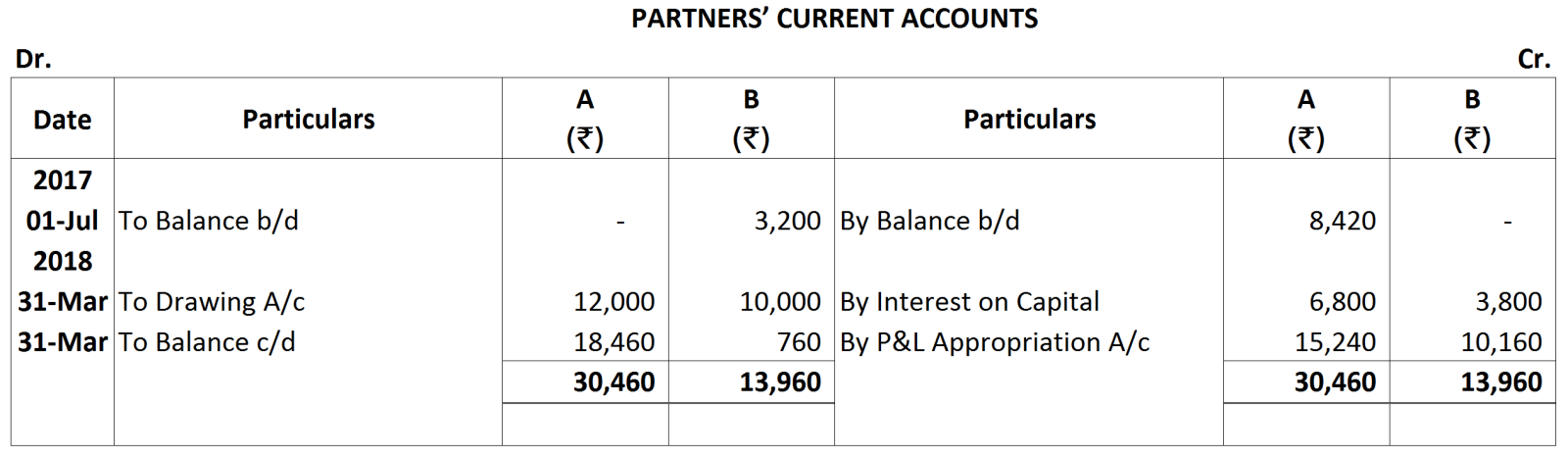 Working Notes:
Calculation of Interest on Capital:
|
|
From 1.4.2013 to 30.6.2013
|
|
₹
|
₹
|
|
A
|
$1,00,000 \times\frac{8}{100}\times\frac{3}{12}$ |
=
|
2,000
|
|
|
B
|
$40,000 \times\frac{8}{100}\times\frac{3}{12}$ |
=
|
|
800
|
| |
From 1.7.2013 to 31.3.2014
|
|
₹
|
₹
|
|
A
|
$80,000 \times\frac{8}{100}\times\frac{9}{12}$ |
=
|
4,800
|
|
|
B
|
$50,000 \times\frac{8}{100}\times\frac{9}{12}$ |
=
|
|
3,000
|
|
|
|
|
6,800
|
3,800
|
View full question & answer→Question 136 Marks
A, B and C are partners in a firm sharing profits in the ratio of 3 : 2 : 1. They earned a profit of ₹ 30,000 during 2017-18. Distribute profit among A, B and C if:
- C's share of profit is guaranteed to be ₹ 6,000 minimum.
- Minimum profit payable to C amounting to ₹ 6,000 is guaranteed by A.
- Guaranteed minimum profit of ₹ 6,000 payable to C is guaranteed by B.
- Any deficiency after making payment of guaranteed ₹ 6,000 will be borne by A and B in the ratio of 3 : 1.
AnswerCase a.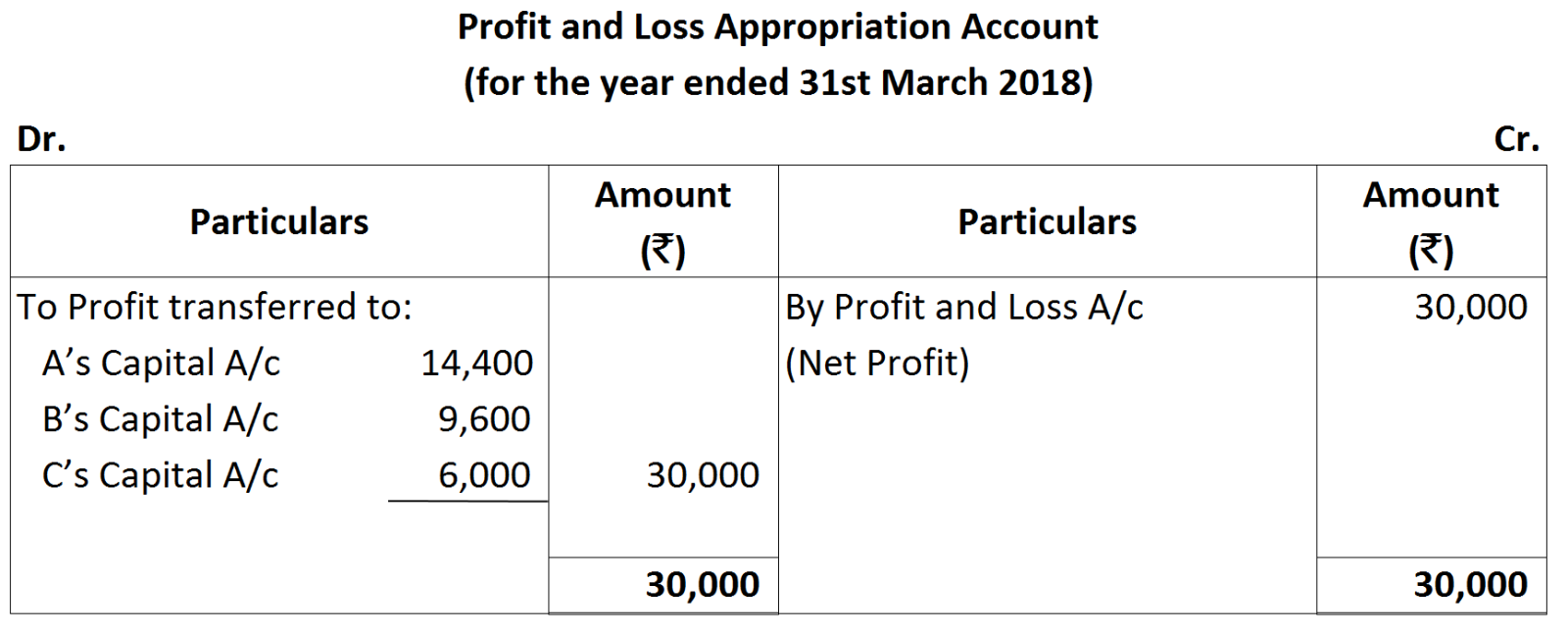
Working Notes:
Profit = ₹ 30,000
Profit sharing ratio = 3 : 2 : 1
C is given a guarantee of minimum profit of ₹ 6,000
A's Profit Share $=30,000\times\frac{3}{6}₹\ 15,000$
B's Profit Share $=30,000\times\frac{2}{6}₹\ 10,000$
C's Profit Share $=30,000\times\frac{1}{6}₹\ 5,000$
Deficiency in C’s Profit Share = 6,000 − 5,000 = ₹ 1,000
This deficiency is to be borne by A and B in their profit sharing ratio i.e. 3 : 2
Deficiency borne by $\text{A}=1,000\times\frac{3}{5}₹\ 600$
Deficiency borne by $\text{B}=1,000\times\frac{2}{5}₹\ 400$
Therefore,
Final Profit Share of A = 15,000 − 600 = ₹ 14,400
Final Profit Share of B = 10,000 − 400 = ₹ 9,600
Final Profit Share of C = 5,000 + 1,000 = ₹ 6,000
Case b.
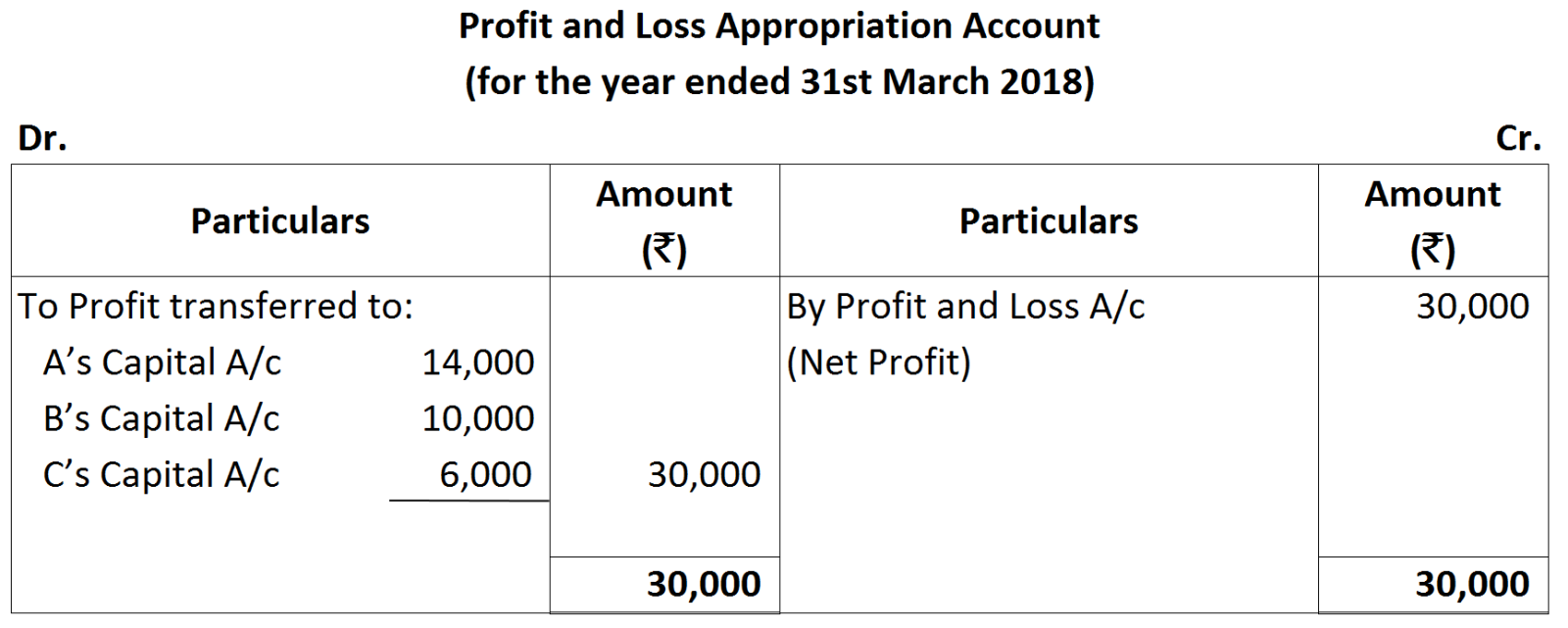
Working Notes:
Deficiency in C’s Profit Share = 6,000 − 5,000 = ₹ 1,000
This deficiency is to be borne by A only.
Therefore,
Final Profit Share of A = 15,000 − 1,000 = ₹ 14,000
Final Profit Share of B = ₹ 10,000
Final Profit Share of C = 5,000 + 1,000 = ₹ 6,000
Case c.
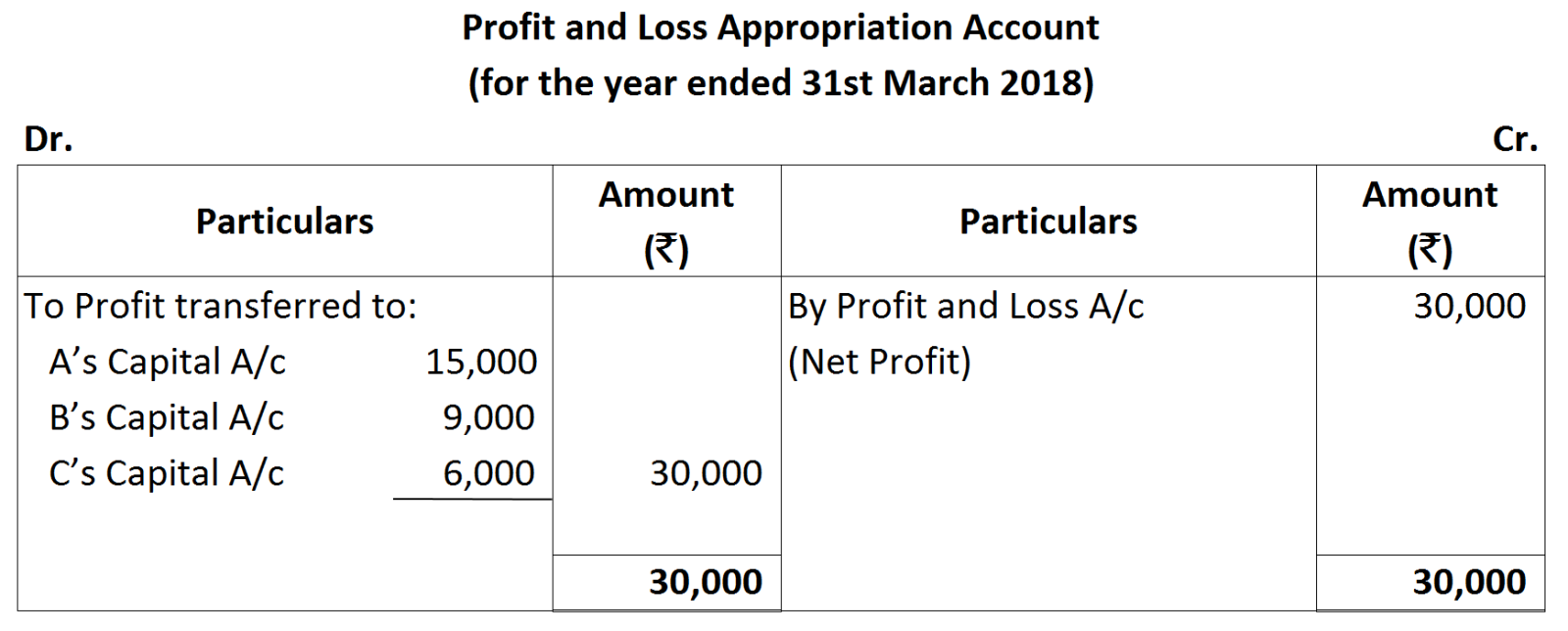
Working Notes:
Deficiency in C’s Profit Share = 6,000 − 5,000 = ₹ 1,000
This deficiency is to be borne by B only.
Therefore,
Final Profit Share of A = ₹ 15,000
Final Profit Share of B = 10,000 − 1,000 = ₹ 9,000
Final Profit Share of C = 5,000 + 1,000 = ₹ 6,000
Case d.
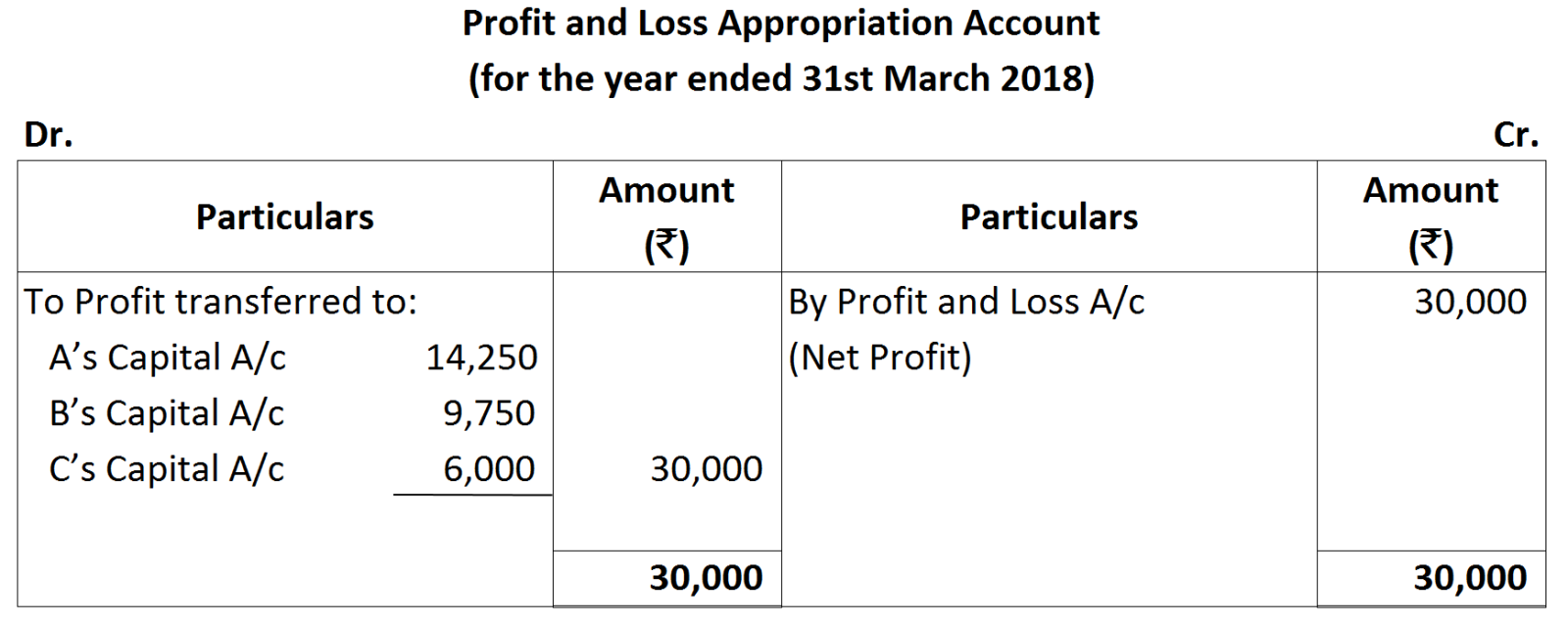
Working Notes:
Deficiency in C’s Profit Share = 6,000 − 5,000 = ₹ 1,000
This deficiency is to be borne by A and B in the ratio of 3 : 1.
Deficiency borne by $\text{A}=1,000\times\frac{3}{4}₹\ 750$
Deficiency borne by $\text{B}=1,000\times\frac{1}{4}₹\ 250$
Therefore,
Final Profit Share of A = 15,000 − 750 = ₹ 14,250
Final Profit Share of B = 10,000 − 250 = ₹ 9,750
Final Profit Share of C = 5,000 + 1,000 = ₹ 6,000 View full question & answer→Question 146 Marks
A and B are partners in a firm sharing profits an losses in the ratio of 3 : 2. The balance in their capital and current accounts as on 1-4-2017 were as under.
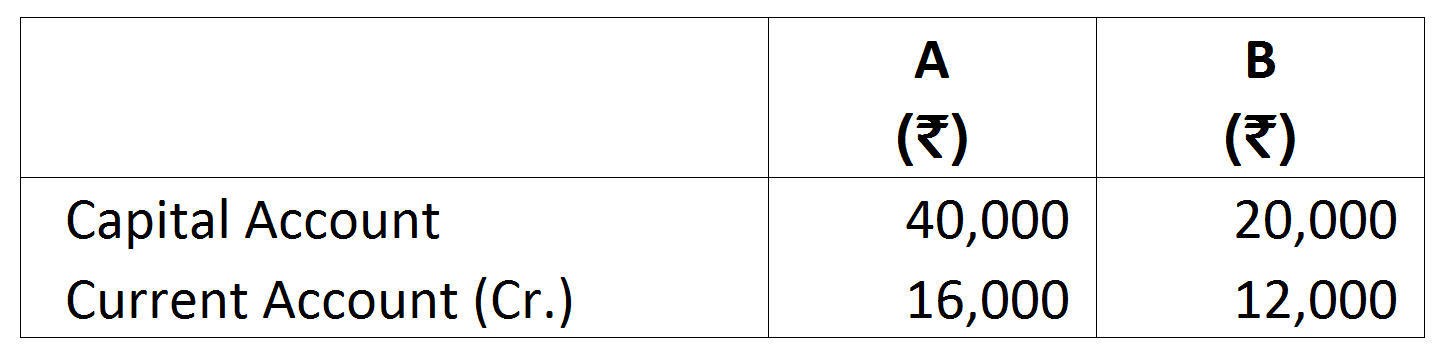
The partnership deed provided that A is to be paid salary @ ₹ 500 p.m. whereas B is to get commission of ₹ 4,000 for the year. Interest on capital is to be allowed @ 6% p.a. The drawings of A and B for the year were ₹ 5,000 and ₹ 2,000, respectively. Interest on drawings for A and B works out at ₹ 225 and ₹ 75 respectively. The net profit of the firm for the year ended 31st March 2018 before making these adjustments was ₹ 35,700 Prepare the Profit and Loss Appropriation Account and the Partners Capital and Current Accounts.
Question 156 Marks
Calculate the interest on Drawings of Tarun @ 8% p.a. for the year ended 31st March, 2018 in each of the following alternative cases:
Case (a) If his drawings during the year were ₹ 60,000.
Case (b) If he withdrew ₹ 5,000 p.m. in the beginning of everymonth.
Case (c) If he withdrew ₹ 5,000 p.m. at the end of every month.
Case (d) If he withdrew ₹ 5,000 p.m.during the year.
Case (e) If he withdrew the following amounts as under.
2015 June, 1 : ₹ 10,000; August 31 : ₹ 12,000; November 1 : ₹ 16,000; December 31 : ₹ 13,000; February 1, 2016 : ₹9,000.
AnswerCalculation of Interest on Drawings:
Case (a). In this case interest will be charged for six months because it will be assumed that the drawings were made evenly throughout the year:
$60,000 \times\frac{8}{100}\times\frac{6}{12} = ₹\ 2,400$
Case (b). In this case interest will be charged for 6.5 months as the drawings are made in the beginning of every month:
$60,000 \times\frac{8}{100}\times\frac{6.5}{12} = ₹\ 2,600$
Case (c). In this case interest will be charged for 5.5 months as the drawings are made at the end of every month:
$60,000 \times\frac{8}{100}\times\frac{5.5}{12} = ₹\ 2,200$
Case (d). In this case interest will be charged for 6 months as the drawings are made during i.e., middle of every month.
$60,000 \times\frac{8}{100}\times\frac{6}{12} = ₹\ 2,400$
Case (e).
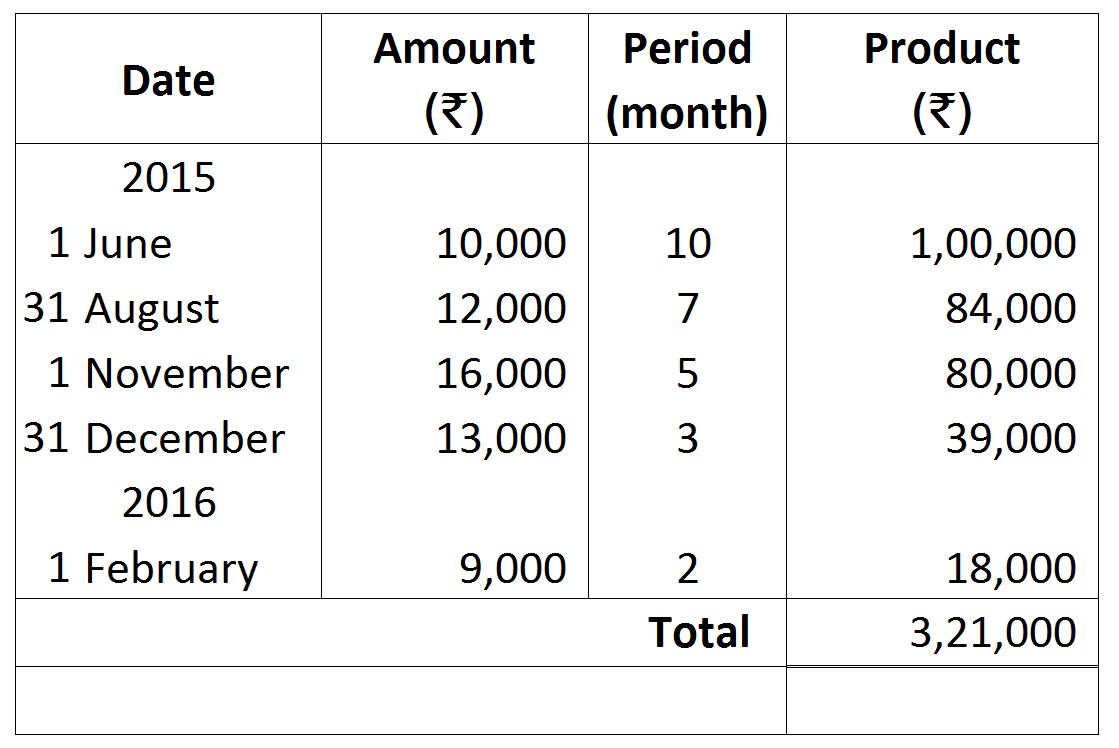
Interest = Total of Products $\times\frac{8}{100}\times\frac{1}{12}$
$= 3,21,000 \times\frac{8}{100}\times\frac{1}{12} = ₹\ 2,140$ View full question & answer→Question 166 Marks
Current Account's Balances as on Ist April, 2017 were as: Amit ₹ 5,000 (Cr.), Namit ₹ 2,000 (Cr.) and Ruchi ₹ 1,000 (Dr.) Profit sharing ratio was 3 : 2 : 1. Amit gets a inonthly salary of ₹ 1,500.
Amit draws ₹ 2,000 on the first day of each month and Namit draws ₹ 2,000 on the last date of each month while Ruehl draws ₹ 6,000 at the end of each quarter. Interest on drawing is to be charged @ 12% p.a Profits for the year ended 31st march 2018 before adjustments of interest on drawings and of salary were ₹ 74,040. Show current Accounts.
Answer
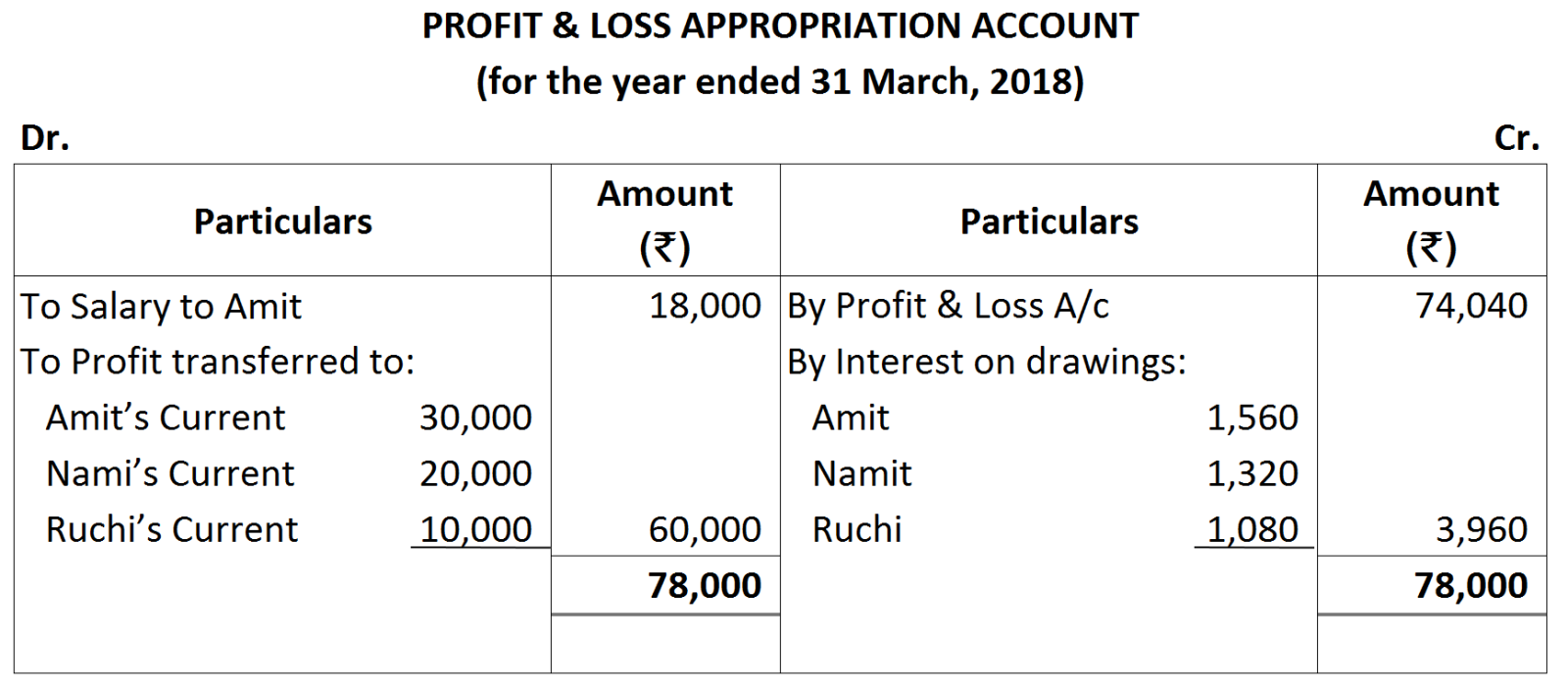
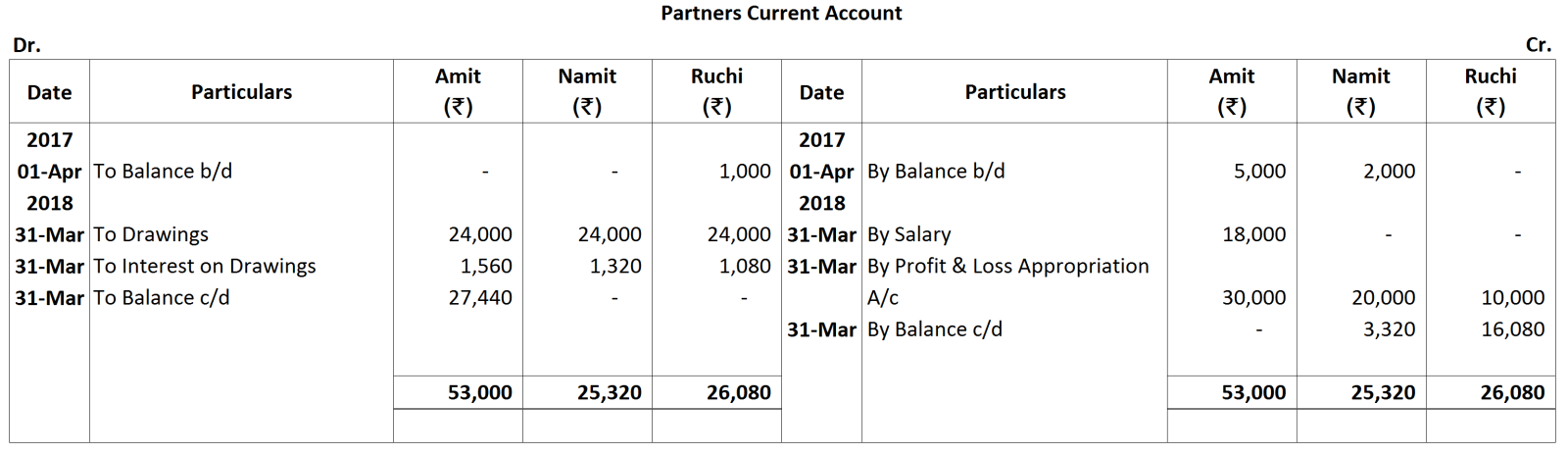 Calculation of Interest on Drawings:
Amit withdraws on the First day of each month
$24,000 \times\frac{12}{100} \times\frac{ 6.5}{12} = ₹\ 1,560$
Namit withdraws on the last date of each month
$24,000 \times\frac{12}{100} \times\frac{ 5.5}{12} = ₹\ 1,320$
Ruchi withdraws at the end of each quarter
Average Period $ = \frac{(9\text{ months} + 0\text{ month})}{2} = 4.5\ \text{months}$
Interest on Drawings $= 24,000 \times\frac{12}{100} = ₹\ 1,080$ View full question & answer→Question 176 Marks
A and B are partners As per the terms of agreement interest is allowed on capitals @ 8% p.a. and charged on drawings @10% p.a. A withdrew ₹ 10,000 per month at the end of each month and B withdrew ₹ 30,000 at the end of each quarter. You required to fill up the missing figures in the following accounts:
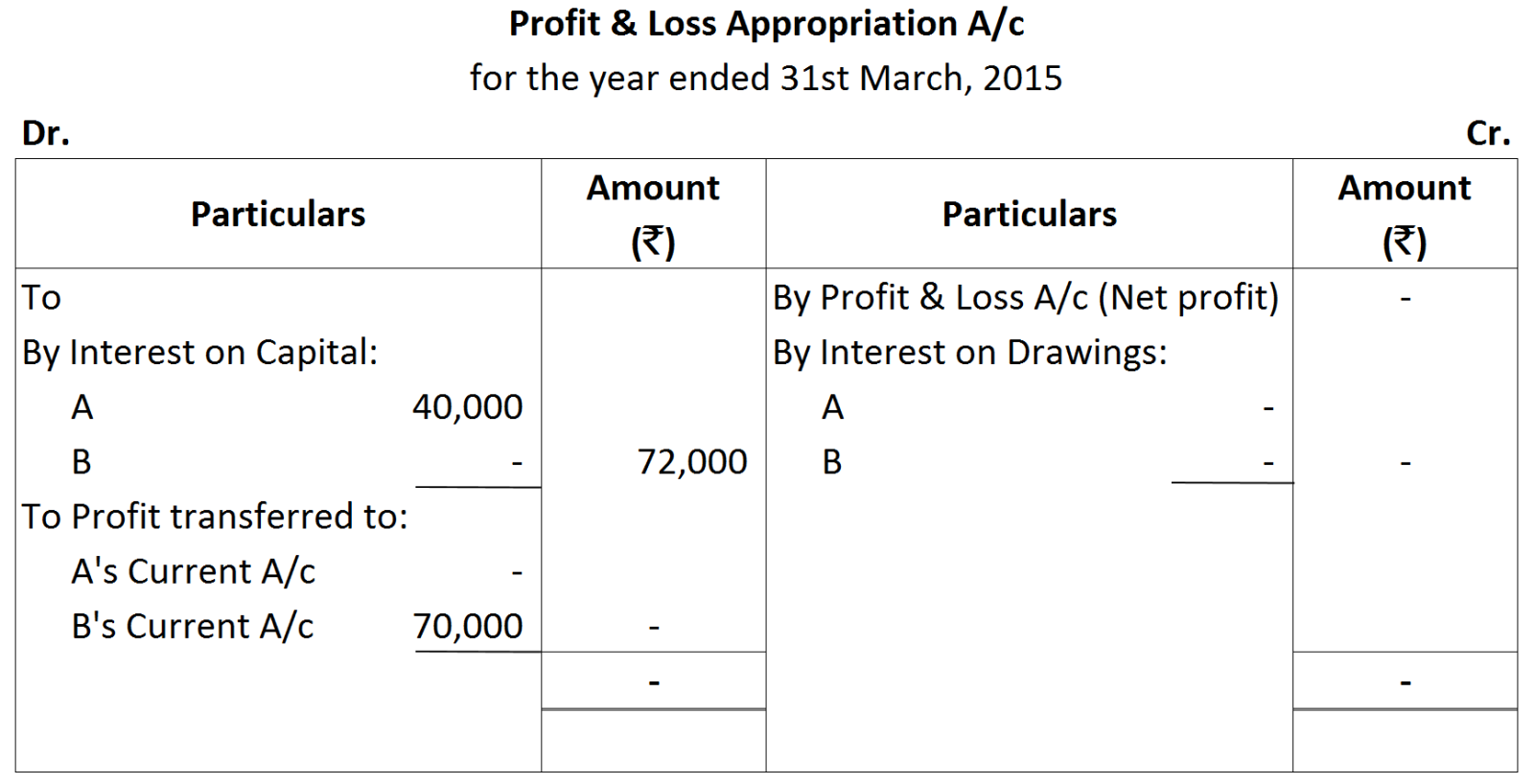
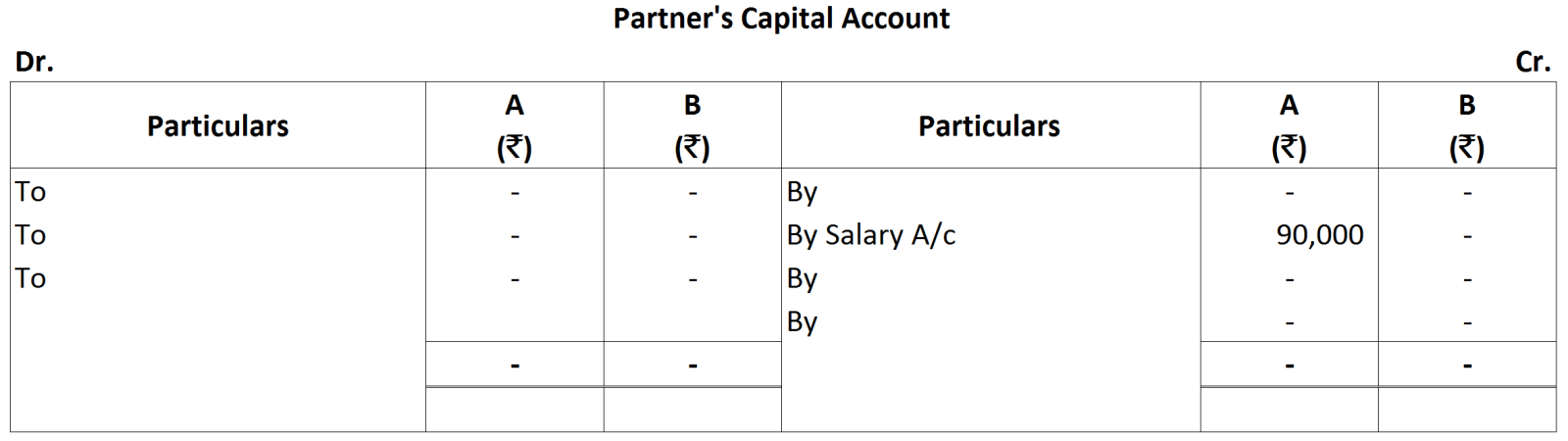
Answer
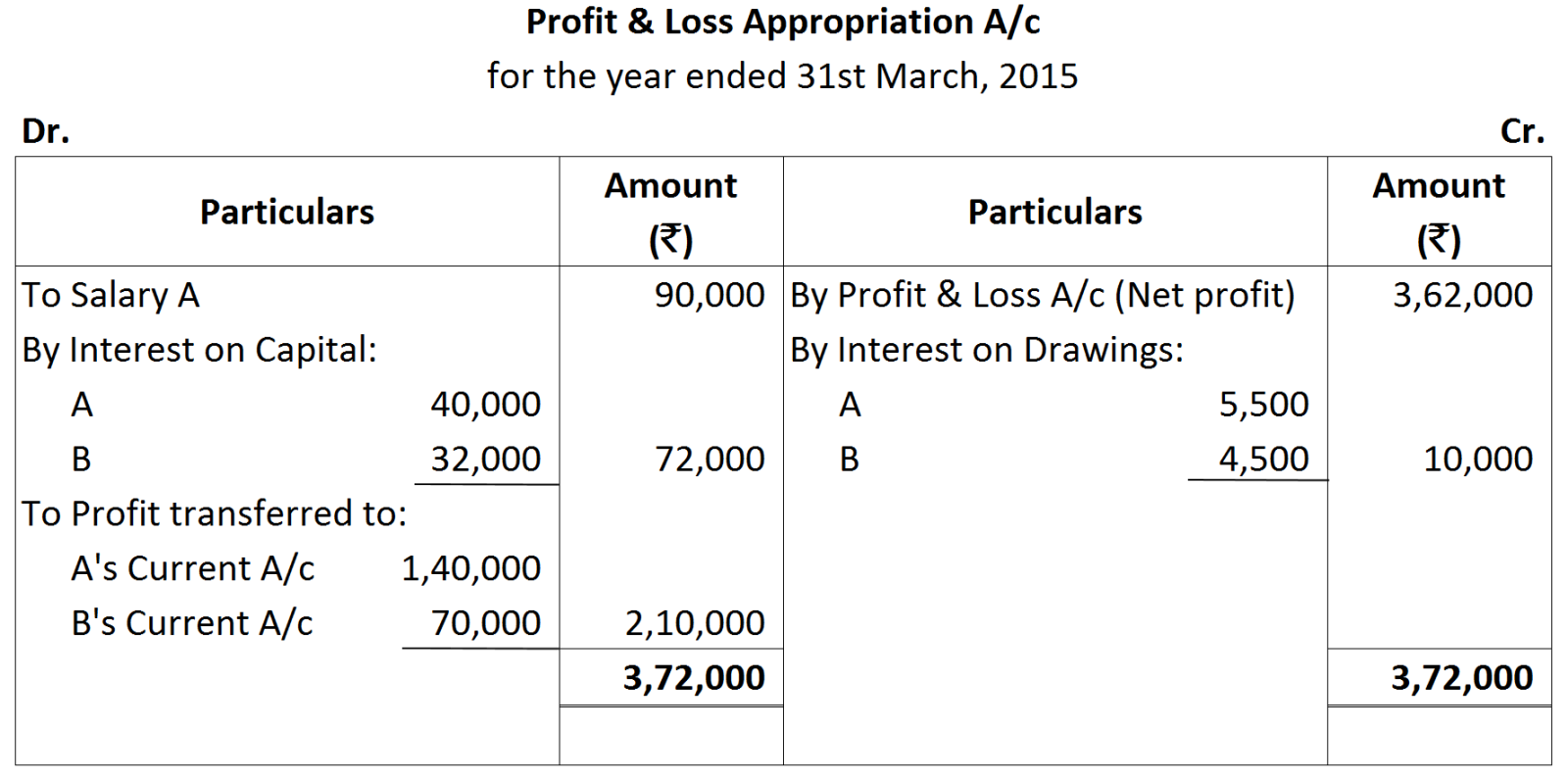
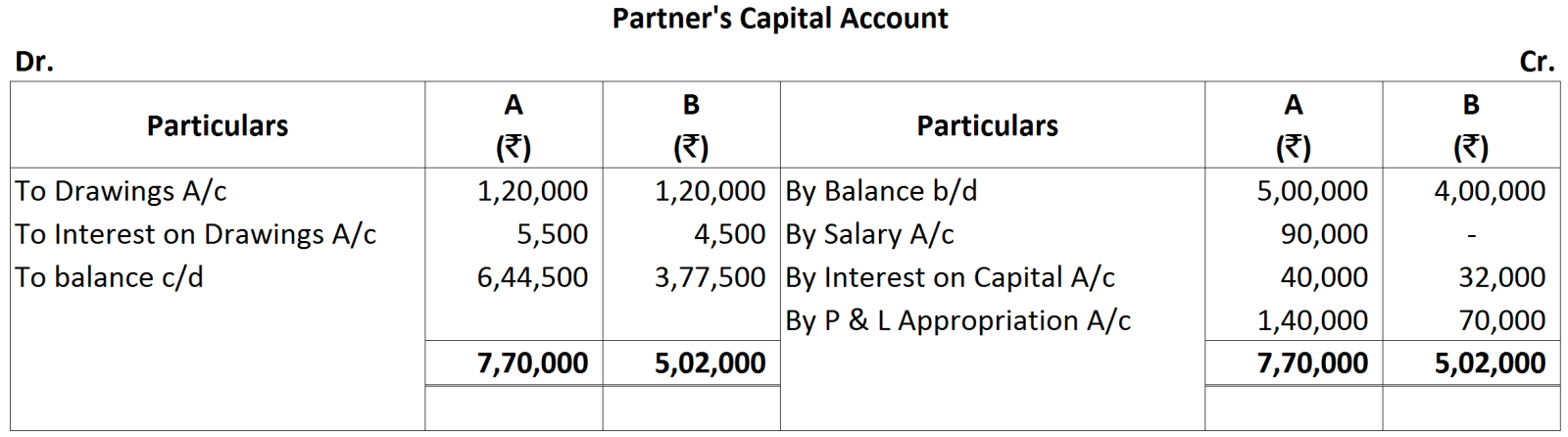 Working Notes:
$\text{A}'\text{s}\ \text{Capital}=40,000\times\frac{100}{8}=₹\ 5,00,000$
$\text{B}'\text{s}\ \text{Capital}=32,000\times\frac{100}{8}=₹\ 4,00,000$
A has drawn at the end of each month. Hence, interest on his drawings will be charged for 5.5 months.
Interest on A's Drawings $=1,20,000\times\frac{10}{100}\times\frac{5.5}{12}=₹\ 5,500$
B has drawn at the end of each quarter. Hence, interest on· his drawings will be charged for 4.5 months.
Interest on B's Drawings $=1,20,000\times\frac{10}{100}\times\frac{4.5}{12}=₹\ 4,500$ View full question & answer→Question 186 Marks
Ajay, Binay and Chetan were partners sharing profits in the ratio of 3 : 3 : 2. The Partnership Deed provided for the following:
- Salary of ₹ 2,000 per quarter to Ajay and Binay.
- Chetan was entitled to a commission of ₹ 8,000
- Binay was guaranteed a pofit of ₹ 50,000 p.a.
The profit of the firm for the year ended 31st March, 2015 was ₹ 1,50,000 which was distributed among Ajay, Binay and Chetan in the ratio of 2 : 2 : 1, without taking into consideration the provisions of Partnership Deed. Pass necessary rectifying entry for the above adjustments in the books of the firm. Show your workings clearly.
Answer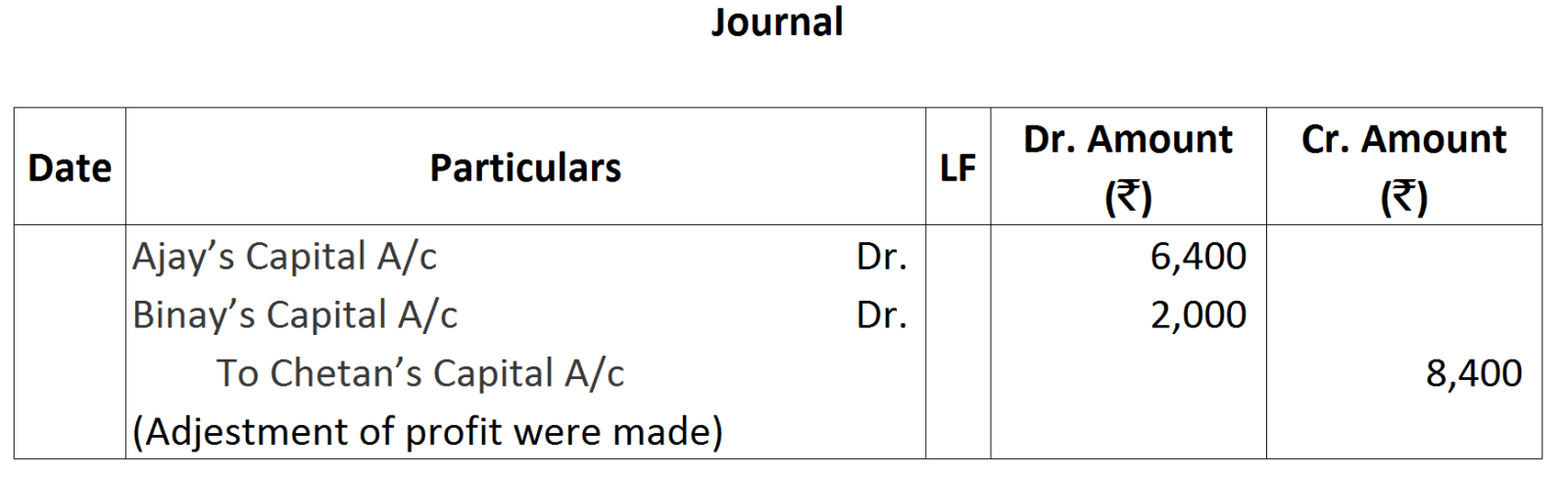 Working Notes:
WN1:
Working Notes:
WN1: Profit & Loss Appropriation A/c
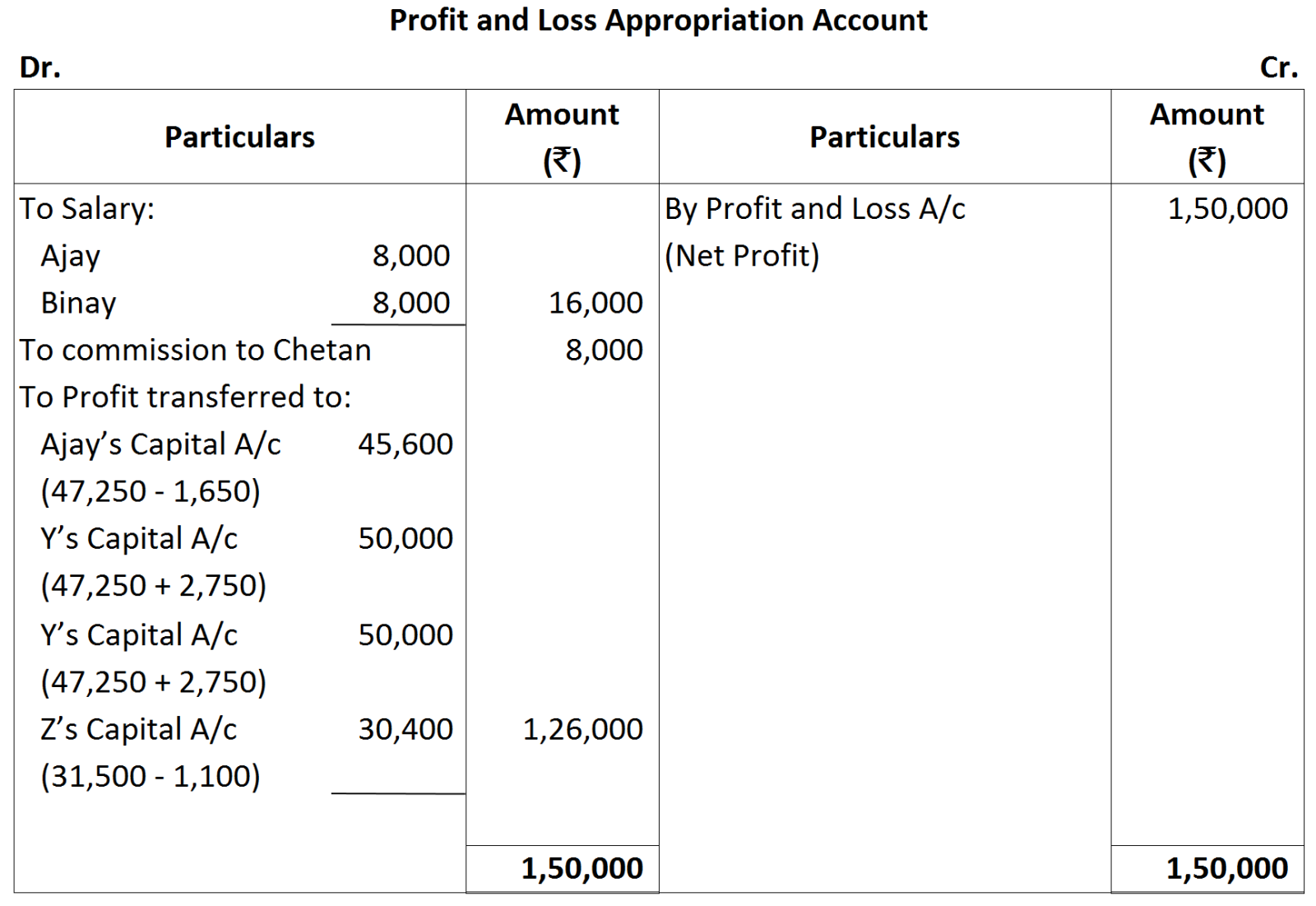 WN2:
WN2: Statement Showing Adjustment
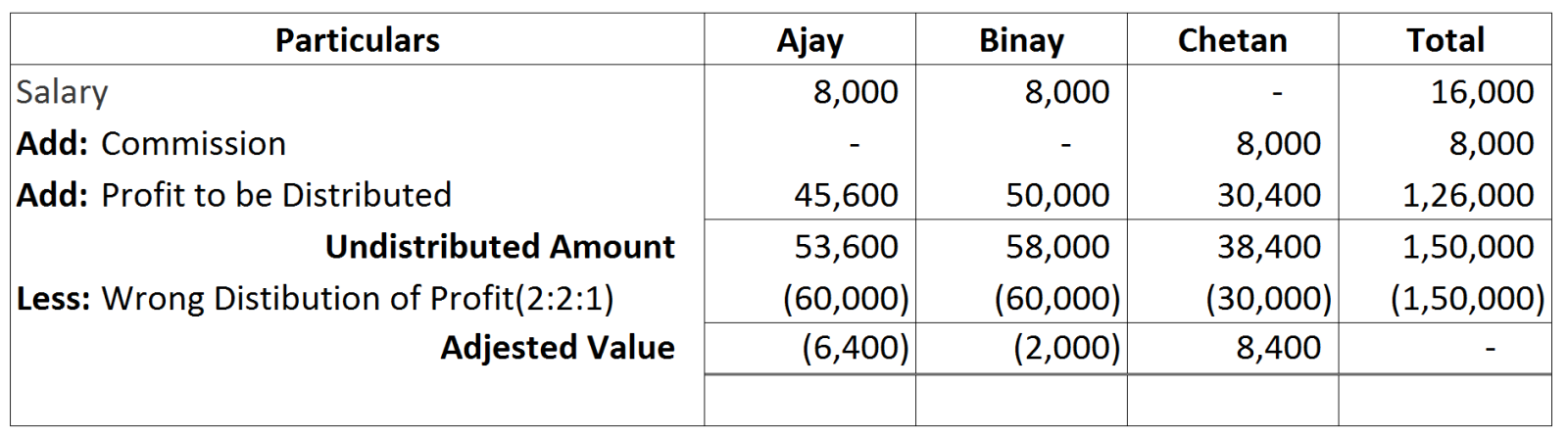
View full question & answer→Question 196 Marks
Sukesh and Vanita were partners in a firm. Their partnership agreement provides that:
- Profits would be shared by Sukesh and Vanita in the ratio of 3 : 2;
- 5% interest is to be allowed on capital;
- Vanita should be paid a monthly salary of ₹ 600.
The following balances are extracted from the books of the firm, on March 31, 2017.
|
|
Sukesh
₹
|
Vanita
₹
|
|
Capital Accounts
Current Accounts
Drawings
|
40,000
(Cr.) 7,200
10,850
|
40,000
(Cr.) 2,800
8,150
|
Net profit for the year, before charging interest on capital and after charging partner’s salary was ₹ 9,500. Prepare the Profit and Loss Appropriation Account and the Partner’s Current Accounts.
Answer
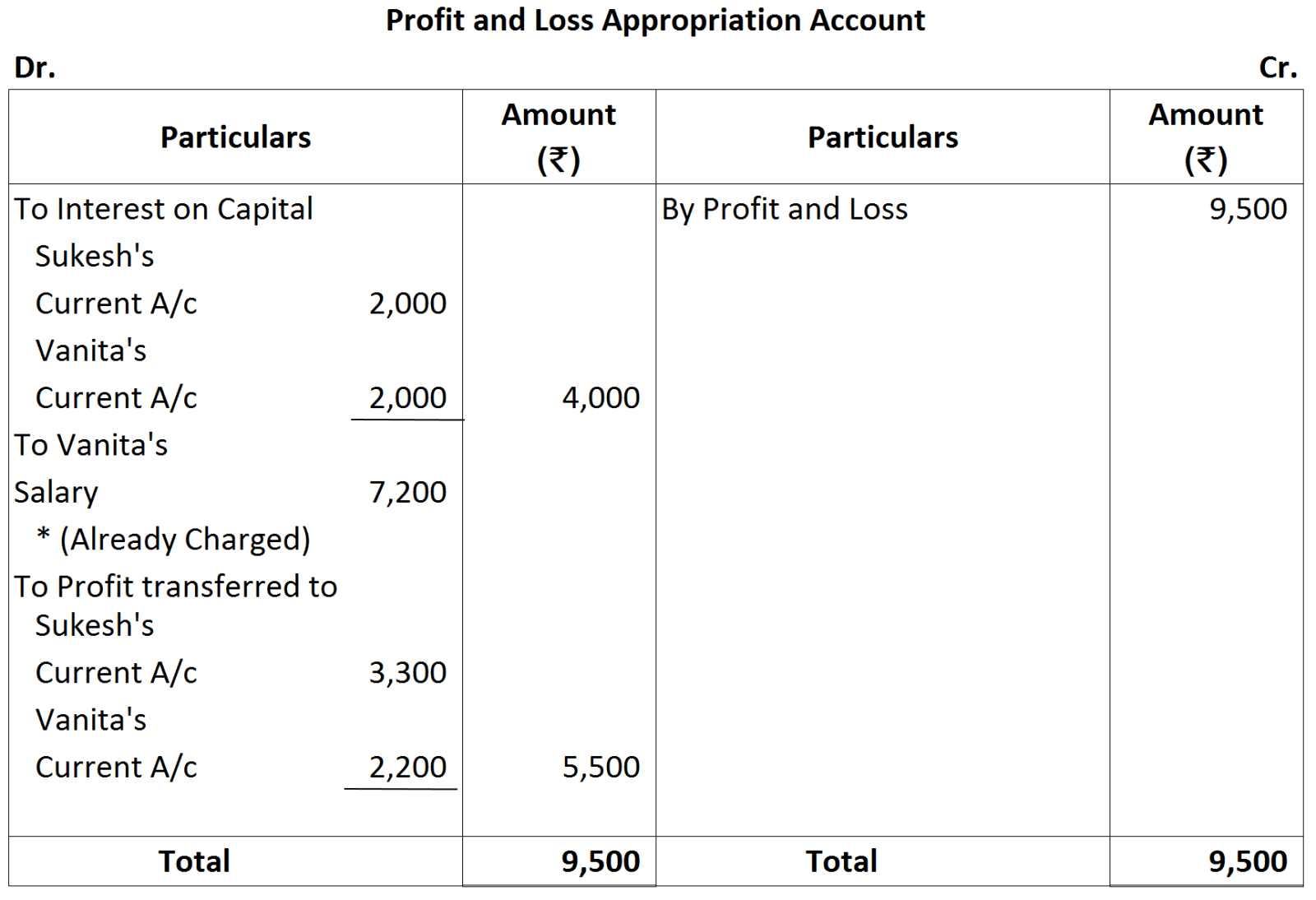
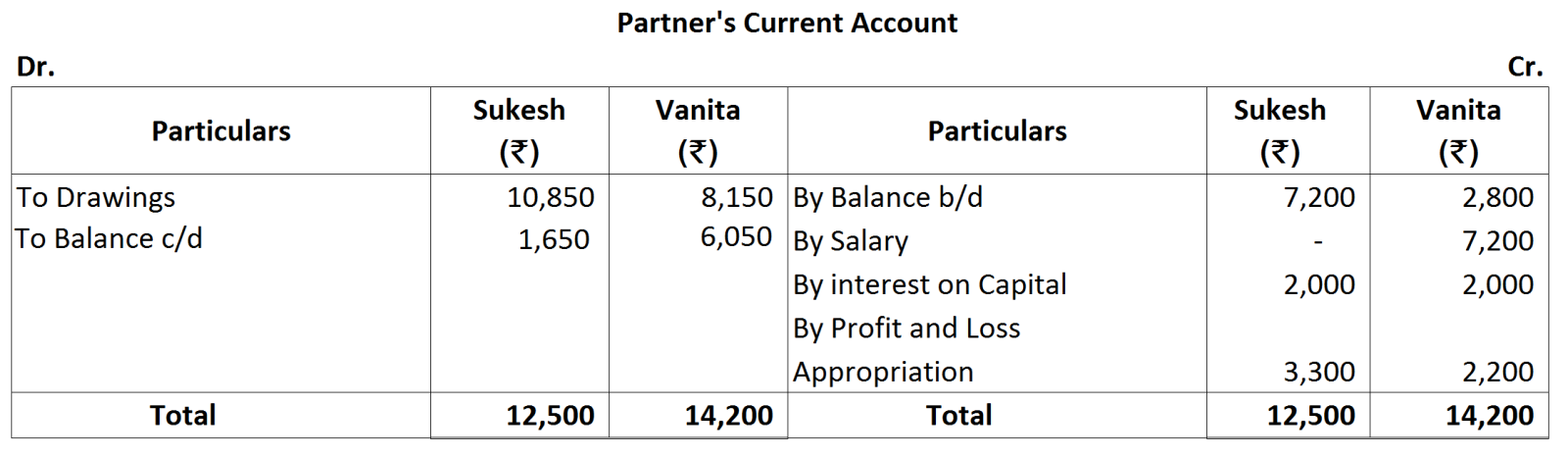 Note: Sukesh's profit $= 5,500\times \frac{3}{5} = 3,300$
Vanita's profit $= 5,500\times \frac{2}{5} = 2,200$
*Vanita salary will not be taken as it is already charged. View full question & answer→Question 206 Marks
A and B started business on 1st April, 2017 with capitals of ₹ 15,00,000 and ₹ 9,00,000 respectively. On 1st October, 2017, they decided that their capitals should be ₹ 12,00,000 each. The necessary adjustments in capitals were made by introducing or withdrawing by cheque. Interest on capital is allowed @ 8% p.a. Compute interest on capital for the year ended 31st March, 2018.
AnswerCalculation of Interest on A’s Capital
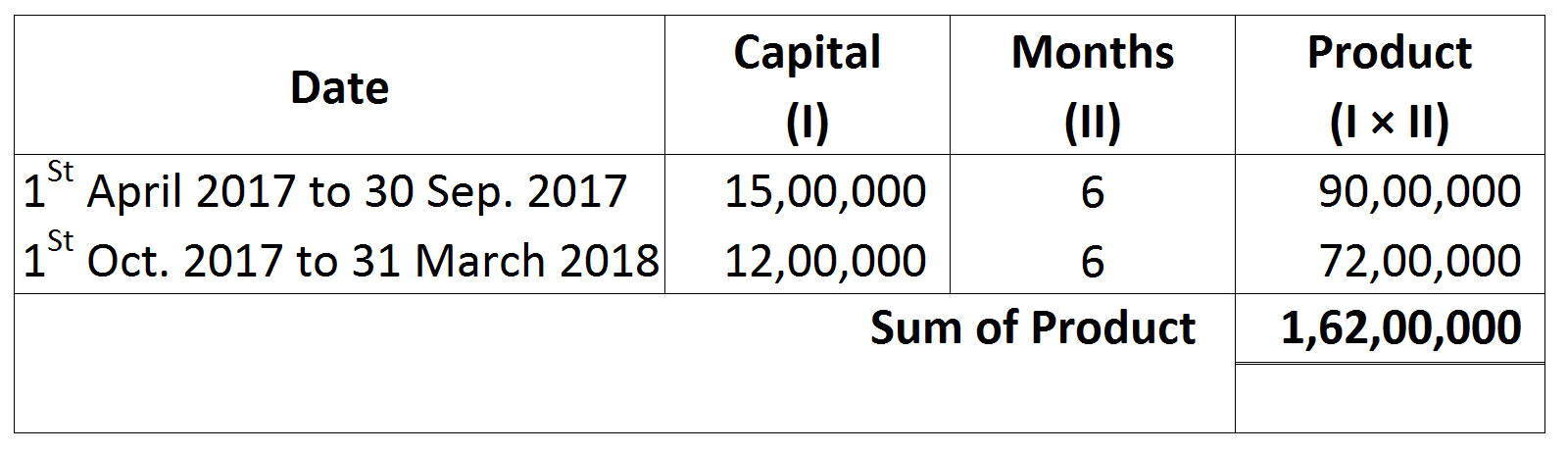
$\text{Interest on A's Capital = Sum of Product}\times\frac{\text{Rate}}{100}\times\frac{1}{12}$
$=1,62,00,000\times\frac{8}{100}\times\frac{1}{12}=₹\ 1,08,000$
Calculation of Interest on B’s Capital
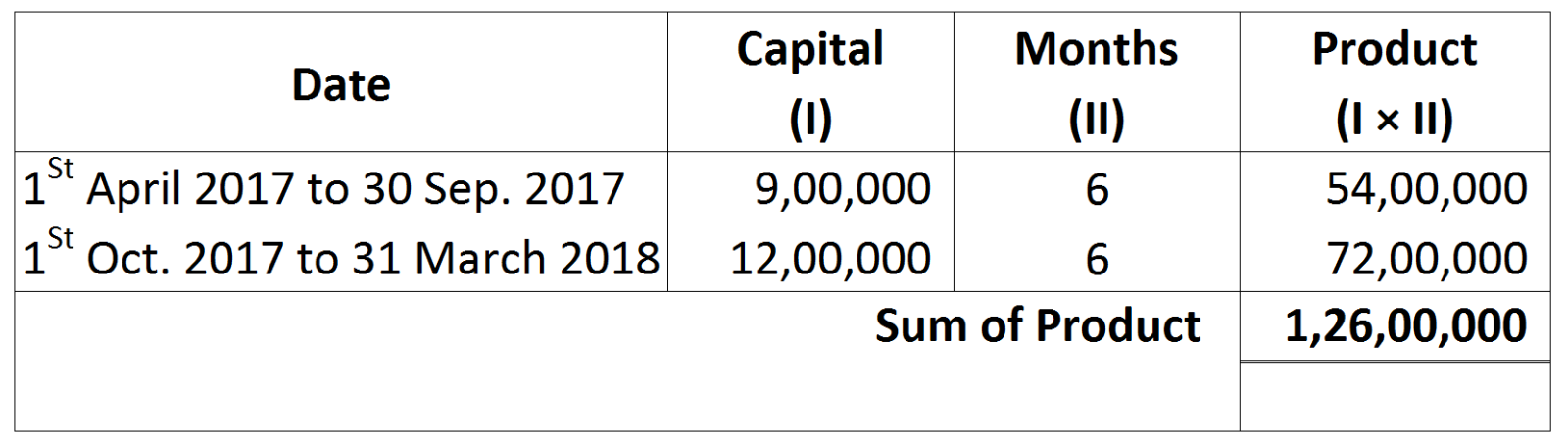
$\text{Interest on B's Capital = Sum of Product}\times\frac{\text{Rate}}{100}\times\frac{1}{12}$
$=1,26,00,000\times\frac{8}{100}\times\frac{1}{12}=₹\ 84,000$ View full question & answer→Question 216 Marks
X and Z are partners with capitals of ₹ 25,000 and ₹ 15,000 respectively on 1st April, 2016. Each partner is entitled to 9% p.a. interest on his capital. Z is entitled to a salary of ₹ 6,000 p.a. together with a commission of 6% of Net Profit remaining after deducting interest on capitals and salary and after charging his commission. The profits for the year ended 31st March, 2017 before making any of the above mentioned adjustments amount to ₹ 30,800. Prepare Partner’s Capital Accounts:
-
When capitals are fixed.
-
When capitals are fluctuating.
Question 226 Marks
Asha and Lata are partners sharing profits in the ratio of 1 : 2. Asha is entitled to a salary of ₹ 2,00,000 p.a. and a commission of 8% of net profit before charging any commission. Lata is entitled to a commission of 8% of net profit after charging her commission. Net Profit for the year ended 31st March, 2018 amounted to ₹ 5,40,000.
Prepare Profit & Loss Appropriation Account.
Question 236 Marks
X and Y contribute ₹ 20,000 and ₹ 10,000 respectively towards capital. They decide to allow interest on capital @ 6% p.a. Their respective share of profits is 2 : 3 and the net profit for the year is ₹ 1,500. Show distribution of profits:
- Where there is no agreement except for interest on capitals.
- Where there is an agreement that the interest on capital as a charge.
AnswerCalculation of Interest on Capital
Interest on X's Capital $=20,000\times\frac{6}{100}=₹\ 1,200$
Interest on Y's Capital $=10,000\times\frac{6}{100}=₹\ 600$
Total Amount of interest on Capital = 1,200 + 600 = ₹ 1,800
Case 1:
Where there is no clean agreement except for interest on capitals
Profit for the year ended = ₹ 1,500
Total amount of interest = ₹ 1,800
Here, total amount of interest on capital is more than the profit available for distribution.
Therefore, profit of ₹ 1,500 is distributed between X and Y in the ratio of their interest on capital.
|
Particulars
|
X
|
:
|
Y
|
|
Interest on Capital
|
1,200
|
:
|
600
|
|
Ratio of interest on Capital
|
2
|
:
|
1
|
X will get Interest on Capital $=1,500\times\frac{2}{3}=₹\ 1,000$
Y will get Interest on X's Capital $=1,500\times\frac{1}{3}=₹\ 500$
Case 2:
In case, there is a clear agreement that the interest on capital will be allowed even if the firm has incurred loss, then the whole amount of interest on capital is to be allowed to the partners.
Interest on X's Capital $=20,000\times\frac{6}{100}=₹\ 1,200$
Interest on Y's Capital $=10,000\times\frac{6}{100}=₹\ 600$
Total Profit of the firm = ₹ 1,500
Total amount of Interest on Capital = ₹ 1,800 (i.e. ₹ 1,200 + ₹ 600). Therefore, loss to the firm amounts to ₹ 300. This loss is to shared by X and Y in their profit sharing ratio that is 2 : 3.
Loss to X $=300\times\frac{2}{5}=₹\ 120$
Loss to Y $=300\times\frac{3}{5}=₹\ 180$ View full question & answer→Question 246 Marks
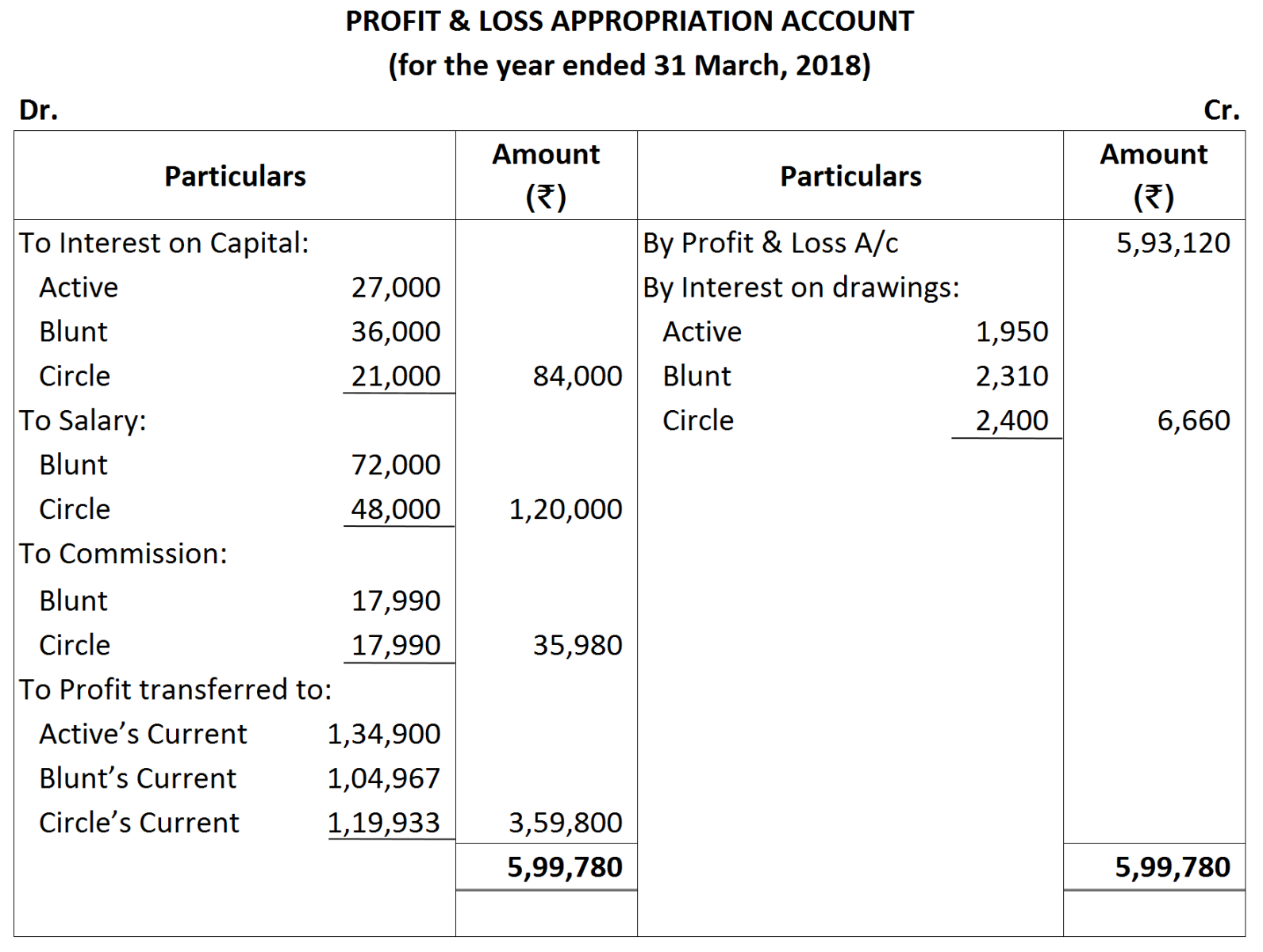
Active, Blunt and Circle started a business on: 1st April, 2017 with capitals of ₹ 4,50,000, ₹ 6,00,000 and ₹ 3,50,000 espectively According to partnership agreement:
- Profit earned in any year will be distributed as under
Upto ₹ 2, 70,000 equally
Excess over ₹ 2, 70,000 one-half to Active, one-sixth to Blunt and one-third to Circle
- Provide interest oncapital and drawing @ 6% p.a
- Circle is entitled to get' a monthlysalary of ₹ 4,000d Blunt is entitled to get a monthly salary of, 6,000. In addition to above. Circle and blunt are entitled to get a commission of 5% each on net profit after taking into consideration salary, intrest and all commissions.
Drawing of the partners during the year were:
- Active withdrew regularly ₹ 5,000 at the beginning of every month.
- Blunt withdrew regularly ₹ 7,000 at the end of every month.
- Circle withdrew ₹ 80,000 during the year.
The profit of the firm for the year ending 31st March, 2018 before charging all of the above adjustments was ₹ 5,93,120.
Distribute the profit among the partners and prepare partners Current A/cs.
Answer
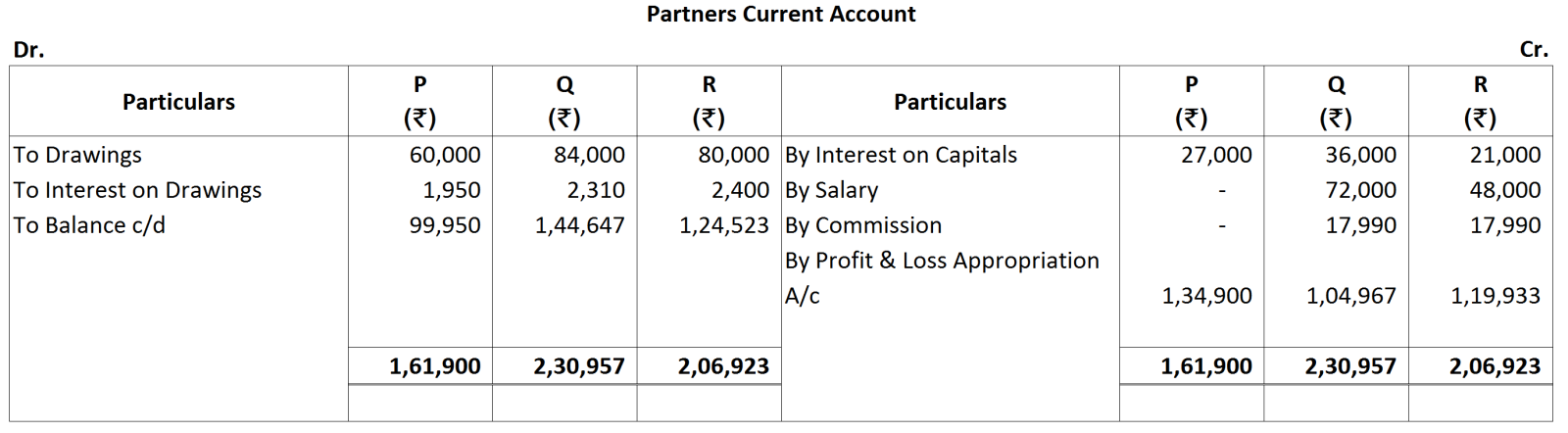 Working Note:
Balance of Profit: ₹ 5,93,120 + 6,660 – 84,000 – 1,20,000 = ₹ 3,95,780
Commission to Blunt and Circle is 5% to each partner after charging such commission.
Hence, the commission will be $\frac{5}{110}$ to each partner
Commission to Blunt $=3,95,780\times\frac{5}{110}=₹\ 17,990$
Commission to Circle $=3,95,780\times\frac{5}{110}=₹\ 17,990$
Divisible Profit ₹ 3,95,780 – 17,990 – 17,990 = ₹ 3,59,800
|
|
Active
₹
|
Blunt
₹
|
Circle
₹
|
|
Upto ₹ 2,70,000
|
90,000
|
90,000
|
90,000
|
|
Equally ₹ 3,59,800 – 2,70,000 = ₹ 89,800
|
|
|
|
|
in $\frac{1}{2}:\frac{1}{6}:\frac{1}{3}$
|
44,900
|
14,967
|
29,933
|
|
|
|
|
|
|
|
1,34,900
|
1,04,967
|
1,19,933
|
View full question & answer→Question 256 Marks
Lata and Mamta a repartners with capitals of ₹ 3,00,000 and ₹ 2,00,000 respectively sharing profits as Lata 70% and Mamta 30%. During the year ended 31st March 2016 they earned a profit of ₹ 26,440 before allowing interest on loan. The teams of partnership are as follows:
-
Interest on Capital is to be allowed @ 7% p.a.
-
Lata to get a salary Of ₹ 2,500 per month.
-
Interest on Manita's Loan account of ₹ 80,000 for the whole year.
-
Interest on drawings of partners at 8% per annum. Drawings being Lata ₹ 36,000 and Mamta ₹ 48,000.
-
$\frac{1}{10}\text{th}$ of the distributable profit should be transferred to General Reserve.
Prepare the Profit and Loss Appropriation Account.
Hints:
-
Interest on Loan will be calculated at 6% p.a.
-
Interest on Drawings will be calculated for an average period of 6 months.
-
Transfer to General Reserve will be 10% of net profit, i.e., 10% of 1,60,000 = ₹ 16, 000.
View full question & answer→Question 266 Marks
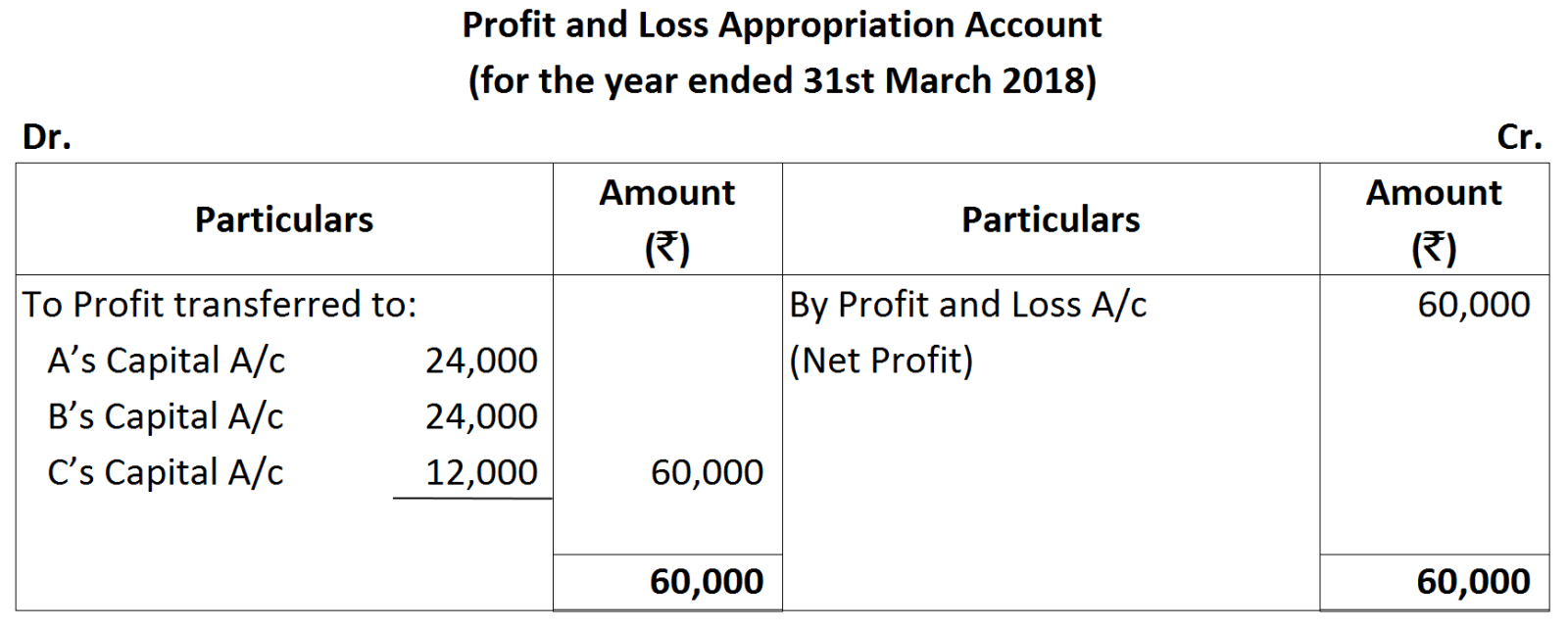
A, B and C are partners in a firm. Their profit-sharing ratio is 2 : 2 : 1. C is guaranteed a minimum amount of ₹ 10,000 as share of profit every year. Any deficiency arising on that amount shall be met by B. The profits for the two years ended 31st March, 2017 and 2018 were ₹ 40,000 and ₹ 60,000 respectively.
Prepare Profit and Loss Appropriation Account for the two years.
Answer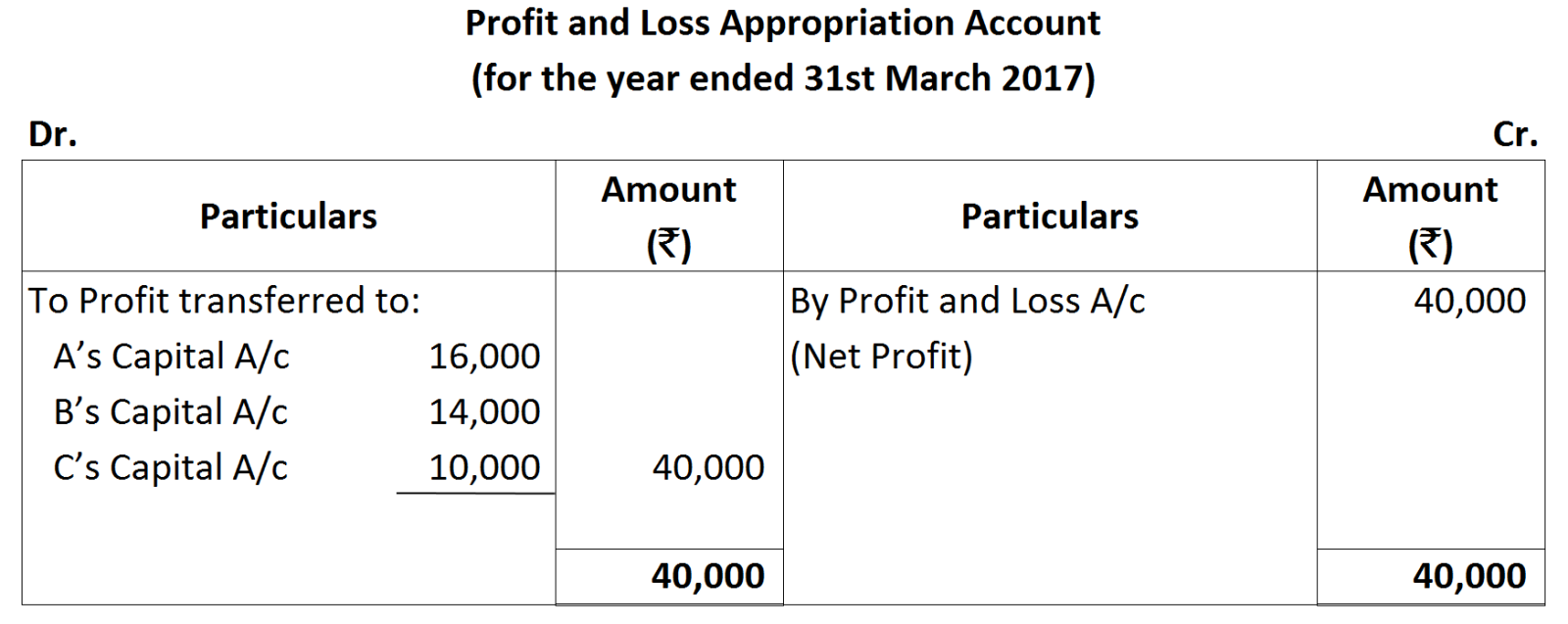
Working Notes:
WN1: Distribution of Profit for the year 2016-17
Profit for 2015 = ₹ 40,000
Profit sharing ratio = 2 : 2 : 1
C is given a guarantee of minimum profit of ₹ 10,000
A's Profit Share $=40,000\times\frac{2}{5}=₹\ 16,000$
B's Profit Share $=40,000\times\frac{2}{5}=₹\ 16,000$
C's Profit Share $=40,000\times\frac{1}{5}=₹\ 8,000$
Deficiency in C’s Profit Share = 10,000 − 8,000 = ₹ 2,000
This deficiency is to be borne by B.
Therefore,
Final Profit Share of A = 16,000
Final Profit Share of B = 16,000 − 2,000 = ₹ 14,000
Final Profit Share of C = 8,000 + 2,000 = ₹ 10,000
WN2: Distribution of Profit for the year 2017-18
Profit for 2016 = ₹ 60,000
Profit sharing ratio = 2 : 2 : 1
C is given a guarantee of minimum profit of ₹ 10,000
A's Profit Share $=60,000\times\frac{2}{5}=₹\ 24,000$
B's Profit Share $=60,000\times\frac{2}{5}=₹\ 24,000$
C's Profit Share $=60,000\times\frac{1}{5}=₹\ 12,000$ View full question & answer→Question 276 Marks
P and Q are partners sharing profits and losses in the ratio 60 : 40. On 1st April, 2014, their capitals were P ₹ 5,00,000 and Q ₹ 3,00,000. During the year ended 31st March, 2015, they earned a net profit of ₹ 7,60,000. The terms of partnership are:
-
Interest on the capital is to be charged @ 8% p.a.
-
P will get commisson @ 3% on turnover.
-
Q will get a salary of ₹ 5,000 per month.
-
Q will get commission of 5% on profits after deduction of interest, salary and commission (including his own commision).
-
P is entitled to a rent of ₹ 20,000 per month for the use of his premises by the firm.
Partner's drawings for the year were : P ₹ 40, 000 and Q ₹ 30, 000. Turnover for-the year was ₹ 20, 000. After considering the above factors, you are required to prepare the Profit and less Appropriation Account for the partners.
Hints:
-
Net Profit Credited to P & L Appropriation A/c : ₹ 1,60,000 Rent ₹ 2,40,000 = ₹ 5, 20, 000.
-
Q's commission $\frac{5}{105}$ of ₹ 3, 36, 000.
-
Rent will be credited to Rent Payable Account.
Answer
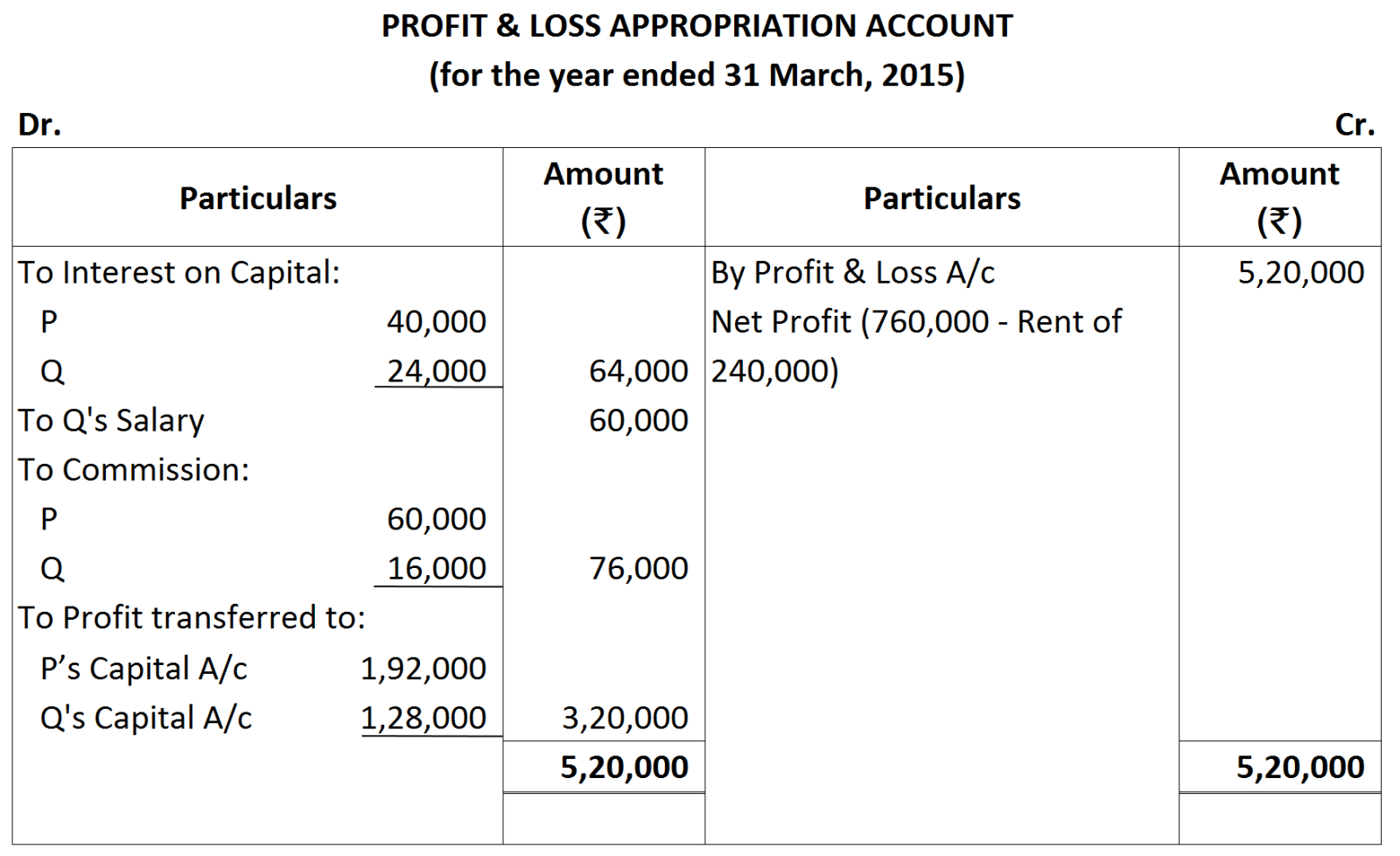
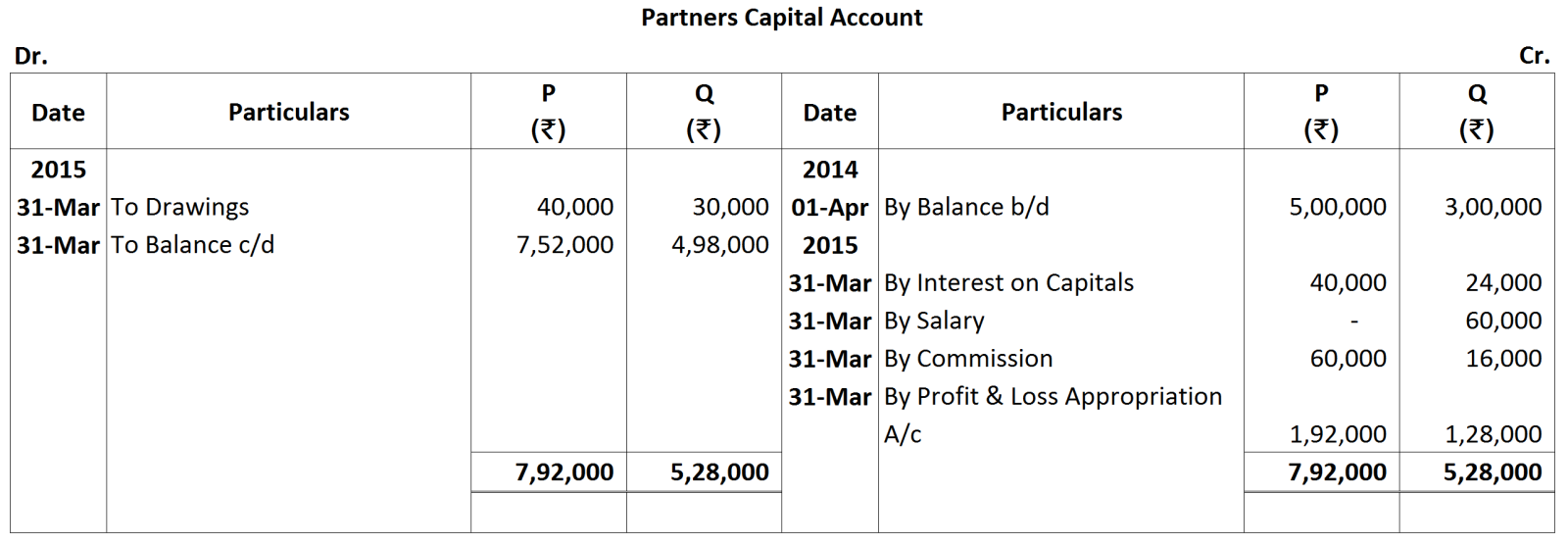 Note:
Note: Interest on Loan is not recorded in the Current Account.
View full question & answer→Question 286 Marks
L, M and N are partners in a firm sharing profits & losses in the ratio of 2 : 3 : 5. On April 1, 2016 their fixed capitals were ₹ 2,00,000, ₹ 3,00,000 and ₹ 4,00,000 respectively. Their partnership deed provided for the following:
-
Interest on capital @ 9% per annum.
-
Interest on Drawings @ 12% per annum.
- Interest on partner's loan @ 12% per annum.
On July 1, 2016, L brought ₹ 1,00,000 as additional capital and N withdrew ₹ 1,00,000 from his capital. During the year L, M and N with drew ₹ 12,000, ₹ 18,000 and ₹ 24,000 respectively for their personal use. On January 1, 2017 the firm obtained a Loan of ₹ 1,50,00 from M. The Net profit of the firm for the year ended March 31, 2017 after charging interest on Ms Loan was ₹ 85,000. Prepare Profit & Loss Appropriation Account and Partner's Capital Accounts.
Hints:
-
Interest on drawings will be charged for an average period of six months.
-
There will be no entry of interest on.M's Loan because net profit given in the question is after charging interest on M's Loan.
Question 296 Marks
Answer
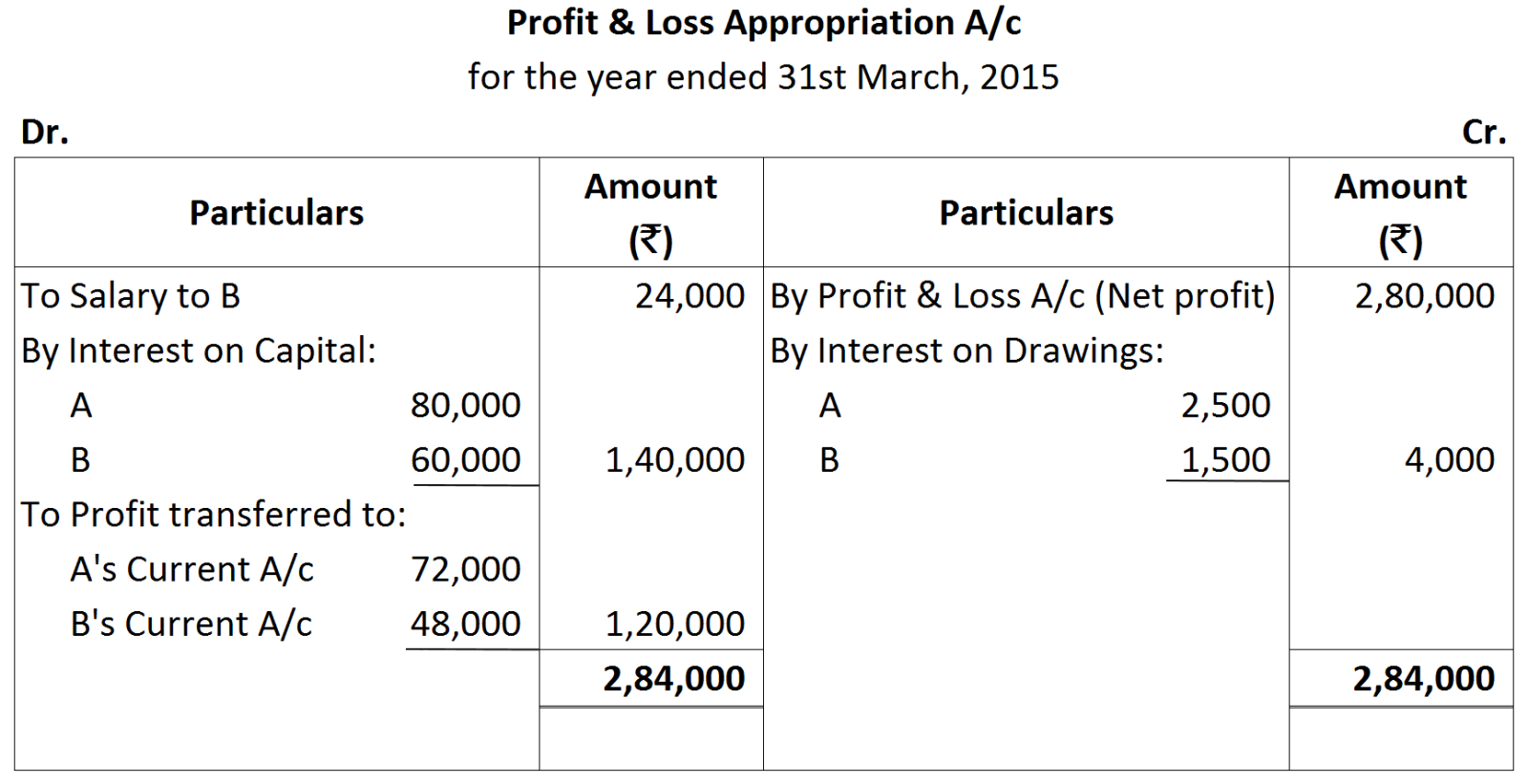

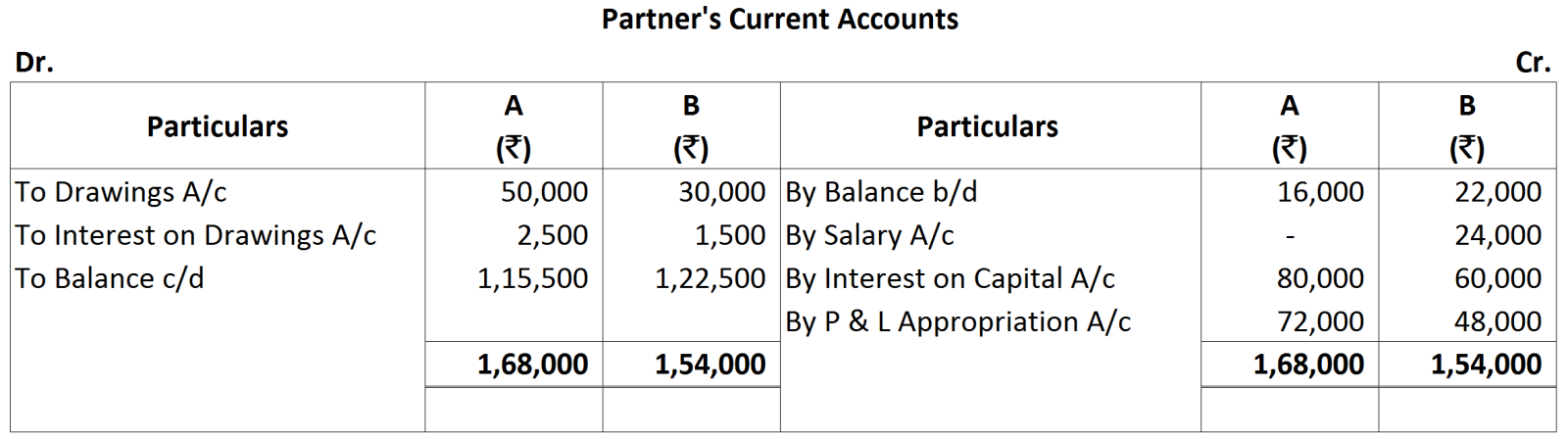 Working Notes:
$\text{A}^{,}\text{s}\ \text{Capital}=80,000\times\frac{100}{10}=₹\ 8,00,000$
$\text{B}^{,}\text{s}\ \text{Capital}=60,000\times\frac{100}{10}=₹\ 6,00,000$
Interest on Drawings must have been charged for an average period of six months.
Hence, $\text{A}^{,}\text{s}\ \text{Drawings}=2,500\times\frac{100}{10}=₹\ 50,000$
$\text{B}^{,}\text{s}\ \text{Drawings}=1,500\times\frac{12}{6}=₹\ 30,000$ View full question & answer→Question 306 Marks
View full question & answer→Question 316 Marks
Rakhi and Shikha are partners in a firm, with capitals of ₹ 2,00,000 and ₹ 3,00,000 respectively. The profit of the firm, for the year ended 2016-17 is ₹ 23,200. As per the Partnership agreement, they share the profit in their capital ratio, after allowing a salary of ₹ 5,000 per month to Shikha and interest on Partner’s capital at the rate of 10% p.a. During the year Rakhi withdrew ₹ 7,000 and Shikha ₹ 10,000 for their personal use.
You are required to prepare Profit and Loss Appropriation Account and Partner’s Capital Accounts.
Question 326 Marks
A and B are in partnership sharing profits and losses in the ratio of 3 : 2. They decided to admit C, their Manager, as a partner with effect from 1st April, 2017, giving him $\frac{1}{4}\text{th}$ share of profits. C, while a Manager, was in receipt of a salary of ₹ 27,000 p.a. and a commission of 10% of the net profits after charging such salary and commission.
In terms of the Partnership Deed, and excess amount, which C will be entitled to receive as a partner over the amount which would have been due to him if he continued to be the manager, would have to be personally borne by A out of his share of profit. Profit for the year ended 31st March, 2018 amounted to ₹ 2,25,000. You are required to show Profit and Loss Appropriation Account for the year ended 31at March, 2018.
Answer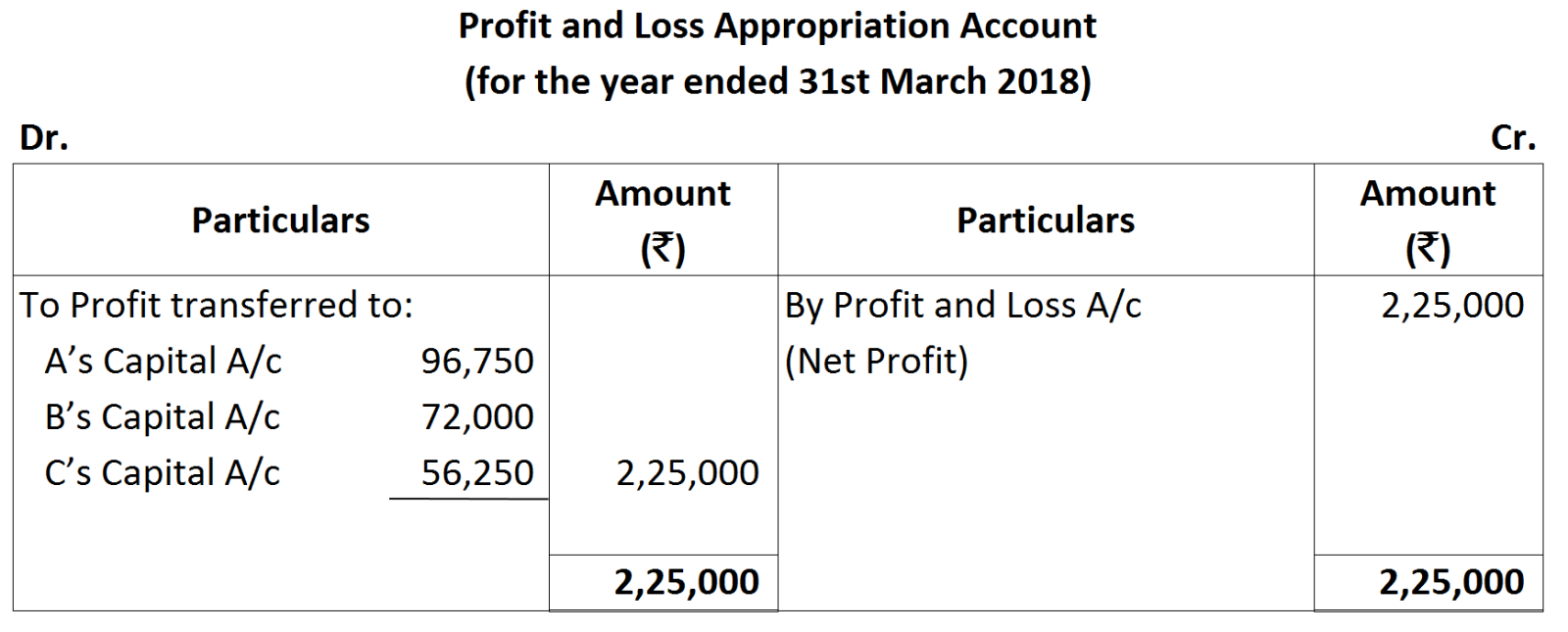 Working Notes:
WN1: Calculation of Remuneration to C as a Manager
Salary to C = ₹ 27,000
Commission to C = 10% of Net Profit after Salary and Commission
Net Profit after Salary and Commission = 2,25,000 − 27,000 = ₹ 1,98,000
$\therefore \text{Commission to C}=1,98,000\times\frac{10}{110}=₹\ 18,000$
C’s remuneration as Manager = Salary + Commission = 27,000 + 18,000 = ₹ 45,000
WN2: Calculation of Profit Share of C as a Partner
Profit = ₹ 2,25,000
C's Profit Share $=2,25,000\times\frac{1}{4}=₹\ 56,250$
Part of C’s Profit Share to be borne by A = 56,250 − 45,000 = ₹ 11,250
Profit available for distribution between A and B = 2,25,000 − 45,000 = ₹ 1,80,000
A's Share of Profit $=1,80,000\times\frac{3}{5}=₹\ 1,08,000$
B's Share of Profit $=1,80,000\times\frac{2}{5}=₹\ 72,000$
A’s Profit share after adjusting C’s deficiency = 1,08,000 − 11,250 = ₹ 96,750 View full question & answer→Question 336 Marks
P, Q and R were partners and the balance of their capital accounts on 1st April 2015 were ₹ 5,00,000 (Credit) 5,00,000 (Credit) and ₹ 20,000 (Debit) respectively As per the terrns of partnership agreement--interest on capitals is to be allowed @ 10% p.a. and is to be charged on drawings @ 12% p.a. Partners withdrew as follows:
- P withdrew ₹ 10,000 p.m. at the end of each month;
- Q withdrew ₹ 1,20,000 out of capital onlst January 2016;
- R withdrew ₹ 1,20,000 during the year.
The profit for the year ended 31st March, 2016.amounted to ₹ 4,30,000.
You are required to prepare journal entries and partner's capital accounts.
Answer
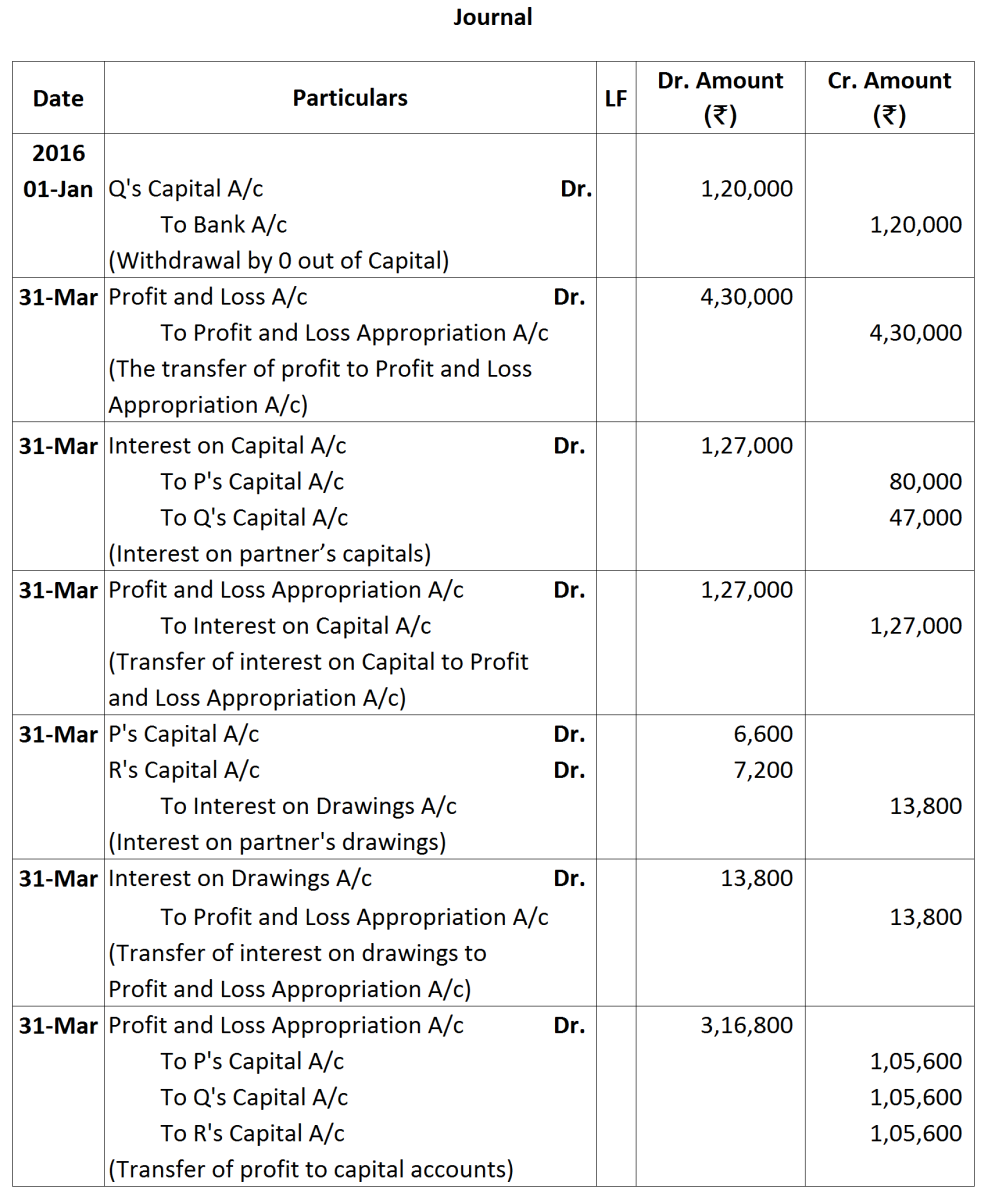
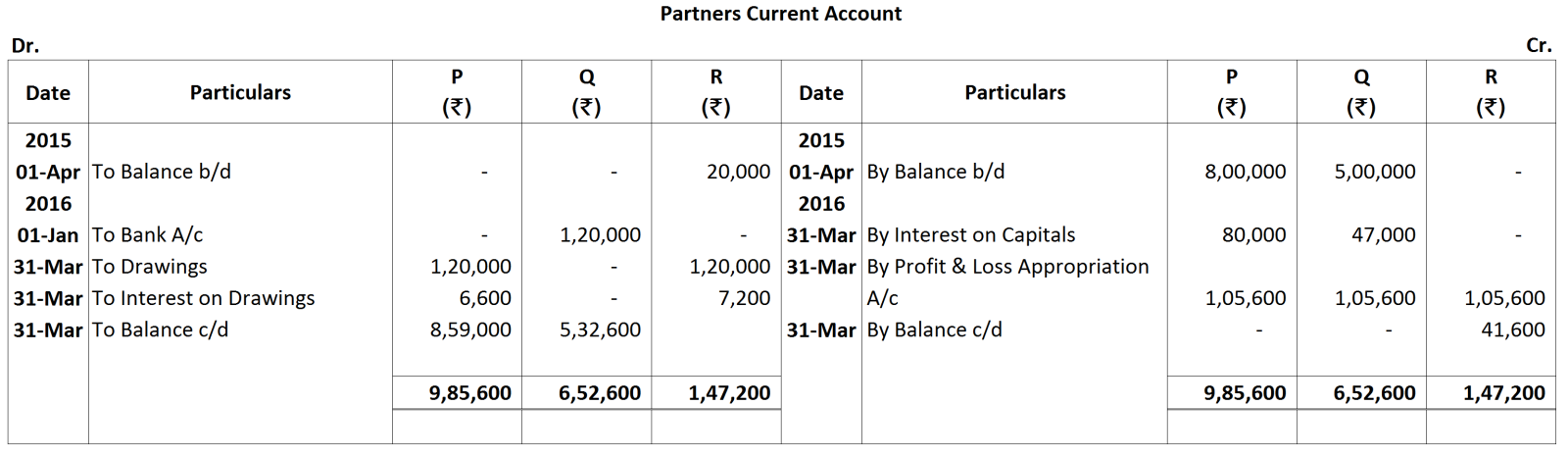 Working Notes:
-
|
Interest on Q's Capital
|
₹
|
|
On ₹ 5,00,000 for 9 months: $5,00,000 \times\frac{10}{100}\times\frac{ 9}{12}$
|
37,500
|
|
On ₹ 3,80,000 for 3 months $3,80,000 \times\frac{10}{100}\times\frac{ 3}{12}$
|
9,500
|
|
|
$\underline{\overline{47,000}}$
|
-
|
Interest on drawings
|
|
₹
|
|
P's Drawings $₹\ 10,000\times 12 = ₹\ 1,20,000 \times\frac{12}{100}\times\frac{5.5}{12}$
|
=
|
6,600
|
|
R's Drawings $₹\ 1,20,000\times\frac{12}{100}\times\frac{6}{12}$
|
=
|
$\underline{7,200}$
|
Note: In the absence of actual dates of drawings of interest thereon has been calculated for the average period i.e. 6 months.
- Divisible Profit = ₹ 4,30,000 – Interest on Capital ₹ 1,27,000 + Interest on Drawings ₹ 13,800 = ₹ 3,16,800
Each Partner’s share = ₹ 3,16,800 ÷ 3 = ₹ 1,05,600 View full question & answer→Question 346 Marks
Kavita and Leela are partners with capitals of ₹ 6,00,000 and ₹ 4,00,000 and sharing profits & losses in the ratio of 2 : 1. Their partnership deed provides that interest on capitals shall be provided @ 8% p.a. and it is to be treated as a charge against profits. Prepare relevant account to allocate the profit in the following altemative cases.
- If profit for the year is ₹ 1, 10,000.
- If profit for the year is ₹ 35,000.
- If loss for the year is ₹ 10,000.
Question 356 Marks
X and Y are partners in a firm sharing profits in the ratio of 3 : 2. They have a manager, Z, who gets ₹ 10,000 p.m. salary plus commission of 5% of the profit after charging his salary and commission, Now, they decide to admit Z as a partner, giving him $\frac{1}{5}\text{th}$ share in the profits of the firm. Any excess amount which Z receives as a partner (over his salary and commission) will be borne by X. The profit for the year ended 31st March, 2018 amounted to ₹ 8,40,000 after charging Z's salary. Prepare Profit and Loss Appropriation Account showing the division of profit for the year.
Answer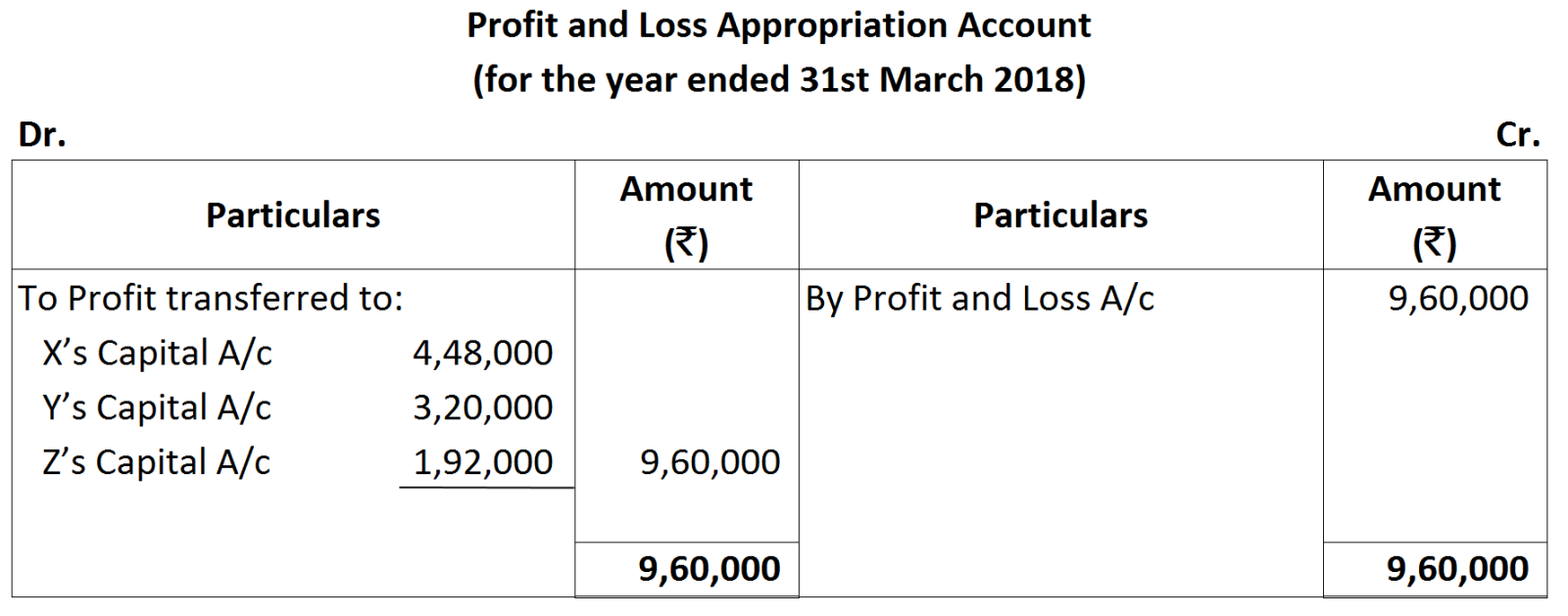
Working Notes:
WN1: Calculation of Remuneration to Z as a Manager.
Salary to Z = ₹ 1,20,000
Commission to Z = 5% of Net Profit after Salary and Commission
Net Profit after Salary and Commission = 8,40,000
Commission to Z $=8,40,000\times\frac{5}{105}=₹\ 40,000$
Z’s remuneration as Manager = Salary + Commission = 1,20,000 + 40,000 = ₹ 1,60,000
WN2: Calculation of Profit Share of Z as a Partner
Profit = ₹ 9,60,000
Z's Profit Share $=9,60,000\times\frac{1}{5}=₹\ 1,92,000$
Part of Z’s Profit Share to be borne by X = 1,92,000 − 1,60,000 = ₹ 32,000
Profit available for distribution between X and Y = 9,60,000 − 1,60,000 = ₹ 8,00,000
X's Share of Profit $=8,00,000\times\frac{3}{5}=₹\ 4,80,000$
Y's Share of Profit $=8,00,000\times\frac{2}{5}=₹\ 3,20,000$
X’s Profit share after adjusting Z’s deficiency = 4,80,000 − 32,000 = ₹ 4,48,000 View full question & answer→Question 366 Marks
Asgar, Chaman and Dholu are partners in a firm. Their Capital Accounts stood at ₹ 6,00,000; ₹ 5,00,000 and ₹ 4,00,000 respectively on 1st April, 2017. They shared Profits and Losses in the proportion of 4 : 2 : 3. Partners are entitled to interest on capital @ 8% per annum and salary to Chaman and Dholu @ ₹ 7,000 per month and ₹ 10,000 per quarter respectively as per the provision of the Partnership Deed. Dholu's share of profit (excluding interest on capital but including salary) is guaranteed at a minimum of ₹ 1,10,000 p.a. Any deficiency arising on that account shall be met by Asgar. The profit for the year ended 31st March, 2018 amounted to ₹ 4,24,000.
Prepare Profit and Loss Appropriation Account for the year ended 31st March, 2018.
Answer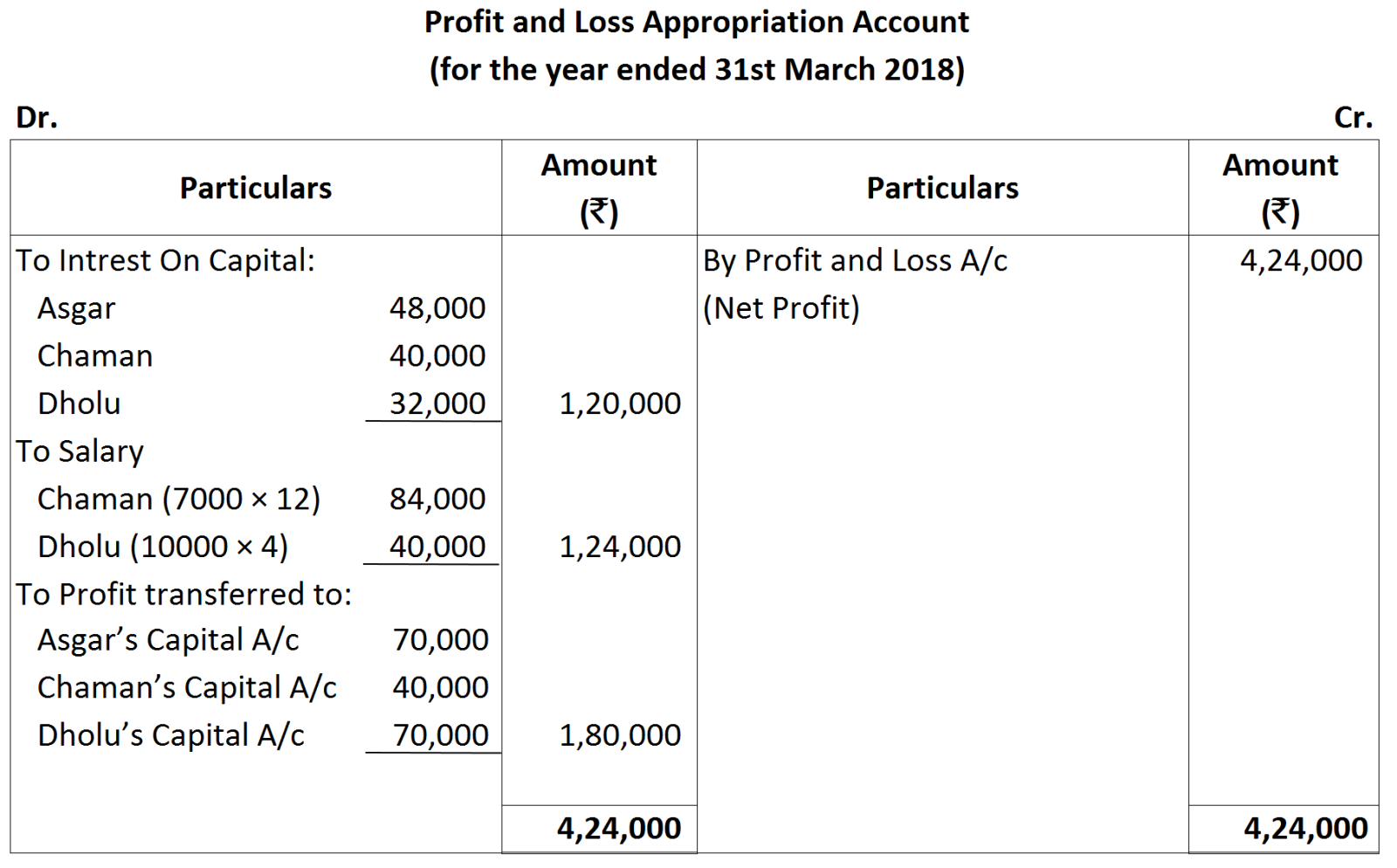 Working Notes:
Profit available for distribution = 4,24,000 – (1,20,000 + 84,000 + 40,000) = ₹ 1,80,000
Profit sharing ratio = 4 : 2 : 3
Asgar's Profit Share $=1,80,000\times\frac{2}{9}₹\ 80,000$
Chaman's Profit Share $1,80,000\times\frac{2}{9}=₹\ 40,000$
Dholu's Profit Share $=1,80,000\times\frac{2}{9}=₹\ 60,000$
Dholu’s Minimum Guaranteed Profit = ₹ 1,10,000 (excluding interest on capital, but including salary)
Dholu’s Minimum Guaranteed Profit (excluding salary) = 1,10,000 – 40,000 = ₹ 70,000
But, Dholu’s Actual Profit Share = ₹ 60,000
Deficiency in Dholu’s Profit Share = 70,000 - 60,000 = ₹ 10,000
This deficiency is to be borne by Asgar alone.
Therefore,
Asgar’s New Profit Share = 80,000 - 10,000 = ₹ 70,000 View full question & answer→Question 376 Marks
Simmi and Sonu are partners in a firm, sharing profits and losses in the ratio of 3 : 1. The profit and loss account of the firm for the year ending March 31, 2017 shows a net profit of ₹ 1,50,000. Prepare the Profit and Loss Appropriation Account by taking into consideration the following information:
- Partners capital on April 1, 2016;
Simmi, ₹ 30,000; Sonu, ₹ 60,000;
- Current accounts balances on April 1, 2016; Simmi, ₹ 30,000 (cr.); Sonu, ₹ 15,000 (cr.);
- Partners drawings during the year amounted to Simmi, ₹ 20,000; Sonu, ₹ 15,000;
- Interest on capital was allowed @ 5% p.a.;
- Interest on drawing was to be charged @ 6% p.a. at an average of six months;
- Partners’ salaries: Simmi ₹ 12,000 and Sonu ₹ 9,000. Also show the partners’ current accounts.
Question 386 Marks
Illustrate how interest on drawings will be calculated under various situations.
AnswerWhen a partner withdraws any amount, either in cash or in any other form, from the firm for his/ her personal use, then it is termed as drawings. The interest charged by the firm on the amount of drawings is termed as interest on drawings. The method of calculating interest on drawings depends on the information available for time and frequency of the drawings made by the partner. The following different situations of drawings made illustrate the calculation of interest charged on drawings. Situation I: When all the information regarding amount, date and rate of interest on drawings is given When a partner withdrew ₹ 10,000 on July 01 and interest on drawings is charged at 12% pa and the firm closed its books on December 31 every year then interest on drawings amount to Rs 600. Interest on drawing $=\text{Total Amount Drawn}\times\frac{\text{Rate of Interest}}{100}\times\frac{\text{Period}}{12}$ Interest on drawings $=10000\times\frac{12}{100}\times\frac{6}{12}=₹\ 600$ Situation II: When information regarding amount, rate of interest on drawings is given:Case I Sometimes amount and rate of interest on drawings (per annum) is given but date is not mentioned in this case when the details regarding the amount of drawings and rate of interest on drawings (pa) is given but the date of drawings is not given then interest will be charged on average basis and the period of drawings will be taken as 6 months,
Interest on drawings $=10,000\times\frac{12}{100}\times\frac{6}{12}=₹\ 600$
Case II Sometimes the amount and rate of is interest on drawings is given but the date and per anum rate of interest is not mentioned.
In this case when the date and the rate of interest aim given but per annum is not specified, then annual interest is charged.
e.g., if a partner withdraws ₹ 10 000 and interest rate is 12%, then the interest on drawings amounts to ₹ 12, 000.
Interest on drawing $=\text{Total Amount withdraw}\times\frac{\text{Rate}}{100}$
Interest on drawings $=10000\times\frac{12}{100}=₹\ 1,200$
Situation III: When a fixed amount is withdrawn at regular intervalCase I Sometimes a fixed amount is withdrawn at the beginning of each month and the rate of interest is given then the interest is calculated for 6-5 months.
e.g. If a partner withdraws ₹ 1,000 in the beginning of every month and the rate of interest is 12% pa, then the interest on drawings amount to Rs 780.
Interest on drawings $=12,000\times\frac{12}{100}\times\frac{65}{12}=₹\ 780$
Total amount of drawings = (1,000 × 12) = ₹ 12,000
Case II Sometimes a fixed amount is withdrawn at the end of each month and the rate of interest is given then the interest is calculated for 5.5 months.
e.g..if a partner withdraws ₹ 1.000 at the end of each month arid rate of interest is 12% pa then the interest on drawings amount to ₹ 660.
Interest on drawings $=\text{Total amount of drawings}\times\frac{\text{Rate}}{100}\times\frac{5.5}{12}$
Interest on drawings $=12,000\times\frac{12}{100}\times\frac{5.5}{12}=₹\ 660$
Case III Sometimes a fixed amount is withdrawn at the mid of each month and the rate of interest is given then the interest is calculated for 6 months.
e g. if a partner.withdraws ₹ 1,000 on 15th of every month and the rate of in’crest is 12% pa then the interest on drawings amount to ₹ 720.
Interest on drawings $=\text{Total amount of drawings}\times\frac{\text{Rate}}{100}\times\frac{6}{12}$
Interest on drawings $=12,000\times\frac{12}{100}\times\frac{6}{12}=₹\ 720$
Case IV If a fixed amount is withdrawn in the beginning of every quarter then the interest is calculated for 7.5 months.
e.g. If a partner withdraws ₹ 5,000 in the beginning of every quarter and the rate of interest is 12% pa then the interest on drawings amount to ₹ 1,800.
Interest on drawings $=\text{Total amount of drawings}\times\frac{\text{Rate}}{100}\times\frac{7.5}{12}$
Interest on drawings $=20,000\times\frac{12}{100}\times\frac{7.5}{12}=₹\ 1,800$
Total amount of drawings = 5000 × 4 = ₹ 20,000
Case V If a fixed amount is withdrawn at the end of every quarter, then the interest is calculated for 4.5 months.
e.g., If a partner withdraws ₹ 5,000 at the end of every quarter and the rate of interest is 12% pa then the interest on drawings amounts to ₹ 900.
Interest on drawings $=\text{Total amount of drawings}\times\frac{\text{Rate}}{100}\times\frac{4.5}{12}$
Interest on drawings $=20,000\times\frac{12}{100}\times\frac{4.5}{12}=₹\ 900$
Total amount of drawings = 5000 × 4 = ₹ 20,000
Situation IV: When different amount is at different intervals
When different amount is withdrawn by a partner at different dates then the interest is calculated by product method. The period of drawings is calculated from the date of withdrawal to the last date of the accounting year,
e.g., A partner withdraws? 6,000 on March 01, ₹ 4,000 on June 01, ₹ 5,000 on Aug 30 and ₹ 2,000 on Nov 30 and the rate of interest on drawings is 12% pa. The firm closes its book on December 31.
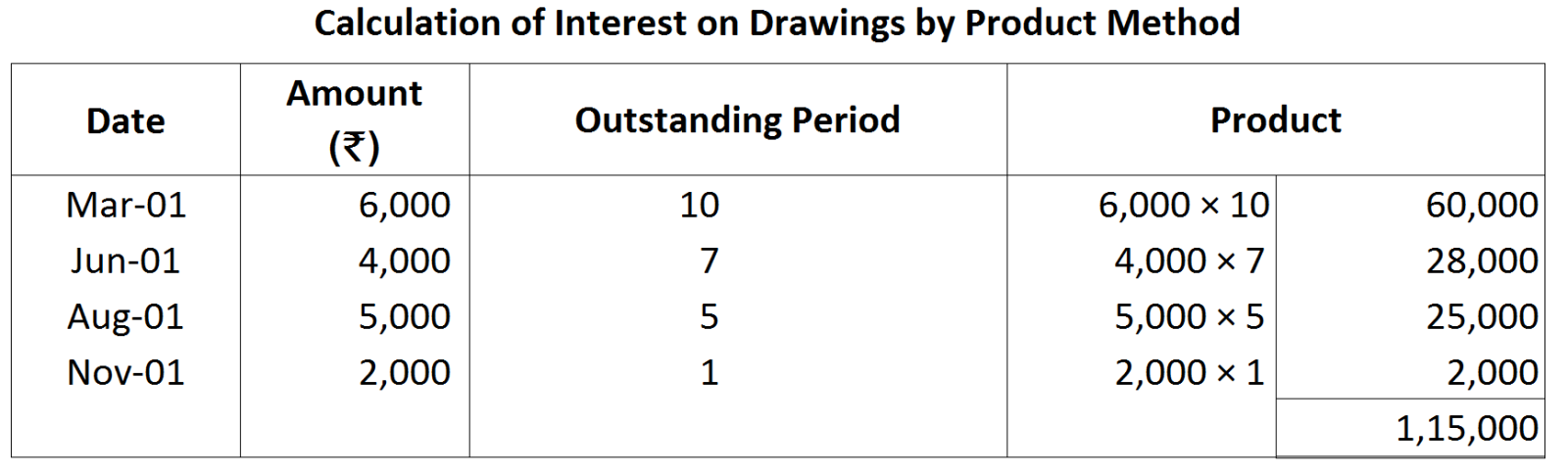
Interest on drawings $=\text{Sum of product}\times\frac{\text{Rate}}{100}\times\frac{1}{2}$ Interest on drawings $=1,15,000\times\frac{12}{100}\times\frac{1}{12}=₹\ 1,150$ View full question & answer→Question 396 Marks
Ankur and Bobby were into the business of providing software solutions in India. They were sharing profits and losses in the ratio 3 : 2. They admitted Rohit for a $\frac{1}{5}$ share in the firm. Rohit, an alumni or IIT, Chennai would help them to expand their business to various South African countries where he had been working earlier. Rohit is guaranteed a minimum profit of ₹ 2,00,000 for the year. Any deficiency in Rohit's share is to be borne by Ankur and Bobby in the ratio 4 : 1. Loss for the year was ₹ 10,00,000. Pass the necessary Journal entries.
Answer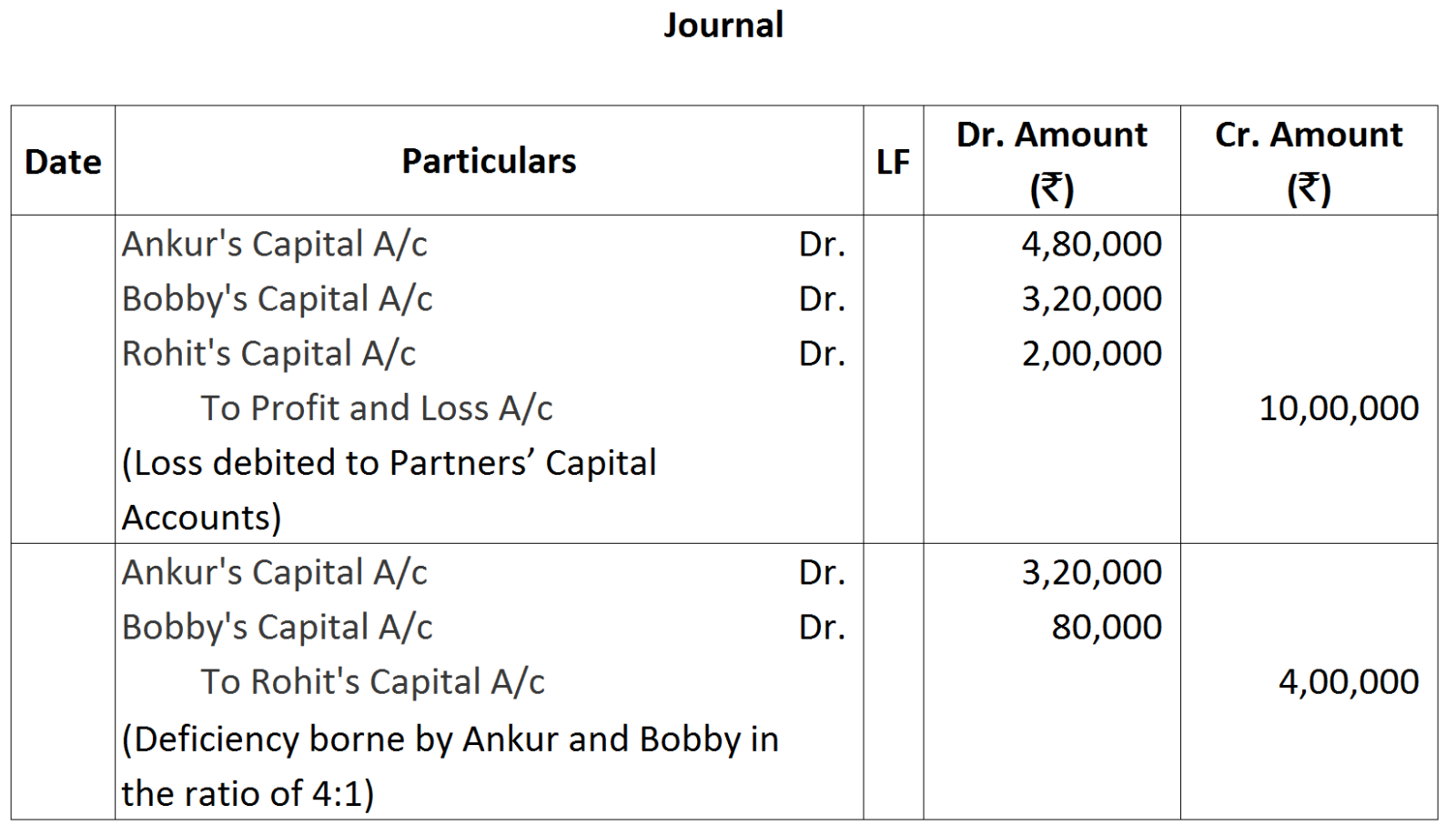 Working Notes:
WN1: Calculation of New Ratio.
Rohit's Share $=\frac{1}{5}$
Let total share $=1$
Remaining Share $=1-\frac{1}{5}=\frac{4}{5}$
Ankur's New Share $=\frac{4}{5}\times\frac{3}{5}=\frac{12}{25}$
Bobby's New Share $=\frac{4}{5}\times\frac{2}{5}=\frac{8}{25}$
New Ratio $=12:8:5$
WN2: Calculation of Share of Loss.
Ankur's Share of Loss $=10,00,000\times\frac{12}{25}=₹\ 4,80,000$
Bobby's Share of Loss $=10,00,000\times\frac{8}{25}=₹\ 3,20,000$
Rohit's Share of Loss $=10,00,000\times\frac{5}{25}=₹\ 2,00,000$
WN3: Calculation of Deficiency
Amount payable to Rohit = Guaranteed Profit Amount + Loss transferred to Rohit’s Capital A/c
Amount payable to Rohit = 2,00,000 + 2,00,000 = ₹ 4,00,000
Deficiency is to be borne by Ankur and Bobby in the ratio of 4 : 1
Deficiency to be borne by Ankur $=4,00,000\times\frac{4}{5}=₹\ 3,20,000$
Deficiency to be borne by Bobby $=4,00,000\times\frac{1}{5}=₹\ 80,000$ View full question & answer→Question 406 Marks
How will you deal with a change in profit sharing ratio among existing partners? Take imaginary figures to illustrate your answer?
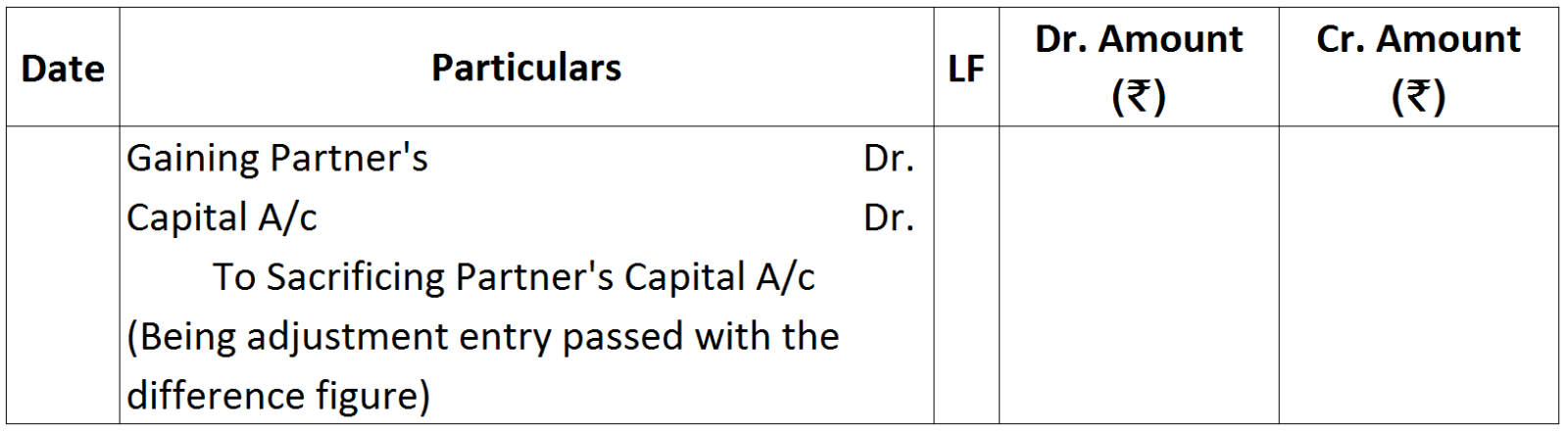
AnswerChange in the profit sharing ratio occurs only in case of the admission, retirement or death of a partner or sometimes due to the general agreement among the partners in which they may decide to change the profit sharing ratio. There may be number of issues that should be considered during the change in the profit sharing ratio such as goodwill, reserves and accumulated profits, profit or loss on the revaluation of assets and liabilities and adjustment of capital, etc. As far as the issue related to general reserve is concerned it is basically the accumulated profits (if any) and profit (or loss) on revaluation of assets and liabilities and should be distributed in the partner’s capital account in partners old profit sharing ratio. Sometimes the existing partners may decide to change the profit sharing ratio then some partners gain at the cost of other partners. In other words one partner gain and other one sacrifice equal to the gain. In that case the former should compensate the latter. Therefore, the gaining partner’s capital account’s are debited to the extent of their gain and sacrificing partner’s capital accounts are credited to the extent of their sacrifice. The following journal entry is passed:
 Example:
 Ram. Mohan and Shyam are partners in a firm sharing profit and loss in 3 : 2 : 1 ratio. They decide to share profit and loss equally in future. On dm: date, the books of the firm shows ₹ 2.40.000 as general reserve, profit on evaluation of Plant and Machinery ₹ 60.000. The following adjustment entry is passed through the capital accounts without affecting the books of accounts.
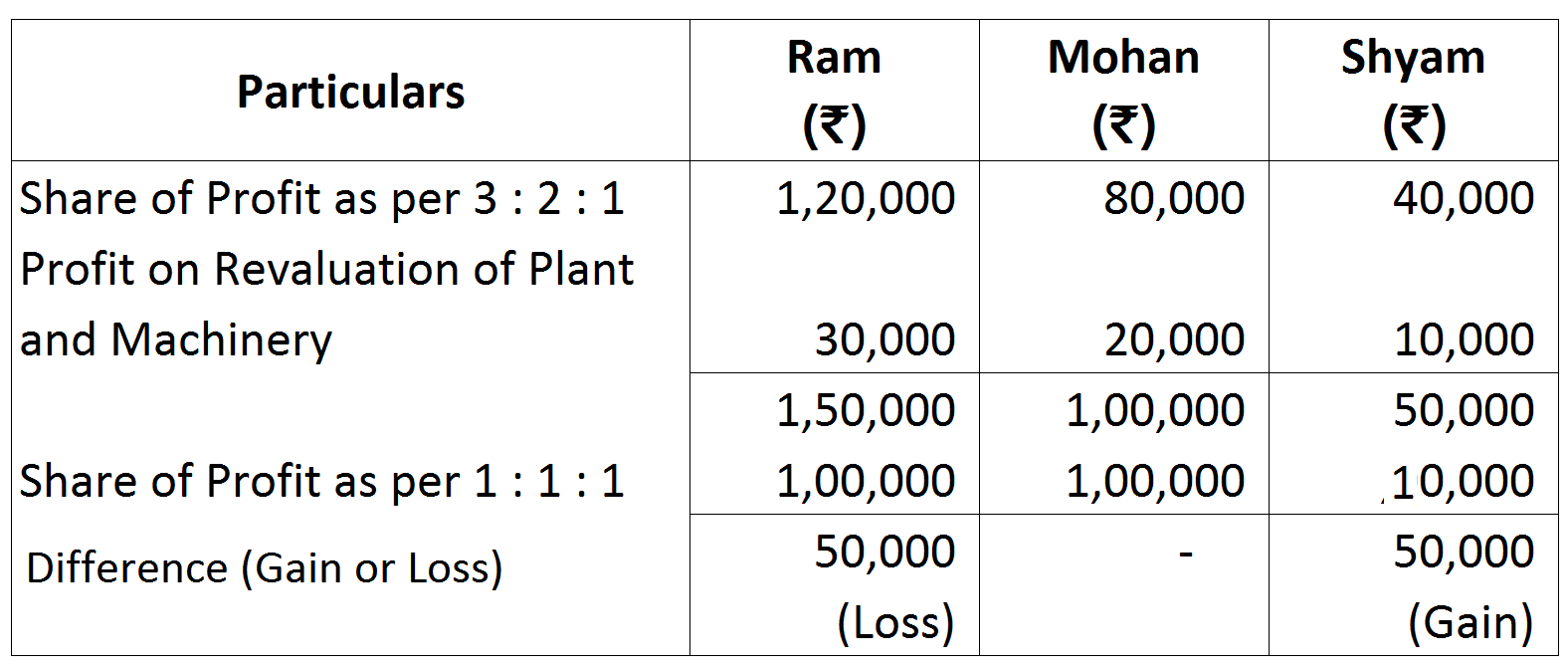
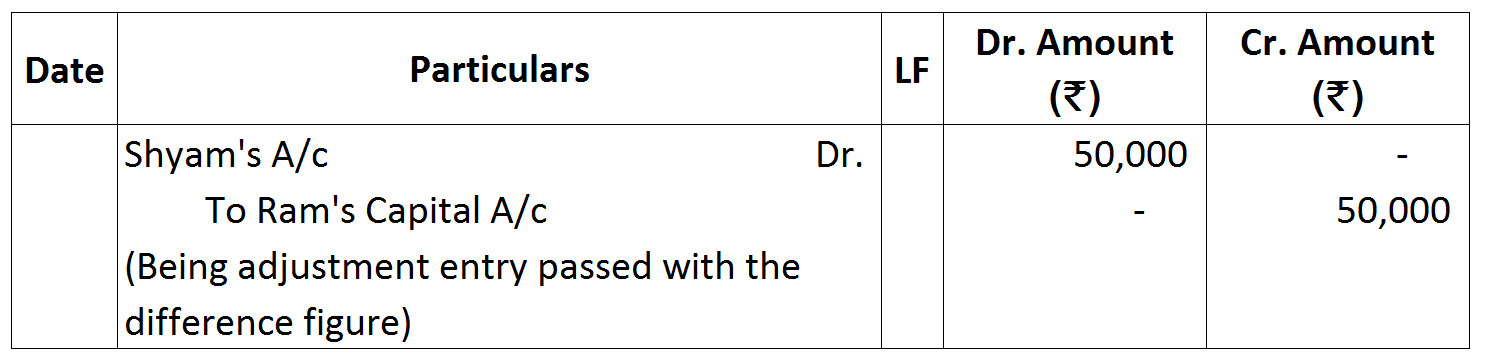
Hence, in the above example. Shyam gains at the cost of Ram. So the Ram needs to be compensated by Shyam with the amount of ₹ 50.000. The following adjustment entry is passed.
View full question & answer→Question 416 Marks
A and B are partners sharing profits in the ratio of 2 : 1. They decided to admit C, their manager, as a partner from 1st April, 2017, giving him $\frac{1}{5}\text{th}$ share of profit. C, while a manager, was getting a salary of ₹ 50,000 p.a. plus a commission of 10% of the net profit after charging such salary and commission. It was also agreed that any excess amount which C receives as a partner (over his salary and commission) will be borne by A.
Profit for the year ended 31st March, 2018 amounted to ₹ 6,44,000, before payment of salary and commission. Prepare Profit and Loss Appropriation Account.
Answer
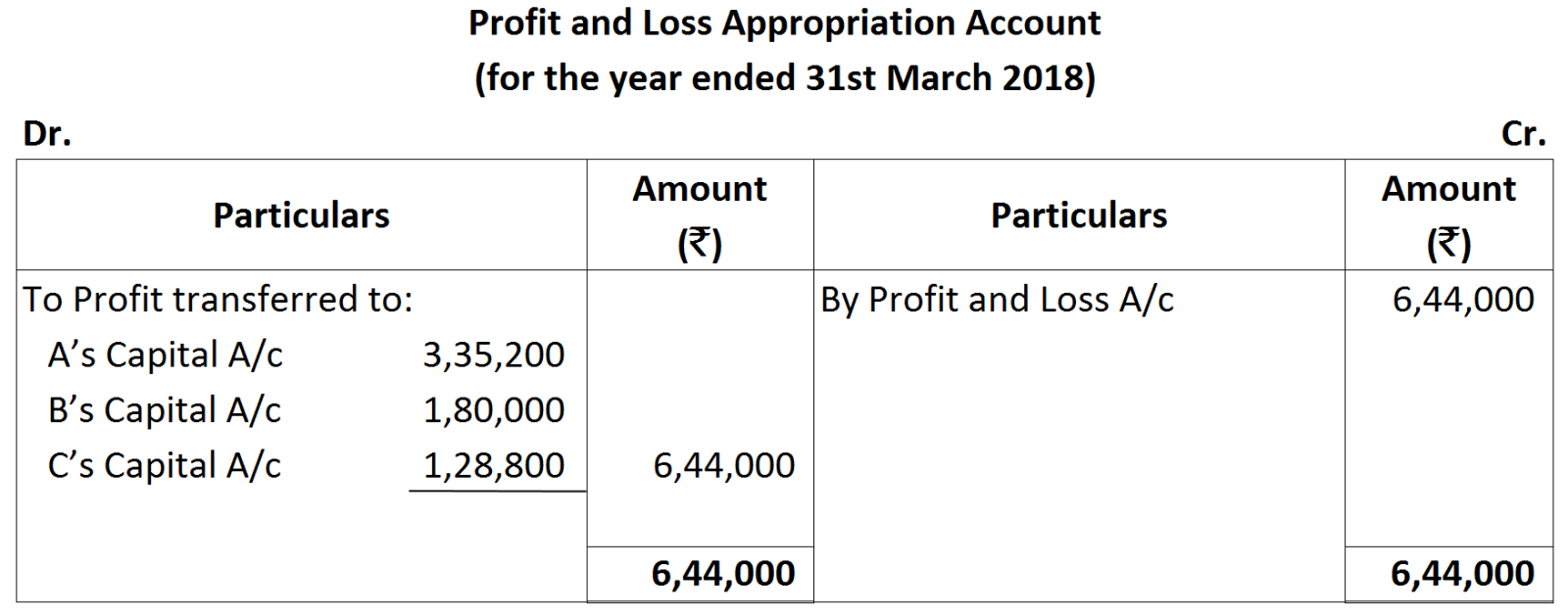 Working Notes:
WN1: Calculation of Remuneration to C as a Manager.
Salary to C = ₹ 50,000
Commission to C = 10% of Net Profit after Salary and Commission.
Net Profit after Salary and Commission = 6,44,000 - 50,000 = ₹ 5,94,000
Commission to C $=5,94,000\times\frac{10}{110}=₹\ 54,000$
C’s remuneration as Manager = Salary + Commission = 50,000 + 54,000 = ₹ 1,04,000
WN2: Calculation of Profit Share of C as a Partner.
Profit = ₹ 6,44,000
C's Profit Share $=6,44,000\times\frac{1}{5}=1,28,800$
Part of C’s Profit Share to be borne by A = 1,28,800 - 1,04,000 = ₹ 24,800
Profit available for distribution between A and B = 6,44,000 - 1,04,000 = ₹ 5,40,000
A's Share of Profit $=5,40,000\times\frac{2}{3}=3,60,000$
B's Share of Profit $=5,40,000\times\frac{1}{3}=1,80,000$
A’s Profit share after adjusting C’s deficiency = 3,60,000 - 24,800 = ₹ 3,35,200 View full question & answer→Question 426 Marks
Ankur, Bhavna and Disha are partners in a firm. On 1st April, 2017, the balance in their Capital Accounts stood at ₹ 14,00,000, ₹ 6,00,000 and ₹ 4,00,000 respectively. They shared profits in the proportion of 7 : 3 : 2 respectively. Partners are entitled to interest on capital @ 6% per annum and salary to Bhavna @ ₹ 50,000 p.a. and a commission of ₹ 3,000 per month to Disha as per the provisions of the partnership Deed.
Bhavna's share of profit (excluding interest on capital) is guaranteed at not less than ₹ 1,70,000 p.a. Disha's share of profit (including interest on capital but excluding commission) is guaranteed at not less than ₹ 1,50,000 p.a. Any deficiency arising on that account shall be met by Ankur. The profit of the firm for the year ended 31st March, 2018 amounted to ₹ 9,50,000.
Prepare 'Profit and Loss Appropriation Account' for the year ended 31st March, 2018.
Answer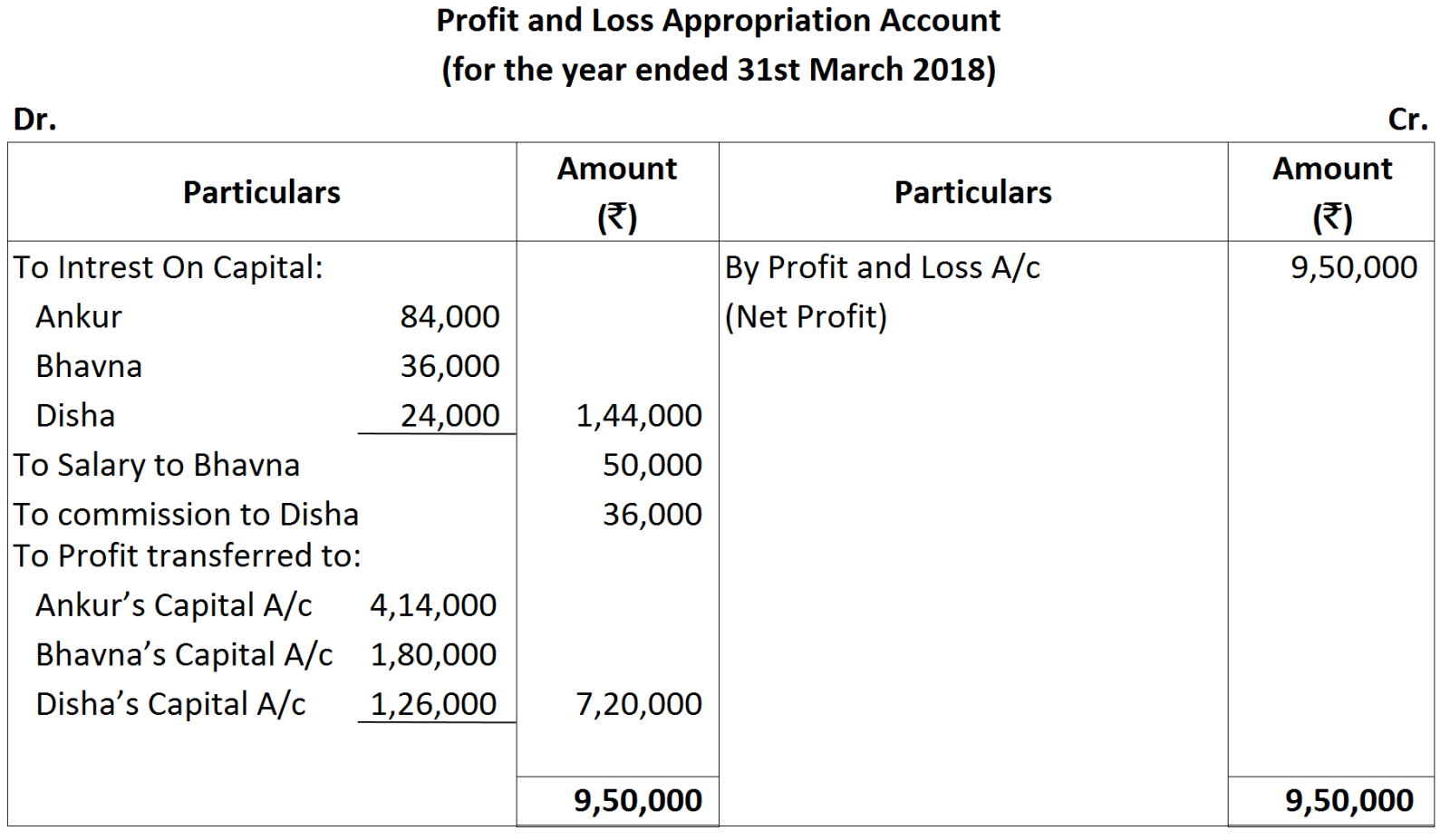 Working Notes:
Profit available for distribution = 9,50,000 - (1,44,000 + 50,000 + 36,000) = ₹ 7,20,000
Profit sharing ratio = 7 : 3 : 2
Ankur's Profit Share $=7,20,000\times\frac{7}{12}=₹\ 4,20,000$
Bhavna's Profit Share $=7,20,000\times\frac{3}{12}=₹\ 180,000$
Disha's Profit Share $=7,20,000\times\frac{2}{12}=₹\ 1,20,000$
Bhavna’s Minimum Guaranteed Profit = ₹ 1,70,000 (excluding interest on capital)
But, Bhavna’s Actual Profit Share = ₹ 1,80,000
This implies that there is no deficiency in Bhavna’s profit share as her actual profit share (i.e. ₹ 1,80,000) exceeds his minimum guaranteed profit share (i.e. ₹ 1,70,000).
Disha’s Minimum Guaranteed Profit = ₹ 1,50,000 (including interest on capital but excluding salary)
Disha’s Minimum Guaranteed Profit (excluding interest) = 1,50,000 - 24,000 = ₹ 1,26,000
But, Disha’s Actual Profit Share = ₹ 1,20,000
Deficiency in Disha’s Profit Share = 1,26,000 – 1,20,000 = ₹ 6,000
This deficiency is to be borne by Ankur alone.
Therefore,
Ankur’s New Profit Share = 4,20,000 - 6,000 = ₹ 4,14,000 View full question & answer→Question 436 Marks
On 31st March, 2014, the balances in the capital accounts of Esha, Manav and Daman after making adjustments for profits and drawings were ₹ 3,20,000, ₹ 2,40,000 and ₹ 1,60,000 respectively. Subsequently, interest on capital and drawings had been omitted.
- The profit for the year ended on 31st March, 2014 was ₹ 90,000.
- During the year, Esha and Manav each withdrew a sum of ₹ 48,000 in equal instalments in the middle of every month and Daman withdrew ₹ 60,000.
- The interest on drawings was to be charged @ 5% per annum and interest on capital was to be allowed @ 10% per annum.
- The profit-sharing ratio of the partners was 3 : 2 : 1.
Showing your workings clearly, pass the necessary rectifying entry.
AnswerCalculation of Interest on Capital:
For the calculation of interest on capital, Opening Capital has to be ascertained:
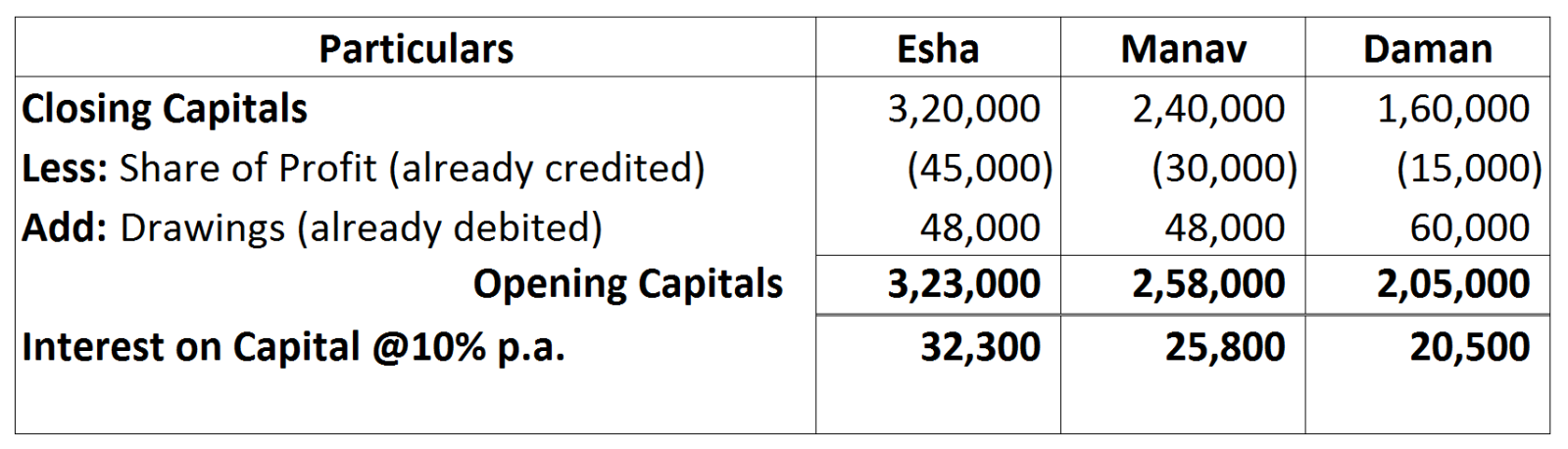
Total Interest on Capital = ₹ 32,300 + ₹ 25,800 – ₹ 20,500 =₹ 78,600
Calculation of Interest on Drawings:
Esha and Manav each withdrew a sum of ₹ 48,000 in equal installments in the middle of every
month. Hence interest on drawings will be charged for 6 months:
$48,000\times\frac{6}{12} \times\frac{5}{100} = ₹\ 1,200\ \text{each}$
Interest on Daman’s Drawings $ = ₹\ 60,000 \times\frac{ 6}{12}\times\frac{5}{100} = ₹\ 1,500$
(Date of Drawings is not given, hence interest will be charged for 6 months)
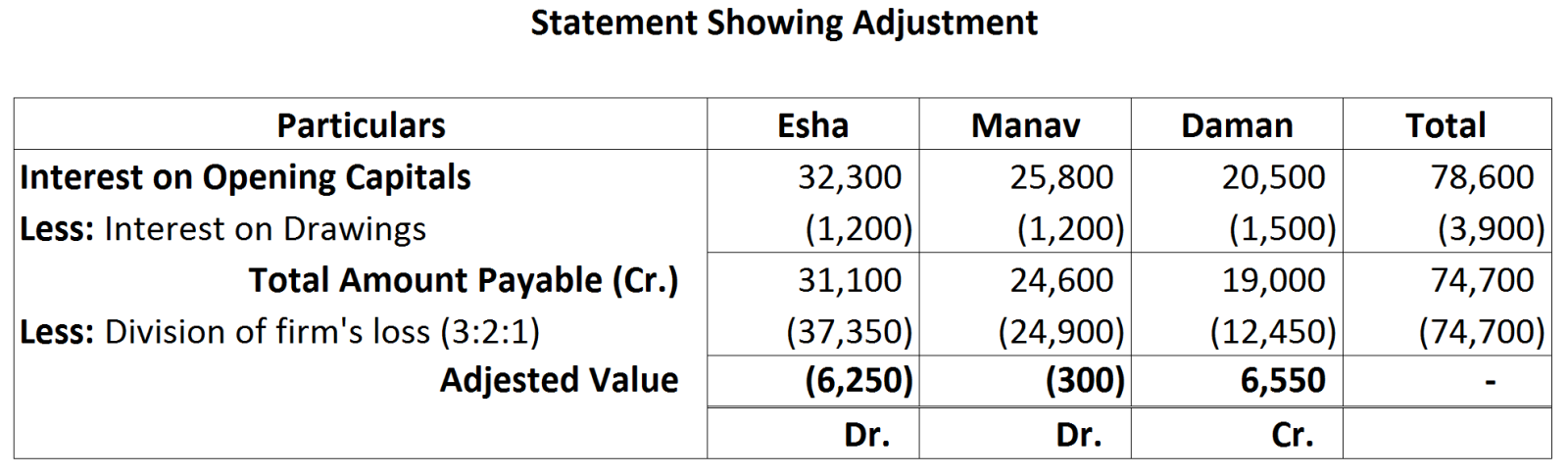
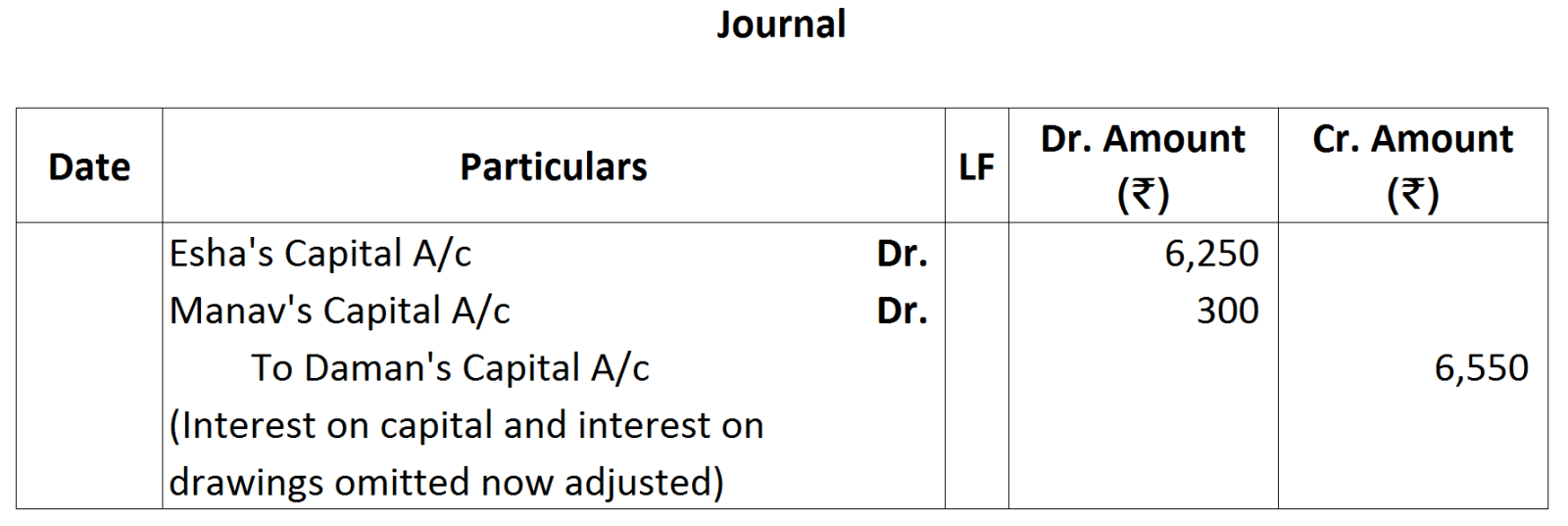
View full question & answer→Question 446 Marks
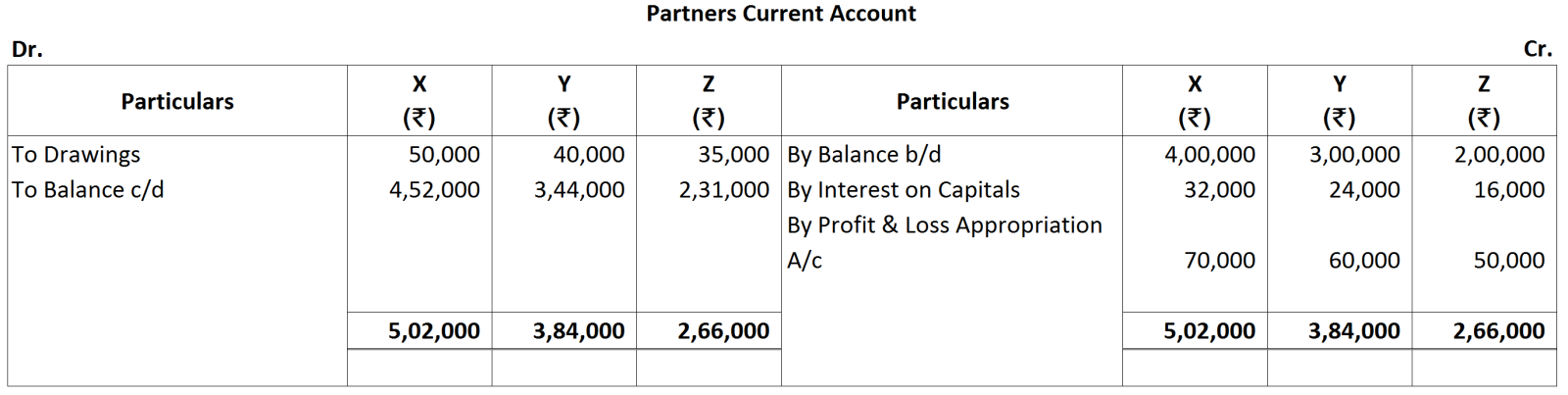
X, Y and Z are partners with capitals of ₹ 4,00,000; ₹ 3,00,000 and ₹ 2,00,000 respectively. They charge 8% p.a. interest on their capitals and divide the profits in the ratio of 3 : 2: 1. Xhas guaranteed that Z's share shall not amount to less than ₹ 50,000 in any one year
Their Drawings duringthe year were ₹ 50,000; ₹ 40,000 and ₹ 35,000 respectively. Net profits for the year before providing interest on capitals was ₹ 2,52,000. Prepare P & L Appropriation A/c and capital accounts.
Answer
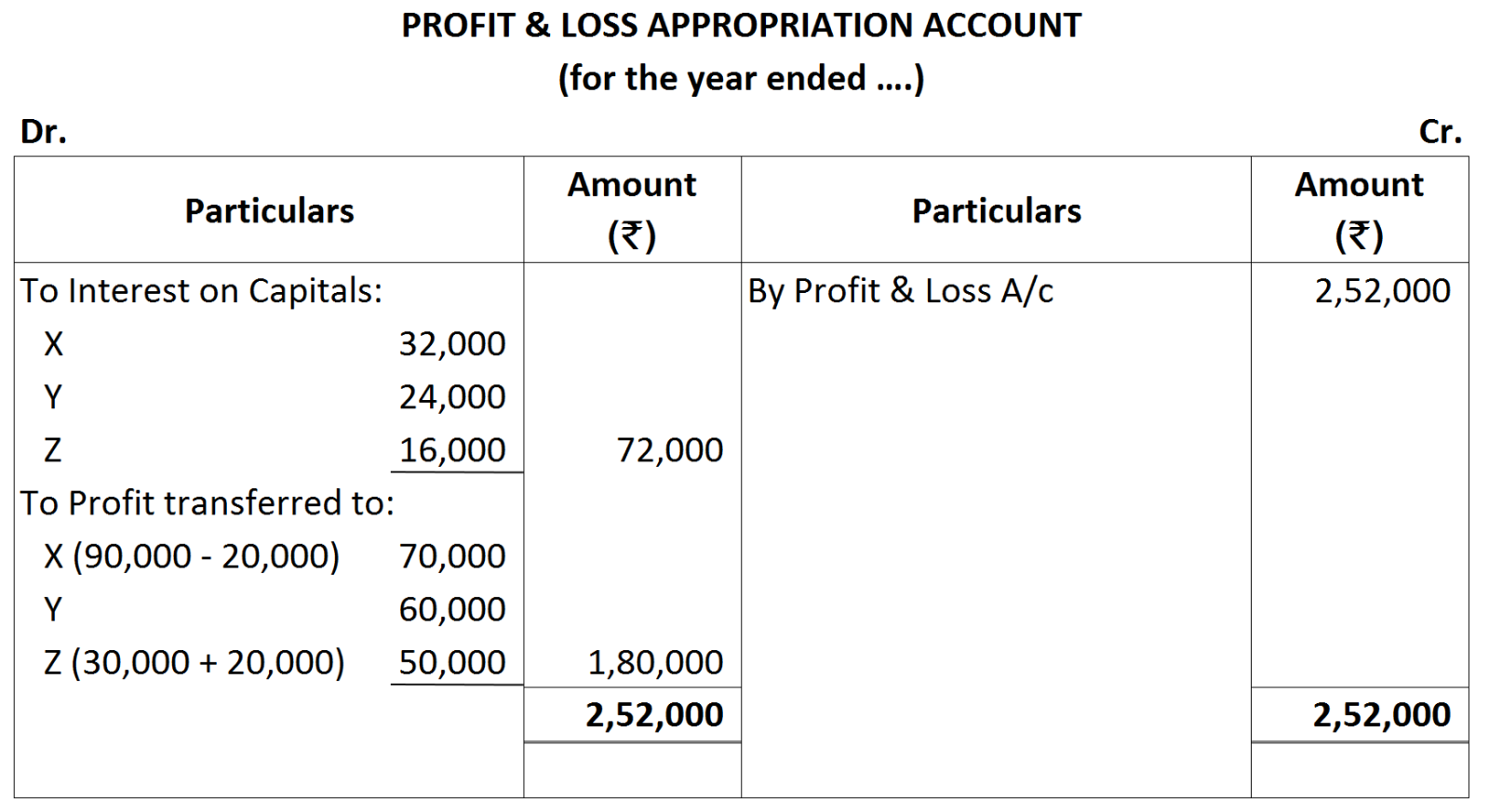 Working Note:
Net Profit after Interest on Capital = ₹ 2,52,000 – ₹ 72,000 = ₹ 1,80,000
Share of Profit $ = \text{X} :₹\ 1,80,000 \times\frac{2}{6} = ₹\ 60,000$
$ = \text{Y} :₹\ 1,80,000 \times\frac{2}{6} = ₹\ 60,000$
$ = \text{Z} :₹\ 1,80,000 \times\frac{1}{6} = ₹\ 30,000$
The minimum guaranteed amount to Z is ₹ 50,000 whereas his share of profit amounts to ₹ 30,000. Hence, the deficiency of ₹ 20,000 will be deducted from A's share and will be added to Z’s share.
View full question & answer→Question 456 Marks
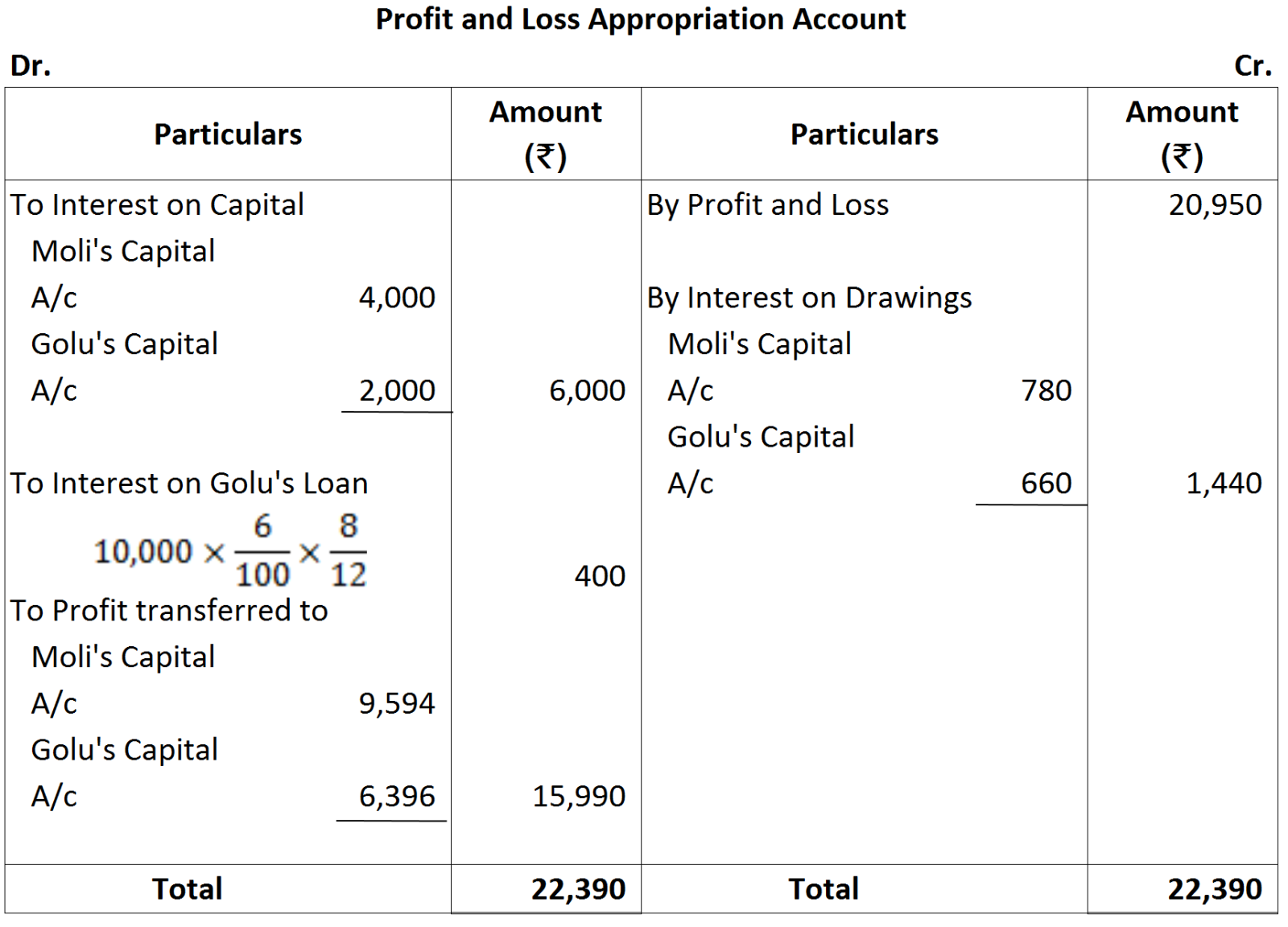
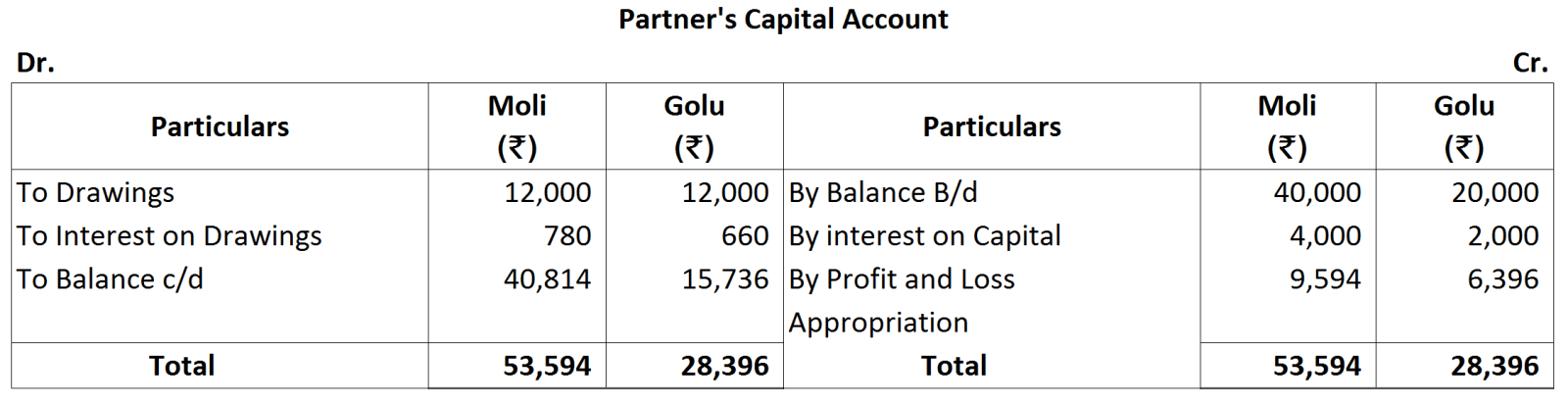
The capital accounts of Moli and Golu showed balances of ₹ 40,000 and ₹ 20,000 as on April 01, 2016. They shared profits in the ratio of 3 : 2. They allowed interest on capital @ 10% p.a. and interest on drawings, @ 12 p.a. Golu advanced a loan of ₹ 10,000 to the firm on August 01, 2016.
During the year, Moli withdrew ₹ 1,000 per month at the beginning of every month whereas Golu withdrew ₹ 1,000 per month at the end of every month. Profit for the year, before the above mentioned adjustments was ₹ 20,950. Calculate interest on drawings show distribution of profits and prepare partner’s capital accounts.
Answer
 Working Note:
Calculation of Interest on Drawings
$\Rightarrow\ \text{Total Drawings}\times\text{Rate}\times\frac{\text{Average Period}}{12}$
Moli $\Rightarrow\ 12,000\times\frac{12}{100}\times\frac{6^{1/2}}{12}=₹\ 780$
Golu $\Rightarrow\ 12,000\times\frac{12}{100}\times\frac{5^{1/2}}{12}=₹\ 660$
Note: If drawings is done at the begining of every month, then interest on drawings is calculated of $6\frac{1}{2}$ months.
If drawings is done at the ending of every month, then interest on drawings is calculated of $5\frac{1}{2}$ months.
If rate of interest on loan is not given, then it will be charged always 6%. View full question & answer→Question 466 Marks
Satnam and Qureshi after doing their MBA decided to start a partnership firm to manufacture ISI marked electronic goods for economically weaker section of the society. Satnam also expressed his willingness to admit Juliee partner without capital who is specially abled but a very creative and intelligent friend of him. Qureshi agreed to this. They formed a partnership on 1st April 2012 on the following terms:
- Satnam will contribute ₹ 4,00,000 and Qureshi will contribute ₹ 2,00,000 as capitals.
- Satnam Qureshi and Juliee will share profits in the ratio of 2 : 2 : 1.
- Interest on capital will be allowed @ 6% p.a.
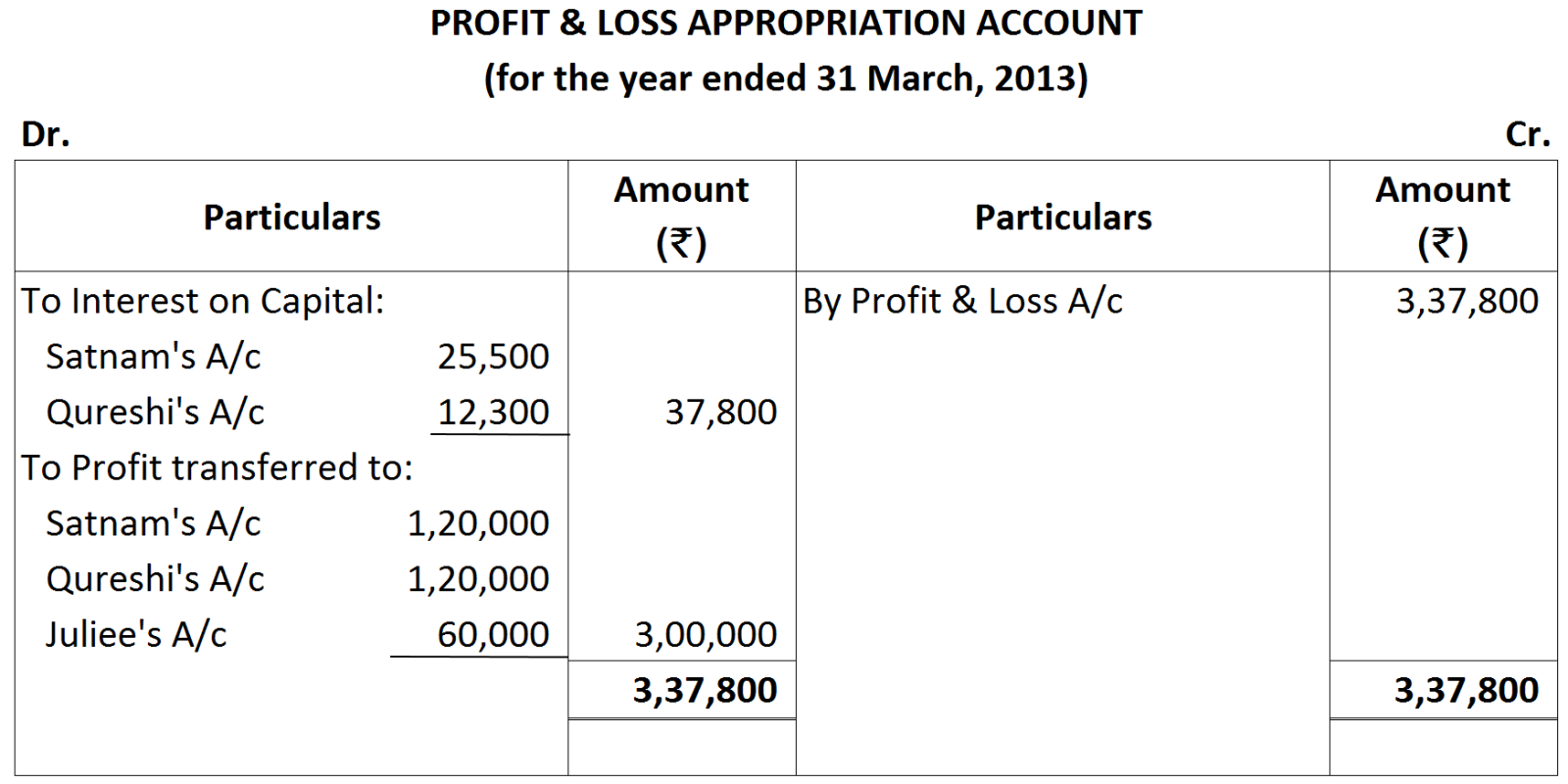
Due to shortage of capital Satnam contributed ₹ 50,000 on 30th September, 2012 and Qureshi contributed ₹ 20,000 on 1st january, 2013 as additional capitals. The profit of the firm for the year ended 31st March, 2013 was ₹ 3,37,800.
- Identify any two values which the firm wants to communicate to the society.
- Prepare profit & Loss Appropriation A/c for the year ending 31st March 2013.
Answer
- Values which the firm wants to communicate to the society are:
- Sensitivity towards specially abled people.
- Encouragiug women entrepreneurshlp.
- Upliftment of economically weaker sections.
- Adherence to law to manufacture ISI marked electronic goods.
-
Working Notes:
Calculation of Interest on Capital:
- Satnam:
|
|
|
₹
|
|
$₹\ 4,00,000\times\frac{6}{100}$
|
=
|
24,000
|
|
$₹\ 50,000\times\frac{6}{100}\times\frac{6}{12}$
|
=
|
1,500
|
|
|
|
$\overline{\underline{25,500}}$
|
- Qureshi:
|
|
|
₹
|
|
$₹\ 2,00,000\times\frac{6}{100}$
|
=
|
12,000
|
|
$₹\ 20,000\times\frac{6}{100}\times\frac{3}{12}$
|
=
|
300
|
|
|
|
$\overline{\underline{12,300}}$
|
View full question & answer→Question 476 Marks
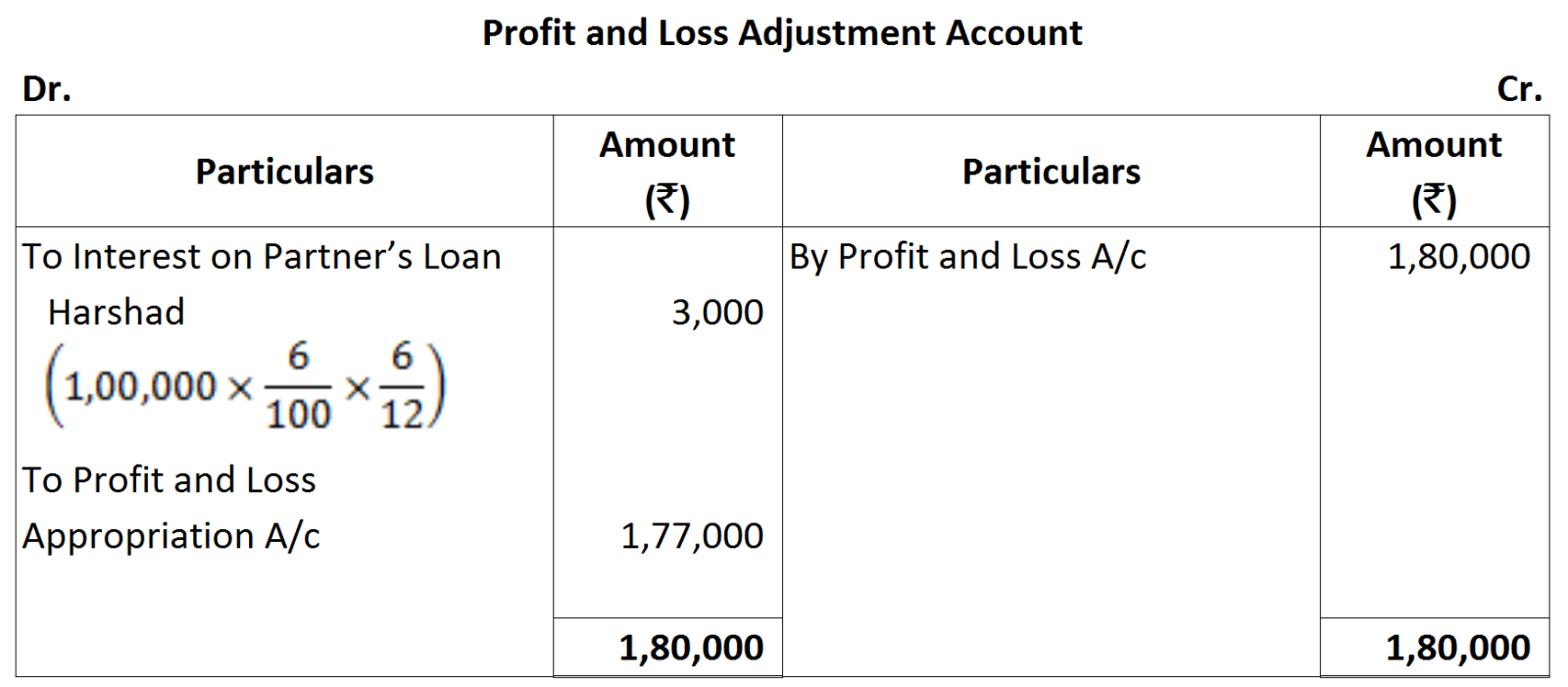
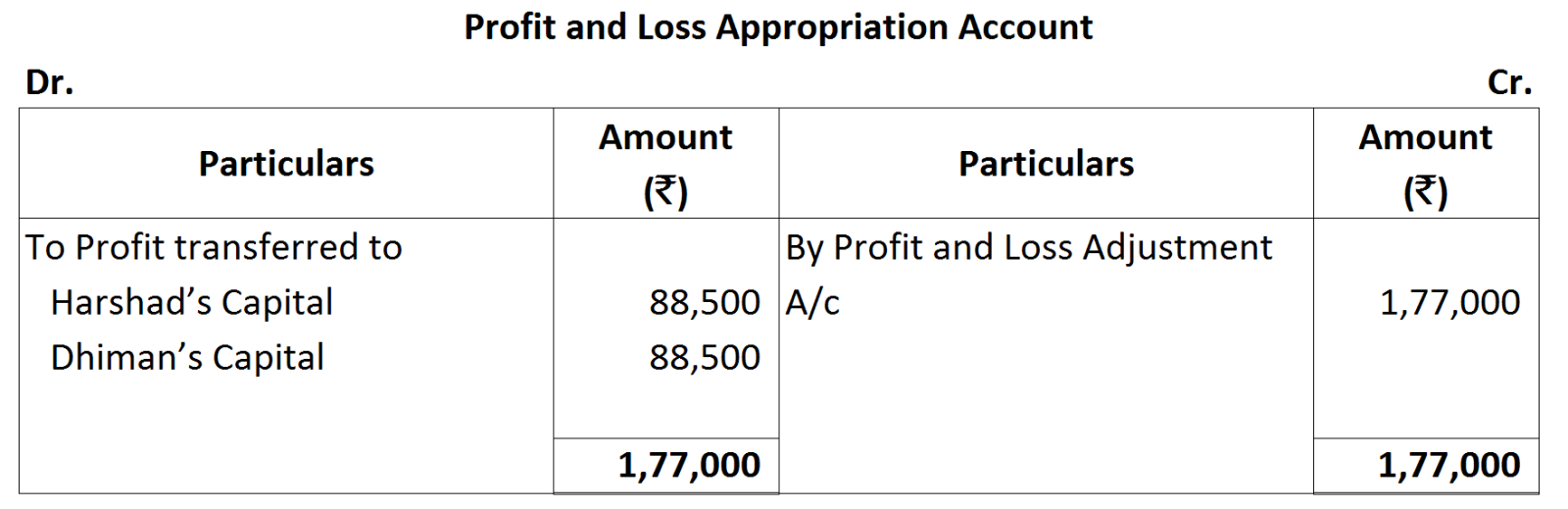
Harshad and Dhiman are in partnership since 1st April, 2017. No partnership agreement was made. They contributed ₹ 4,00,000 and ₹ 1,00,000 respectively as capital. In addition, Harshad advance an amount of ₹ 1,00,000 to the firm on 1st October, 2017. Due to long illness, Harshad could not participate in business activities from 1st August to 30th September, 2017. The profit for the year ended 31st March, 2018 amounted to ₹ 1,80,000. Dispute has arisen between Harshad and Dhiman.
Harshad Claims:
- He should be given interest @ 10% per annum on capital and loan.
- Profit should be distributed in proportion of capital.
Dhiman Claims:
- Profit should be distributed equally.
- He should be allowed ₹ 2,000 p.m. as remuneration for the period he managed the business in the absence of Harshad.
- Interest on Capital and loan should be allowed @ 6% p.a.
You are required to settle the dispute between Harshad and Dhiman. Also prepare Profit and Loss Appropriation Account.
AnswerDISTRIBUTION OF PROFITS: Harshad Claims:Decisions:
- If there is no agreement on interest on partner’s capital, according to Indian partnership act 1932, no interest will be allowed to partners.
- If there is no agreement on the matter of profit sharing, according to partnership act 1932, profit shall be distributed equally.
Dhiman Claims: Decisions
- Dhiman claim is justified, according partnership act 1932 if there is no agreement on the matter of profit distribution, profit shall be distributed equally.
- No salary will be allowed to any partner because there is no agreement on matter of remuneration.
- Dhiman’s claim is not justified on the matter of interest on capital but justified on the matter of interest on loan. If there is no agreement on interest on partner’s loan, Interest shall be provided at 6% p.a.
View full question & answer→Question 486 Marks
Mohan, Vijay and Anil are partners, the balance on their capital accounts being ₹ 30,000, ₹ 25,000 and ₹ 20,000 respectively. In arriving at these figures, the profits for the year ended March 31, 2017 amounting to Rupees 24,000 had been credited to partners in the proportion in which they shared profits. During the tear their drawings for Mohan, Vijay and Anil were ₹ 5,000, ₹ 4,000 and ₹ 3,000, respectively. Subsequently, the following omissions were noticed:
- Interest on Capital, at the rate of 10% p.a., was not charged.
- Interest on Drawings: Mohan ₹ 250, Vijay ₹ 200, Anil ₹ 150 was not recorded in the books.
Record necessary corrections through journal entries.
Question 496 Marks
View full question & answer→Question 506 Marks
Kavita and Pradeep are partners, sharing profits in the ratio of 3 : 2. They employed Chandan as their manager, to whom they paid a salary of ₹ 750 p.m. Chandan deposited ₹ 20,000 on which interest is payable @ 9% p.a. At the end of 2017 (after the division of profit), it was decided that Chandan should be treated as partner w.e.f. Jan. 1, 2014 with $\frac{1}{6}\text{th}$ share in profits. His deposit being considered as capital carrying interest @ 6% p.a. like capital of other partners. Firm’s profits after allowing interest on capital were as follows:
|
|
|
₹
|
|
2014
|
Profit
|
59,000
|
|
2015
|
Profit
|
62,000
|
|
2017
|
Loss
|
(4,000)
|
|
2018
|
Profit
|
78,000
|
Record the necessary journal entries to give effect to the above. AnswerAmount Paid to Chandan as Manager.
- Salary @ 750per manth × 12 × 4 = 36,000
- $\text{Interest on Loan} = 20,000 ×\frac{9}{100}×4= 7,200$
Total amount payable as manager 36,000 + 7,200 = 43,200
Amount Payable to Chandan as partner
Share in profit
Total Profit of firm = 59,000 + 62,000 + 78,000 - 4,000
= 1,95,000
(+) Salary as Manager = 36,000
(+) 9% - 6% = 3%
Interest on deposit 20,000 for 4 years = 2,400
Total divisible profit = 2,33,400
Chandan's Share in profit $=2,33,400\times\frac{1}{6}=38,900$
(+) Interest on capital for 4 years @ 6% $20,000\times\frac{6}{100}\times4=4,800$
Total amount payable as Partner = 43,700
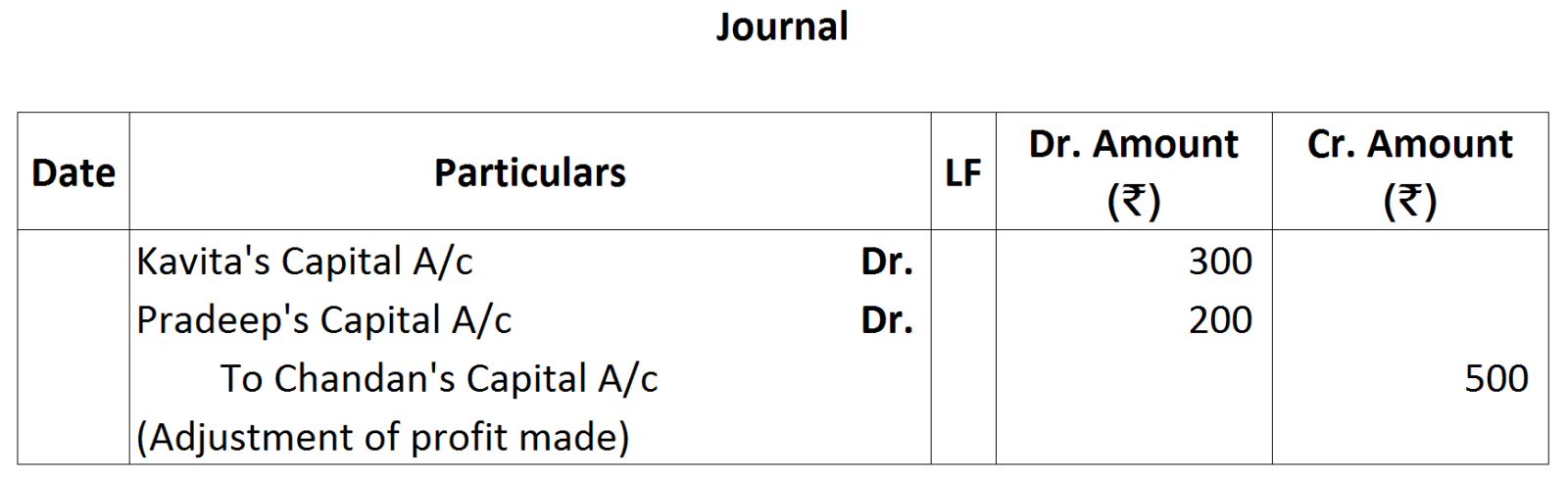
Difference in chandan's share = 43,700 - 43,200 = 500
(to be brone by kavita and pradeep in 3 : 2 ratio)
View full question & answer→