Question
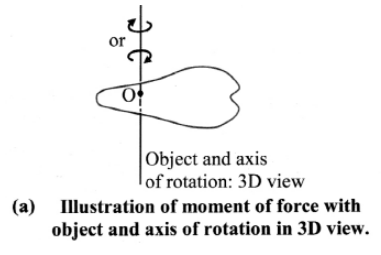
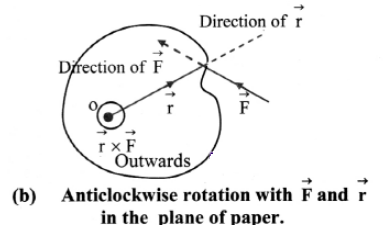
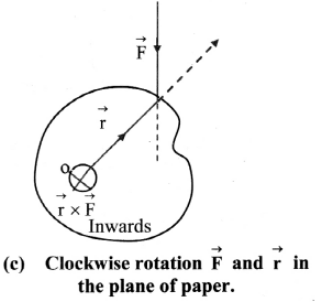
Illustrate with an example how direction of the torque acting on any object is determined.
Need a full question paper?

Generate a complete, print-ready paper with questions like this in minutes — across 16+ boards, with answer keys.

Start Generating Free

Similar questions

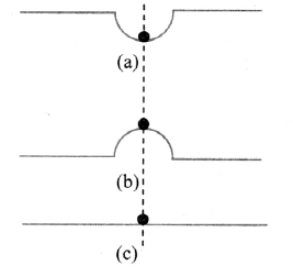
The figure below shows three situations of a ball at rest under the action of balanced forces. Is the bail in mechanical equilibrium? Explain how the three situations differ.
Image
A ball of mass $100\ g$ dropped on the ground from $5\ m$ bounces repeatedly. During every bounce $64 \%$ of the potential energy is converted into kinetic energy. Calculate the following:
(a) Coefficient of restitution.
(b) Speed with which the ball comes up from the ground after third bounce.
(c) Impulse given by the ball to the ground during this bounce.
(d) Average force exerted by the ground if this impact lasts for $250\ ms$.
(e) Average pressure exerted by the ball on the ground during this impact if contact area of the ball is $0.5\ cm^2$.
[Ans: $0.8, 5.12 m/s, 1.152N s, 4.608 N, 9.216 \times 104 N/m^2$]
Write a note on projectile motion.
Explain the graph showing variation of acceleration due to gravity with altitude and depth.
Derive expression for couple acting on an electric dipole in a uniform electric field.
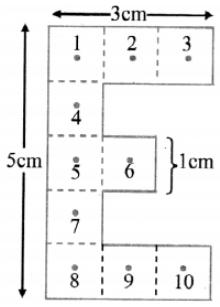
A letter $‘E \ ’$ is prepared from a uniform cardboard with shape and dimensions as shown in the figure. Locate its centre of mass.
Image
Find unit vectors perpendicular to the plane of the vectors, $\overrightarrow{ A }=$ and $\overrightarrow{ B }=2 \hat{ i }-\hat{ k }$
Define time period of a satellite.
Obtain an expression for the period of a satellite in a circular orbit round the Earth. Show that the square of the period of revolution of a satellite is directly proportional to the cube of the orbital radius.
Evaluate resistance for the following colour $-$ coded resistors:
$i$. Yellow $–$ Violet $–$ Black $–$ Silver
$ii$. Green $–$ Blue $–$ Red $–$ Gold
$iii$. Brown $–$ Black $–$ Orange $–$ Gold
To understand the process of change of state:
Take some cubes of ice in a beaker. Note the temperature of ice (0 °C). Start heating it slowly on a constant heat source. Note the temperature after every minute. Continuously stir the mixture of water and ice. Observe the change in temperature. Continue heating even after the whole of ice gets converted into water. Observe the change in temperature as before till vapours start coming out. Plot the graph of temperature (along Y-axis) versus time (along X-axis). Obtain a graph of temperature versus time