MCQ
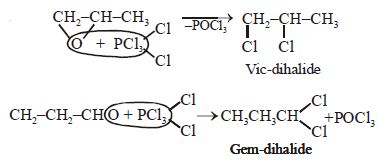
(image) $CH_3CH_2CHO+PCl_5 \to (B)$, $(A)$ and $(B)$ are
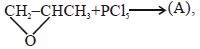
- Agem-dihalides
- B$(A)$ gem-dihalide, $(B)$ Vic-dihalide
- CVic-dihalides
- ✓$(A)$ Vic-dihalide, $(B)$ gem-dihalide
Generate a complete, print-ready paper with questions like this in minutes — across 16+ boards, with answer keys.
$I.$ $CH_3 -CH = CH_2$ $\xrightarrow[{{\text{(CC}}{{\text{l}}_4}{\text{ )}}}]{{{\text{C}}{{\text{l}}_2}}}$ $\begin{array}{*{20}{c}}
{Cl\,\,}\\
{\,\,|\,\,\,\,\,}\\
{C{H_3} - CH - C{H_2}}\\
{\,\,\,\,\,\,\,\,\,\,\,\,\,\,\,\,\,\,\,\,\,\,\,\,\,\,|}\\
{\,\,\,\,\,\,\,\,\,\,\,\,\,\,\,\,\,\,\,\,\,\,\,\,\,\,\,Cl}
\end{array}$
$II.$ $\begin{array}{*{20}{c}}
O\\
{||}\\
{C{H_3} - C - C{H_3}}
\end{array}$ $\xrightarrow[{{}^\Theta OH}]{{{\text{HCN}}}}$ $\begin{array}{*{20}{c}}
{\,\,\,\,\,OH}\\
|\\
{C{H_3} - C - C{H_3}}\\
|\\
{\,\,\,\,\,CN}
\end{array}$
$III.$ $CH_3-CH_2-CH_3$ $\xrightarrow[{hv}]{{C{l_2}}}$ $\begin{array}{*{20}{c}}
{Cl\,\,}\\
{|\,\,\,\,}\\
{C{H_3} - CH - C{H_3}}
\end{array}$
$C{H_3}C{H_2}OH\xrightarrow{{P + {I_2}}}A\xrightarrow[{ether}]{{Mg}} $ $B\xrightarrow{{HCHO}}C\xrightarrow{{{H_2}O}}D$
$\left[\right.$ Given $: \mathrm{h}=6.63 \times 10^{-34} \,\mathrm{Js}$ and $\left.\mathrm{c}=3.0 \times 10^{8} \,\mathrm{~ms}^{-1}\right]$

| Column $I$ | Column $II$ |
| $(A)$ $\mathrm{O}_2^{-} \rightarrow \mathrm{O}_2+\mathrm{O}_2{ }^{2-}$ | $(p)$ redox reaction |
| $(B)$ $\mathrm{CrO}_4{ }^{2-}+\mathrm{H}^{+} \rightarrow$ | $(q)$ one of the products has trigonal planar structure |
| $(C)$ $\mathrm{MnO}_4^{-}+\mathrm{NO}_2^{-}+\mathrm{H}^{+} \rightarrow$ | $(r)$ dimeric bridged tetrahedral metal ion |
| $(D)$ $\mathrm{NO}_3^{-}+\mathrm{H}_2 \mathrm{SO}_4+\mathrm{Fe}^{2+} \rightarrow$ | $(s)$ disproportionation |
$(a)$ saline hydrides produce $H_2$ gas when reacted with $H_2O.$
$(b)$ reaction of $LiAH_4$ with $BF_3$ leads to $B_2H_6.$
$(c)$ $PH_3$ and $CH_4$ are electron - rich and electron-precise hydrides, respectively.
$(d)$ $HF$ and $CH_4$ are called as molecular hydrides.