Question 14 Marks
In 1827, a German physicist Georg Simon Ohm (1787-1854) found out the relationship between the current I, flowing in metallic wire and the potential difference across its terminals. He stated that the electric current flowing through a metallic wire is directly proportional to the potential difference V, across its ends provided its temperature remains the same.
The resistance of a circuit is defined as the ratio between the voltage applied to the current flowing through it. Rearranging the above relation,
$R=\frac{V}{I}$
Electric charge flows easily through some materials than others. The electrical resistance measures how much the flow of this electric charge is restricted within the circuit.
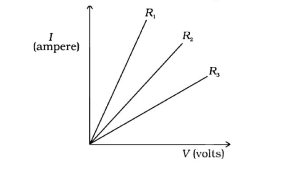
i. What is the unit of electrical resistance?
ii. Define Ohm's law.
iii. From graph which resistance have high resistance?
OR
What does the slope of V-I graph at any point represent?
The resistance of a circuit is defined as the ratio between the voltage applied to the current flowing through it. Rearranging the above relation,
$R=\frac{V}{I}$
Electric charge flows easily through some materials than others. The electrical resistance measures how much the flow of this electric charge is restricted within the circuit.
i. What is the unit of electrical resistance?
ii. Define Ohm's law.
iii. From graph which resistance have high resistance?
OR
What does the slope of V-I graph at any point represent?
Answer
View full question & answer→i. Ohm is the unit of electrical resistance.
ii. According to Ohm's law, there is a relation between the current flowing through a conductor and the potential difference across it. It is given by,
$\mathrm{V} \propto \mathrm{I} \mathrm{V}=\mathrm{IR}$
iii. $\mathrm{R}_{3}$ resistance has high resistance.
OR
The slope of V-I graph at any point represents resistance.
ii. According to Ohm's law, there is a relation between the current flowing through a conductor and the potential difference across it. It is given by,
$\mathrm{V} \propto \mathrm{I} \mathrm{V}=\mathrm{IR}$
iii. $\mathrm{R}_{3}$ resistance has high resistance.
OR
The slope of V-I graph at any point represents resistance.