Question
In a CE transistor amplifier there is a current and voltage gain associated with the circuit. In other words there is a power gain. Considering power a measure of energy, does the circuit voilate conservation of energy?

Answer

Key concept: Different gain in CE transistor amplifier:
  1. Ac current gain: $\beta_\text{ac}=\Big(\frac{\Delta\text{i}_\text{c}}{\Delta\text{i}_\text{b}}\Big)\text{V}_\text{CE}=\text{constant}$
  2. dc current gain: $\beta_\text{dc}=\frac{\text{i}_\text{c}}{\text{i}_\text{b}}$
  3. Voltage gain: $\text{A}_\text{v}=\frac{\Delta\text{V}_0}{\Delta\text{V}_\text{i}}=\beta_\text{ac}\times\text{Resistance gain}$
  4. Power gain: $=\frac{\Delta\text{P}_0}{\Delta\text{P}_\text{i}}=\beta_\text{ac}^2\times\text{Resistance gain}$
The power gain is very high in CE transistor amplifier. In this circuit, the extra power required for amplified output is obtained from DC source. Thus, the circuit used does not violate the law of conservation.

Need a full question paper?

Generate a complete, print-ready paper with questions like this in minutes — across 16+ boards, with answer keys.
Start Generating Free

Similar questions

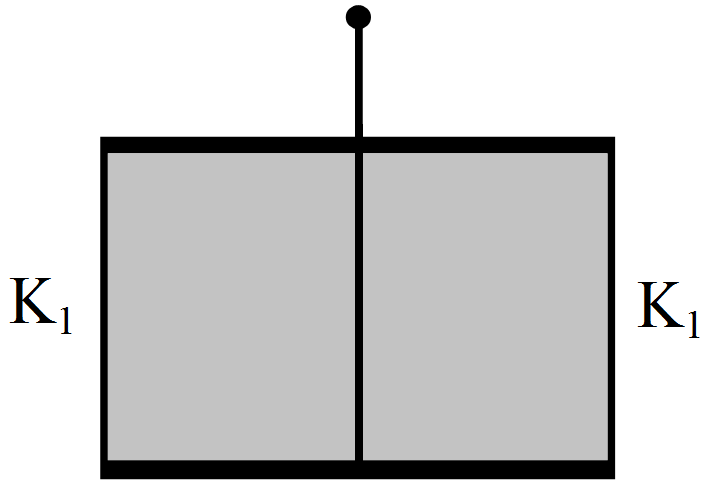
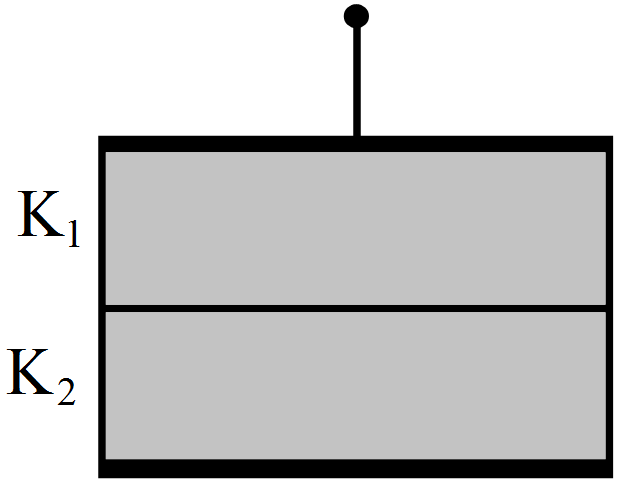
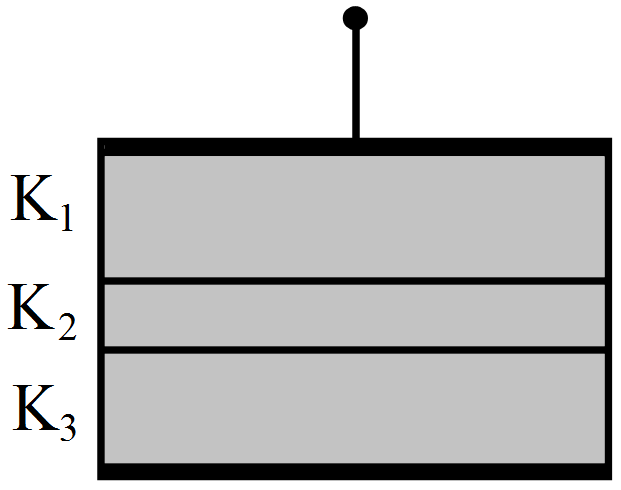
Find the capacitances of the capacitors shown in figure. The plate area is A and the separation between the plates is d. Different dielectric slabs in a particular part of the figure are of the same thickness and the entire gap between the plates is filled with the dielectric slabs.


Hydrogen gas is contained in a closed vessel at 1atm (100kPa) and 300K. (a) Calculate the mean speed of the molecules. (b) Suppose the molecules strike the wall with this speed making an average angle of 45° with it. How many molecules strike each square metre of the wall per second?
Suppose that the radius of cross-section of the wire used in the previous problem is r. Find the increase in the radius of the loop if the magnetic field is switched off. Young's modulus of the material of the wire is Y.
Obtain the answers to (a) and (b) in Exercise 7.15 if the circuit is connected to a 110V, 12kHz supply? Hence, explain the statement that a capacitor is a conductor at very high frequencies. Compare this behaviour with that of a capacitor in a dc circuit after the steady state.
A parallel-plate capacitor of plate area $40cm^2$ and separation between the plates 0.10mm, is connected to a battery of emf 2.0V through a $16\Omega$ resistor. Find the electric field in the capacitor 10ns after the connections are made.
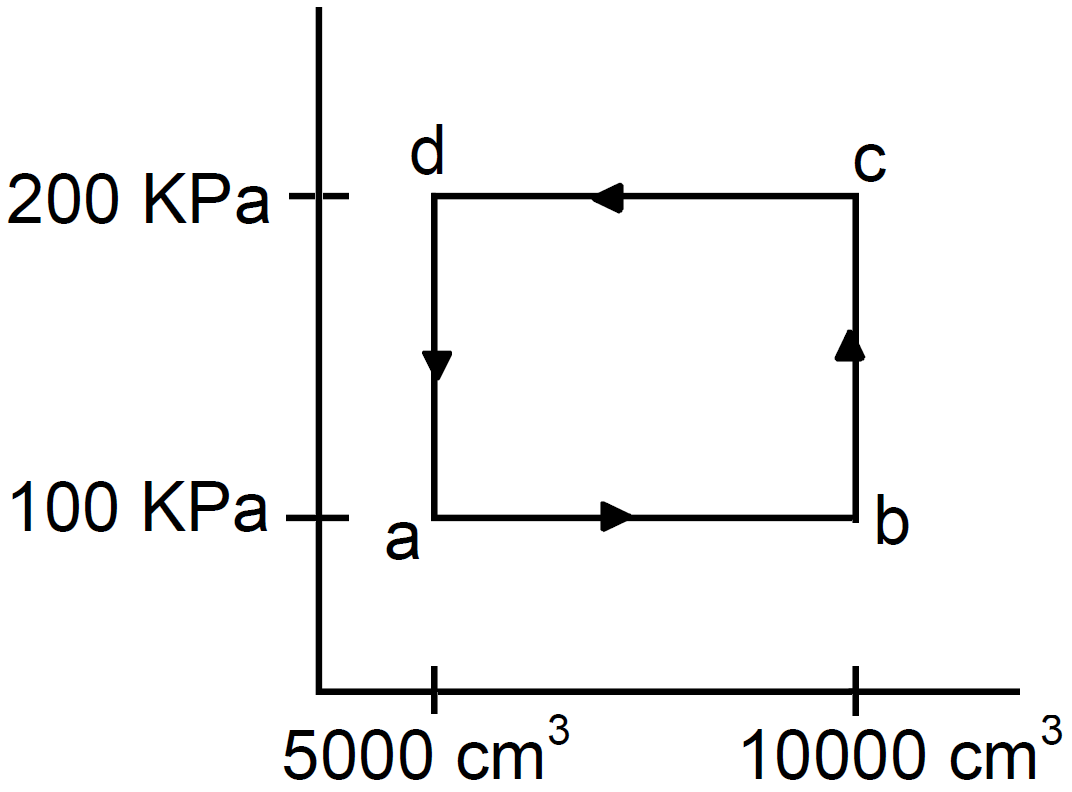
Half mole of an ideal gas $\Big(\gamma=\frac{5}{3}\Big)$ is taken through the cycle abcda, as shown in the figure. Take $\text{R}=\frac{25}{3}\text{JK}^{-1}\text{mol}^{-1}.$
  1. Find the temperature of the gas in the states a, b, c and d.
  2. Find the amount of heat supplied in the processes ab and bc.
  3. Find the amount of heat liberated in the processes cd and da.
A heavy particle is suspended by a 1.5m long string. It is given a horizontal velocity of $\sqrt{57}\text{m/s}.$
  1. Find the angle made by the string with the upward vertical, when it becomes slack.
  2. Find the speed of the particle at this instant.
  3. Find the maximum height reached by the particle over the point of suspension. Take $g = 10m/s^2.$
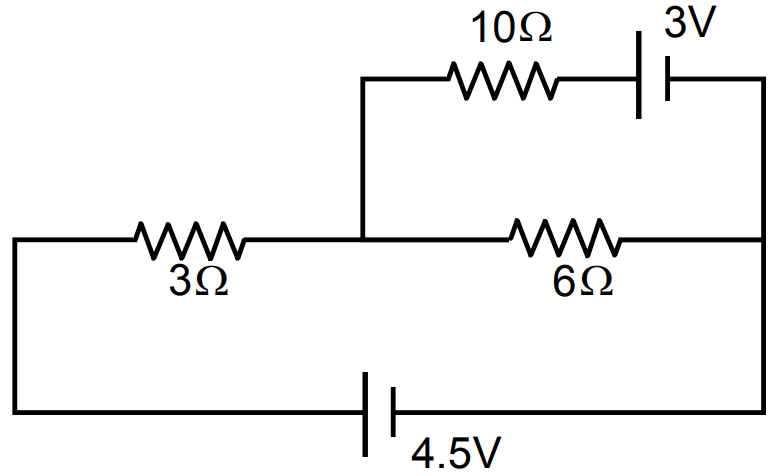
Find the current through the $10\Omega$ resistor shown in figure.
A capacitor of capacitance C is given a charge Q. At t = 0, it is connected to an uncharged capacitor of equal capacitance through a resistance R. Find the charge on the second capacitor as a function of time.
The wavelengths of $\text{K}_\alpha$ and $\text{L}_\alpha$ X-rays of a material are 21.3pm and 141pm respectively. Find the wavelength of $\text{K}_\beta$ X-ray of the material.