Question
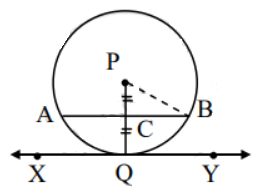
In a circle with centre $P ,$ chord $AB$ is parallel to a tangent and intersects the radius drawn from the point of contact to its midpoint. If $AB = 16\sqrt3$ then find the radius of the circle
Answer

Image
Given: Chord $A B||$ tangent $X Y$
$A B=16 \sqrt{3}$  units 
$PQ$ is radius of the circle.
$P C=C Q$
To find: Radius of the circle, $i.e.,I(PQ)$
Construction: Draw seg $PB.$
In given figure, $ \angle P Q Y=90^{\circ}..(i) [$Tangent theorem$]$
Chord $A B \|$ line $X Y$
$\therefore \angle PCB \cong \angle PQY$
$\therefore \angle PCB =90^{\circ}(ii) ...[$From $(i)]$
Now $C B=\frac{1}{2} A B$
$ \begin{array}{l} \therefore C B=\frac{1}{2} \times 16 \sqrt{3} \ldots . .\left[\begin{array}{c} \text { A perpendicular drawn from the } \\ \text { centre of a circle on its chord } \\ \text { bisects the chord } \end{array}\right] \\\end{array}$
$C B=8 \sqrt{3}....(iii) $
Let the radius of the circle be $x$ units
$\therefore PQ = x$
$\therefore PC =\frac{1}{2} PQ \ldots \ldots . .[ PC = CQ , P - C - Q ]$
$\therefore PC =\frac{1}{2} x \ldots \ldots . (v)$
$\text { In } \triangle PCB ,$
$\angle PCB =90^{\circ} \ldots . .[$From $(ii)] $
$\therefore PB P ^2= PC ^2+ CB ^2 \ldots . .[$ Pythagoras theorem $]$
$\therefore x ^2=\left(\frac{1}{2} x\right)^2+(8 \sqrt{3})^2 \ldots . . .[$ From $(iii), (iv)$ and $( v )]$
$\therefore x ^2=\frac{x^2}{4}+64 \times 3$
$\therefore 4 x^2=x^2+192$
$\therefore 4 x ^2- x ^2=192$
$\therefore 3 x^2=192$
$\therefore x ^2=\frac{192}{3}$
$\therefore x^2=64$
$\therefore x =8$ units $[$Taking square root of both sides$]$
$\therefore$ The radius of the circle is $8$ units.

Need a full question paper?

Generate a complete, print-ready paper with questions like this in minutes — across 16+ boards, with answer keys.
Start Generating Free

Similar questions

Mrs. Parekh invested an equal amount in two companies by purchasing equity shares with market price ₹ 145 and ₹ 160 each. At the end of the year, both the companies declared the dividend of 20 % and 30 % each. In which company was her investment profitable?
The sum of the squares of two consecutive positive odd numbers is $514$. Find the numbers.
A fraction becomes $\frac{9}{11}$ if is added to both numerator and the denominator. If 3 is added to both the numerator and the denominator it becomes $\frac{5}{6}.$ Find the fraction.
Solve the following quadratoic equations by factorization:
$\frac{1}{2\text{a}+\text{b}+2\text{x}}=\frac{1}{2\text{a}}+\frac{1}{\text{b}}+\frac{1}{2\text{x}}$
Find the sum:$1 + 3 + 5 + 7 + ..... + 199.$
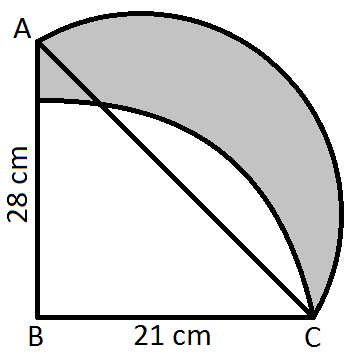
In the following figure, ABC is a right-angled triangle,$\angle\text{B}=90^\circ,$ $AB = 28\ cm$ and $BC = 21\ cm$.
With $AC$ as diameter a semicircle is drawn and with $BC$ as radius a quarter circle is drawn.
Find the area of the shaded region correct to two decimal places.
Solve the following quadratic equations by factorization:
$\frac{\text{x}-1}{2\text{x}+1}+\frac{2\text{x}+1}{\text{x}-1}=\frac{5}{2},$ $\text{x}\neq-\frac{1}{2},1$
All integers between $100$ and $550$ which are not divisible by $9$.
$\triangle PQR \sim \triangle ABC , PQ =3 cm, QR =4 cm, PR =5 cm$ $A (\triangle PQR ): A (\triangle ABC )=1: 4$. Construct both triangles
The radii of the circular ends of a frustum of a cone are 14 cm and 8 cm. If the height of the frustum is 8 cm. Find (i) Curved surface area of the frustum (ii) Total surface area of the frustum (iii) Volume of the frustum.