Question
In a Coolidge tube, electrons strike the target and stop inside it. Does the target get more and more negatively charged as time passes?

Answer

An electron emitted from the filament undergoes a number of collisions inside the material and loses its kinetic energy before coming to rest. This energy is utilised to give out photons or reject electrons from the atoms of the target. These electrons move to the battery connected to the circuit. Thus, the target does not get more and more negatively charged as time passes.

Need a full question paper?

Generate a complete, print-ready paper with questions like this in minutes — across 16+ boards, with answer keys.
Start Generating Free

Similar questions

Draw the circuit diagram of a full wave rectifier using two p-n junction
diodes. Explain its working and show input and output voltage variations.
(a) When a telescope is turned upside down and looked at the objective, it appears very small, why?
(b) Why does this not happen in a microscope?
Explain the shortcomings of Bohr's Theory.
A circular coil of 20 turns and radius 10 cm is placed in a uniform magnetic field of 0.10 T normal to the plane of the coil. If the current in the coil is 5.0 A, what is the
  1. Total torque on the coil,
  2. Total force on the coil,
  3. Average force on each electron in the coil due to the magnetic field.
(The coil is made of copper wire of cross-sectional area 10–5 m2 , and the free electron density in copper is given to be about 1029 m–3).
A cyclotron’s oscillator frequency is 10 MHz. What should be the operating magnetic field for accelerating protons? If the radius of its ‘dees’ is 60 cm, calculate the kinetic energy (in MeV) of the proton beam produced by the accelerator.
Using Bohr's total postulates, derive the expression for the total energy of the electron in the stationary states of hydrogen atom.
How are electromagnetic waves produced? What is the source of energy of these waves? Draw a schematic sketch of the electromagnetic waves propagating along the + x-axis. Indicate the directions of the electric and magnetic fields. Write the relation between the velocity of propagation and the magnitudes of electric and magnetic fields.
Prove that, if an insulated, uncharged conductor is placed near a charged conductor and no other conductors are present, the uncharged body must be intermediate in potential between that of the charged body and that of infinity.
A particle having a charge of 2.0 × 10-4C is placed directly below and at a separation of 10cm from the bob of a simple pendulum at rest. The mass of the bob is 100g. What charge should the bob be given so that the string becomes loose?
(a) A closed loop is held stationary in the magnetic field between the north and south poles of two permanent magnets held fixed. Can we hope to generate current in the loop by using very strong magnets?
(b) A closed loop moves normal to the constant electric field between the plates of a large capacitor. Is a current induced in the loop (i) when it is wholly inside the region between the capacitor plates (ii) when it is partially outside the plates of the capacitor? The electric field is normal to the plane of the loop.
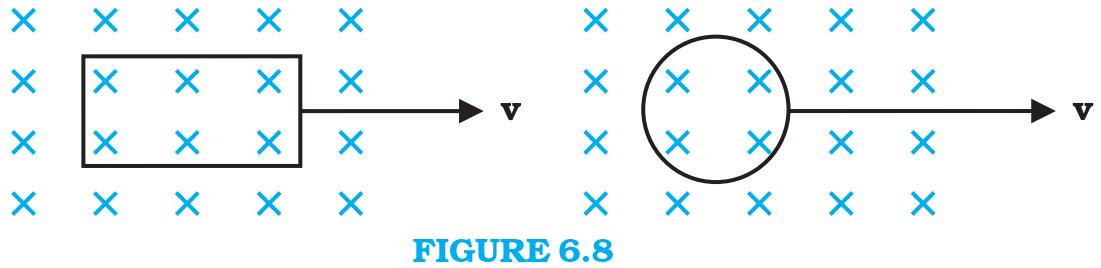
(c) A rectangular loop and a circular loop are moving out of a uniform magnetic field region (Fig. 6.8) to a field-free region with a constant velocity $v$. In which loop do you expect the induced emf to be constant during the passage out of the field region? The field is normal to the loops.
Image
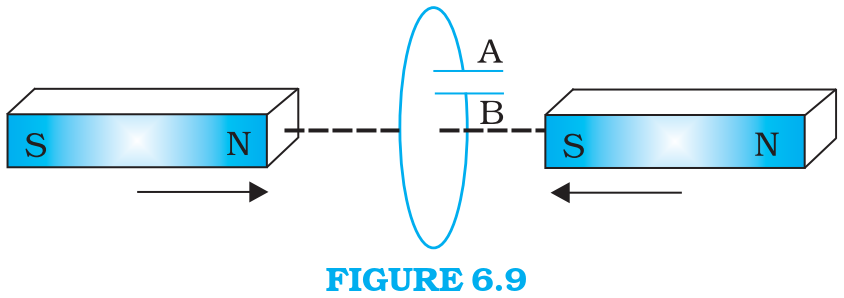
(d) Predict the polarity of the capacitor in the situation described by Fig. 6.9.

Image