MCQ
In a current carrying conductor the net charge is:
- A1.6 × 10–19 coulomb.
- B6.25 × 10–18 coulomb.
- CZero.
- DInfinite.
Generate a complete, print-ready paper with questions like this in minutes — across 16+ boards, with answer keys.
Five equal resistances each of value R are connected in a form shown alongside. The equivalent resistance of the network

|
(a) Between the points B and D is R |
(b) Between the points B and D is |
|
(c) Between the points A and C is R |
(d) b, c |
A convex lens of crown glass (n =1.525) will behave as a divergent lens if immersed in
|
(a) Water (n = 1.33) |
(b) In a medium of n = 1.525 |
|
(c) Carbon disulphide n = 1.66 |
(d) It cannot act as a divergent lens |
As the switch S is closed in the circuit shown in figure, current passed through it is
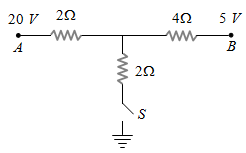
|
(a) 4.5 A |
(b) 6.0 A |
(c) 3.0 A |
(d) Zero |
The power of an achromatic convergent lens of two lenses is + 2D. The power of convex lens is + 5D. The ratio of dispersive power of convex and concave lens will be
|
(a) 5 : 3 |
(b) 3 : 5 |
(c) 2 : 5 |
(d) 5 : 2 |
A metallic ring connected to a rod oscillates freely like a pendulum. If now a magnetic field is applied in horizontal direction so that the pendulum now swings through the field, the pendulum will
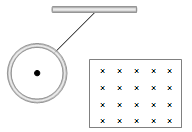
|
(a) Keep oscillating with the old time period |
|
(b) Keep oscillating with a smaller time period |
|
(c) Keep oscillating with a larger time period |
|
(d) Come to rest very soon |
The activity of a sample is 64 × 10–5 Ci. Its half-life is 3 days. The activity will become 5 × 10⁻⁶ Ci after
|
(a) 12 days |
(b) 7 days |
(c) 18 days |
(d) 21 days |
Assertion : Newton’s rings are formed in the reflected system. When the space between the lens and the glass plate is filled with a liquid of refractive index greater than that of glass, the central spot of the pattern is dark.
Reason : The reflection is Newton’s ring cases will be from a denser to a rarer medium and the two interfering rays are reflected under similar conditions.
|
(a) If both assertion and reason are true and the reason is the correct explanation of the assertion. |
|
(b) If both assertion and reason are true but reason is not the correct explanation of the assertion. |
|
(c) If assertion is true but reason is false. |
|
(d) If the assertion and reason both are false. |
