Question
In a cyclotron, a charged particle:

Answer

  1. Undergoes acceleration all the time.
Solution:
In a cyclotron, a charged particle describes the circular path inside the dees & is accelerated while going from one dee to another due to the electric field.
While moving in the circular path, charged particles have centripetal acceleration which is provided by the magnetic force due to the magnetic field.
A charged particle undergoes acceleration all the time, inside the cyclotron.

Need a full question paper?

Generate a complete, print-ready paper with questions like this in minutes — across 16+ boards, with answer keys.
Start Generating Free

Similar questions

A convex lens(a) Converges light rays(b) Diverges light rays(c) Form real images always(d) Always forms virtual images
   
   
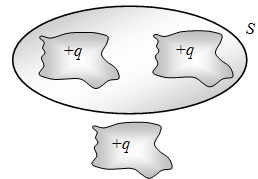
Shown below is a distribution of charges. The flux of electric field due to these charges through the surface $S$ is
Principle of photoelectric effect was established by :
The ultimate individual unit of magnetism in any magnet is called(a) North pole(b) South pole(c) Dipole(d) Quadrupole
       
In a Young's experiment, two coherent sources are placed $0.90\ mm$ apart and the fringes are observed one metre away. If it produces the second dark fringe at a distance of $1\ mm$ from the central fringe, the wavelength of monochromatic light used would be
A galvanometer with a resistance of $12\Omega$ gives full scale deflection when a current of $3\ mA$ is passed. It is required to convert it into a voltmeter which can read up to $18\ V.$  the resistance to be connected is
Assertion :   Mass of moving photon varies inversely as the wavelength.
Reason : Energy of the particle $=$ Mass $\times (\text { Speed of light })^2$
In non-resonant circuit, what will be the nature of the circuit for frequencies higher than the resonant frequency?
The forces in which sum of kinetic energy and potential energy is conserved are called as:
The resultant of $\overrightarrow{\text{A}}$ and $\overrightarrow{\text{B}}$ makes an angle a with $\overrightarrow{\text{A}}$ and $\beta$ with $\overrightarrow{\text{B}},$
  1. $\alpha<\beta$
  2. $\alpha<\beta \text{ if}\text{ A}<\text{B}$
  3. $\alpha<\beta \text{ if}\text{ A}>\text{B}$
  4. $\alpha<\beta \text{ if}\text{ A}=\text{B}$