MCQ
In a diffraction pattern due to a single slit of width a with incident light of wavelength $\lambda$ at an angle of diffraction $\theta$, the condition for the first minimum is
  • A
    $\lambda \sin \theta=a$
  • B
    $a \cos \theta=\lambda$
  • $a \sin \theta=\lambda$
  • D
    $\lambda \cos \theta=a$.

Answer

Correct option: C.
$a \sin \theta=\lambda$

Need a full question paper?

Generate a complete, print-ready paper with questions like this in minutes — across 16+ boards, with answer keys.

Start Generating Free

Similar questions

Which of the following statements is correct for diamagnetic materials?
A beam of unpolarized light passes through a tourmaline crystal $A$ and then it passes through a second tourmaline crystal $B$ oriented so that its principal plane is parallel to that of $A$. The intensity of emergent light is $I_0$. Now $B$ is rotated by $45^{\circ}$ about the ray. The emergent light will have intensity $\left(\cos 45^{\circ}=\frac{1}{\sqrt{2}}\right)$
The path difference between two interfering light waves meeting at a point on the screen is $\left(\frac{87}{2}\right) \lambda$. The band obtained at that point is
The electric field intensity on the surface of a solid charged sphere of radius ' $r$ ' and volume charge density ' $Q$ ' is ( $\varepsilon_0=$ permittivity of free space)
A stretched string, $2 m$ long, vibrates in its third overtone. The distance between consecutive nodes is
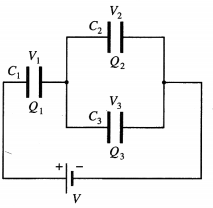
Three capacitors $C_1, C_2$ and $C_3$ are connected to a battery of p.d. $V$ as shown. Which of the following are the correct relations for the charges on the capacitors and the p.d.s across them ?

Image

Two uniform wires of the same material are vibrating under the same tension. If the first overtone of the first wire is equal to the second overtone of the second wire and radius of the first wire is twice the radius of the second wire then the ratio of the lengths of the first wire to second wire is
In a certain unit, the radius of gyration of a uniform disc about its central and transverse axis is $\sqrt{2.5}$. Its radius of gyration about a tangent in its plane (in the same unit) must be
Which of the following system freely allows the exchange of energy and matter with its environment? 
The potential energy of a molecule on the surface of a liquid compared to the molecules inside the liquid is