MCQ
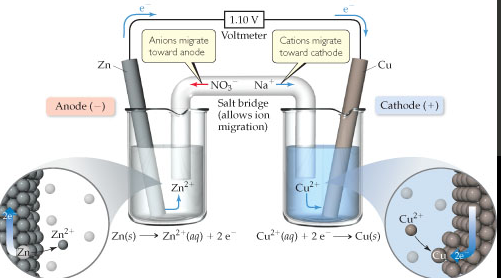
In a galvanic cell electron flow will be from:
- ANegative electrode to positive electrode.
- BPositive electrode to negative electrode.
- CThere will be no flow of electrons.
- DCathode to anode in the extenal circuit.
Explanation:
Electron flows opposite to the direction of current, i.e. from low to high voltage.
$\therefore$ Electron flows from negative to the positive electrode.
Generate a complete, print-ready paper with questions like this in minutes — across 16+ boards, with answer keys.
$'X'\,\,\xrightarrow{{water}}$ Insoluble
$'X'\xrightarrow{{5\% \,HCl}}$ Insoluble
$'X'\xrightarrow{{10\% \,NaOH}}$ Insoluble
$'X'\xrightarrow{{10\% \,NaHC{O_3}}}$ Insoluble
[Given, molar mass of $A =100 \,g\, mol ^{-1} ; B =200 \,g\, mol ^{-1}$$\left. C =10,000 \,g\, mol ^{-1}\right]$
$E_{F{e^{2 + }}/Fe}^o\, = \, - \,0.44\,\,V\,;\,\,E_{Z{n^{2 + }}/Zn}^o\, = \, - \,0.76\,\,V\,;\,$
$E_{C{u^{ + 2}}/Cu}^o\, = \,0.34\,\,V$
Based on this data, which of the following is the strongest reducing agent ?