MCQ
 In a hydro power plant:
  • A
    Potential energy possessed by stored water is converted into electricity.
  • B
    Kinetic energy possessed by stored water is converted into potential energy.
  • C
    Water is heated to produce electricity.
  • D
    Water is converted into steam to produce electricity.
Answer

  1. Potential energy possessed by stored water is converted into electricity.

Explanation:

Hydro power plant uses the potential energy stored in water. When water flows down the dam, potential energy is converted into kinetic energy which is used to rotate the turbine which produce electricity.

Need a full question paper?

Generate a complete, print-ready paper with questions like this in minutes — across 16+ boards, with answer keys.

Start Generating Free

Similar questions

The wave function of a pulse is given by $y=\frac{5}{(4 x+6 t)^2}$, where $x$ and $y$ are in metre and $t$ is in second. The velocity of pulse is ......... $m / s$
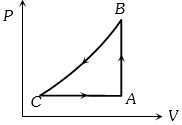
A sample of an ideal gas is taken through a cycle a shown in figure. It absorbs $50J$ of energy during the process $AB$, no heat during $BC$, rejects $70J$ during $CA.$ $40J$ of work is done on the gas during $BC$. Internal energy of gas at $A$ is $1500J$, the internal energy at $C$ would be ........ $J$
Two bodies $A$ and $B$ of mass $m$ and $2\, m$ respectively are placed on a smooth floor. They are connected by a spring of negligible mass. $A$ third body $C$ of mass $m$ is placed on the floor. The body $C$ moves with a velocity $v_0$ along the line joining $A$ and $B$ and collides elastically with $A$. At a certain time after the collision it is found that the instantaneous velocities of $A$ and $B$ are same and the compression of the spring is $x_0$. The spring constant $k$ will be
Two cars OF SAME LENGTH move in the same direction along parallel roads. One of them is a 100m long travelling with a velocity of 7.5 ms−1. How long will it take for the first car to overtake the second car?
The deceleration experienced by a moving motor boat, after its engine is cut-off is given by $\frac{{dv}}{{dt}} =  - k{v^3}$ , where $k$ is constant. If $v_0$ is the magnitude of the velocity at cut-off, the magnitude of the velocity at a time $t$ after the cut-off is
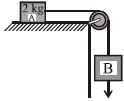
The coefficient of static friction, $\mu _s$ between block $A$ of mass $2\,kg$ and the table as shown in the figure is $0.2$. What would be the maximum mass value of block $B$ so that the two blocks $B$ so that the two blocks do not move? The string and the pulley are assumed to be smooth and masseless ....... $kg$ $(g = 10\,m/s^2)$
The resultant of $\overrightarrow A + \overrightarrow B $ is ${\overrightarrow R _1}.$ On reversing the vector $\overrightarrow {B,} $ the resultant becomes ${\overrightarrow R _2}.$ What is the value of $R_1^2 + R_2^2$
A particle of mass $m$ moving towards west with speed $v$ collides with another particle of mass $m$ moving towards south. If two particles stich to each other, the speed of the new particle of mass $2 m$ will be ..........
An aeroplane moving horizontally with a speed of $720 \,km/h$ drops a food pocket, while flying at a height of $396.9\, m$. the time taken by a food pocket to reach the ground and its horizontal range is (Take $g = 9.8 m/sec^{2}$)
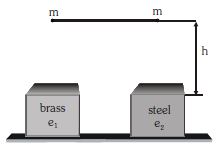
A dumbbell consisting of two masses $m$ each, connected by a light rigid rod of length $l$, falls on two pads of equal height, one steel and the other brass through a height $h$. The coefficient of restitution are $e_1$ and $e_2$ ($e_1 < e_2$). To what maximum height will the centre of mass of the dumbbell rise after bouncing of the pads?