Questions · Page 1 of 5

M.C.Q (1 Marks)

🎯

Test yourself on this topic

50 questions · timed · auto-graded

MCQ 11 Mark
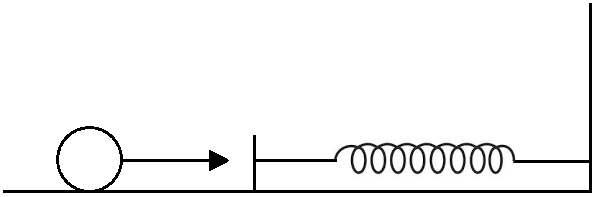
A mass of 0.5kg moving with a speed of 1.5ms-1 on a horizontal smooth surface, collides with a nearly weightless spring of spring constant k = 50N/ m-1

The maximum compression of the spring would be:
  • A
    0.15m
  • B
    0.12m
  • C
    1.5m
  • D
    0.5m
Answer
  1. 0.15m
View full question & answer
MCQ 21 Mark
A body of mass 2kg makes an elastic collision with another body at rest and comes to rest. The mass of the second body which collides with the first body is:
  • A
    2kg
  • B
    1. 2kg
  • C
    3kg
  • D
    1kg
Answer
  1. 2kg
View full question & answer
MCQ 31 Mark
Which one of the following energies cannot be possessed by a body at rest?
  • A
    Potential energy
  • B
    Kinetic energy
  • C
    Thermal energy
  • D
    Magnetic energy
Answer
  1. Kinetic energy

Explanation:

Kinetic energy is possessed by a body by virtue of its state of motion. So, a body at rest cannot possess kinetic energy. A body at rest will possess potential energy. Thermal and magnetic energies are irrespective of state of rest or of motion of a body.

View full question & answer
MCQ 41 Mark
Which one of the following possesses potential energy?
  • A
    Moving vehicle on the road.
  • B
    A running athlete.
  • C
    Stone on the road.
  • D
    A stretched rubber band.
Answer
  1. A stretched rubber band.

Explanation:

Moving vehicle on the road possesses kinetic energy.

A running athlete possesses kinetic energy.

Stone on the road possesses kinetic energy.

A stretched rubber band possesses potential energy.

View full question & answer
MCQ 51 Mark
A ball is projected upwards. As it rises, there is increase in its:
  • A
    Momentum.
  • B
    Retardation.
  • C
    Kinetic energy.
  • D
    Potential energy.
Answer
  1. Potential energy.

Explanation:

When a ball is projected upwards it's height increases.

As height increases, v velocity decreases  (Kinetic Energy Decreases) so Potential energy increases.

Potential Energy = mgh

View full question & answer
MCQ 61 Mark
Two weights of 5kg and 10kg are placed on a horizontal table of height 1.5m. Which will have more potential energy?
  • A
    5kg
  • B
    10kg
  • C
    Both will have equal energy
  • D
    None of the above
Answer
  1. 10kg

Explanation:

We know that, P.E = mgh

So, It is directly proportional to height and mass.

Since both the weights are at the same height, so the weight with a larger mass will have more potential energy.

Since 10kg object has a larger mass than a 5 medical history

So, the potential energy of a 10kg mass will be greater.

View full question & answer
MCQ 71 Mark
A particle is acted upon by a force of constant magnitude which is always perpendicular to the velocity of the particle. The motion of the particle takes place in a plane. It follows that:
  • A
    Its velocity is constant.
  • B
    Its acceleration is constant.
  • C
    Its kinetic energy is constant.
  • D
    It moves in a circular path.
Answer
  1. Its kinetic energy is constant.
  2. It moves in a circular path.

Explanation:

When the force on a particle is always perpendicular to its velocity, the work done by the force on the particle is zero, as the angle between the force and velocity is 90°. So, kinetic energy of the particle will remain constant. The force acting perpendicular to the velocity of the particle provides centripetal acceleration that causes the particle to move in a circular path.

View full question & answer
MCQ 81 Mark
A body is moving unidirectionally under the influence of a source of constant power. Its displacement in time t is proportional to:
  • A
    $\text{t}^{\frac{1}{2}}$
  • B
    $\text{t}$
  • C
    $\text{t}^\frac{3}{2}$
  • D
    $\text{t}^2$
Answer
  1. $\text{t}^\frac{3}{2}$

Solution:

As power, P = force × veclocity

$\text{P}=\big[\text{MLT}^{-2}\big]\big[\text{LT}^{-1}\big]=\big[\text{ML}^2\text{T}^{-3}\big]$

As, $\text{P}=\big[\text{ML}^2\text{T}^{-3}\big]$

= Constant

$\therefore\text{ L}^2\text{T}^3=\text{Constant}$

Or, $\frac{\text{L}^2}{\text{T}^3}=\text{Constant}$

$\therefore\text{ L}^2\propto\text{T}^3$

Or, $\text{L}\propto \text{T}^{\frac{3}{2}}$

Hence, right choice is (iii) $\text{t}^{\frac{3}{2}}$

View full question & answer
MCQ 91 Mark
A body of mass 'M' collides against a wall with a velocity v and retraces its path with the same speed. the change in momentum is ............. (take initial direction of velocity as positive)
  • A
    Zero
  • B
    2Mv
  • C
    Mv
  • D
    -2 Mv
Answer
  1. 2Mv

Explanation:

Taking + x direction to be positive, and assuming ball was travelling in + x direction initially.

Pi = Mv

After collision ball will move in - x direction

Pf ​= − Mv

Change in momentum:

ΔP = Pi ​− Pf​

ΔP = Mv + Mv = 2Mv

View full question & answer
MCQ 101 Mark
Name the type of energy (kinetic energy K or potential energy U) possessed in a compressed spring:
  • A
    U
  • B
    K
  • C
    Both U and K
  • D
    None
Answer
  1. U

Explanation:

When you compress a spring, it possess potential energy. The force of compression is proportional to the compression, according to Hooke's Law. Releasing the spring turns the potential energy into kinetic energy. The spring can be then used to propel some object.

View full question & answer
MCQ 111 Mark
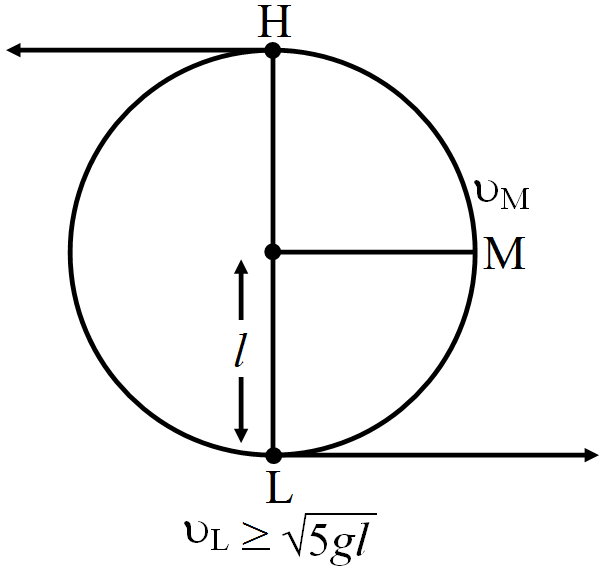
A particle is rotated in a vertical circle by connecting it to a string of length l and keeping the other end of the string fixed. The minimum speed of the particle when the string is horizontal for which the particle will complete the circle is:
  • A
    $\sqrt{\text{gl}}$
  • B
    $\sqrt{2\text{gl}}$
  • C
    $\sqrt{3\text{gl}}$
  • D
    $\sqrt{5\text{gl}}$
Answer
  1. $\sqrt{3\text{gl}}$

Explanation:

Suppose that one end of an extensible string is attached to a mass m, while the other end is fixed. The mass moves with a velocity v in a vertical circle of radius R. At some instant, the string makes an angle $\theta$ with the vertical as shown in the figure.


For a complete circle, the minimum velocity at L must be $\nu_\text{L}=\sqrt{5\text{gl}}.$

Applying the law of conservation of energy, we have:

Total energy at M = total energy at L

i.e., $\frac{1}{2}\text{m}\nu_{\text{M}^2}+\text{mgl}=\frac{1}{2}\text{m}\nu_{\text{L}^2}$

$\Rightarrow\frac{1}{2}\text{m}\nu_{\text{M}^2}=\frac{1}{2}\text{m}\nu_{\text{L}^2}-\text{mgl}$

Using $\nu_\text{L}\geq\sqrt{5\text{gl}},$ we have:

$\frac{1}{2}\text{m}\nu_{\text{M}^2}\geq\frac{1}{2}\text{m}(5\text{gl})-\text{mgl}$

$\therefore\ \nu_\text{M}=\sqrt{3\text{gl}}$

View full question & answer
MCQ 121 Mark
What are conservative forces? Distinguish the conservative and non-conservative forces among the following:
  • A
    Gravitational force.
  • B
    Frictional force.
  • C
    Air resistance.
  • D
    Electrostatic force.
Answer

Conservative forces are those forces in which work done (i) in a closed path is zero and (ii) is independent of path.

  1. Conservative forces: Gravitational and Electrostatic force.

  2. Non-conservative forces: Frictional force and air resistance. 

View full question & answer
MCQ 131 Mark
A one kilowatt motor is used to pump water from a well 10m deep. The quantity of water pumped out per second is nearly:
  • A
    1kg.
  • B
    10kg.
  • C
    100kg.
  • D
    1000kg.
Answer
  1. 10kg.
View full question & answer
MCQ 141 Mark
By stretching the rubber strings of a catapult we store .......... energy in it.
  • A
    Potenti on of the
  • B
    Electrical
  • C
    Heat
  • D
     i'mnot c
Answer
  1. Potenti on of the

Explanation:

The energy exerted or work done by our muscles on the rubber band is consumed in changing its shape. It gets stored in the stretched rubber band as its potential energy. It is this stored energy that is used by the rubber band to move to its original state, shape, and size. When the rubber band is released, this stored potential energy gets converted into kinetic energy.

If a pebble is placed in contact with the stretched rubber band, this kinetic energy is transferred to the pebble. This kinetic energy of the pebble is enough to do some destructive work, like breaking a glass window, injuring someone, etc.

View full question & answer
MCQ 151 Mark
How many collision are possible between the blocks?
  • A
    2
  • B
    4
  • C
    27
  • D
    infinite
Answer
  1. infinite

Explanation:

As the distance keeps on decreasing  and there will be a deceleration in the blocks.

In further results,   collision increases frequently many times  and slowly come in contact.

View full question & answer
MCQ 161 Mark
Name the type of energy (kinetic energy K or potential energy In the) possessed in the following case.
A piece of stone placed on the roof.
  • A
    In the
  • B
    K
  • C
    In the and K
  • D
    No energy
Answer
  1. In the

Explanation:

When a stone is placed at the roof it is at a certain height that is given by In the = m × g × h

As we have a certain value for h there would be some value for potential energy.

As the stone is at rest at the roof it will not have any kinetic energy as its velocity is zero, $\text{K}=\frac{1}{2}(\text{m}\times\text{in}^2)=0$

View full question & answer
MCQ 171 Mark
A ball of mass m moving with velocity in collides elastically with wall and rebounds. The change in momentum of the ball will be:
  • A
    4min
  • B
    2min
  • C
    min
  • D
    zero
Answer
  1. 2min

Explanation:

Here, a ball of mass m moving with velocity in collides elastically with wall hence, momentum is.

pi = min

The ball rebounds from wall hence, final momentum is.

pf​ = −min

Change in momentum is.

Δp = pi ​− pf​

Δp = mv − (−min) = 2min

View full question & answer
MCQ 181 Mark
______ of a two particle system depends only on the separation between the two particles. The most appropriate choice for the blank space in the above sentence is:
  • A
    Kinetic energy.
  • B
    Total mechanical energy.
  • C
    Potential energy.
  • D
    Total energy.
Answer
  1. Potential energy.

Explanation:

The potential energy of a two particle system depends only on the separation between the particles.

View full question & answer
MCQ 191 Mark
A particle is acted by a constant power. Then, which of the following physical quantity remains constant?
  • A
    Speed.
  • B
    Rate of change of acceleration.
  • C
    Kinetic energy.
  • D
    Rate of change of kinetic energy.
Answer
  1. Rate of change of kinetic energy.

Explanation:

By definition, $\text{p}\frac{\text{dW}}{\text{dt}}$

$\because$ Work done = Kinetic energy

$\Rightarrow\text{p}=\frac{\text{dW}}{\text{dt}}$

$=\frac{\text{d(KE)}}{\text{dt}}=\text{constant}$

View full question & answer
MCQ 201 Mark
One end of a light spring of spring constant k is fixed to a wall and the other end is tied to a block placed on a smooth horizontal surface. In a displacement, the work done by the spring is $\frac{1}{2}\text{kx}^2.$ The possible cases are:
  • A
    At spring was initially compressed by a distance x and was finally in its natural length.
  • B
    It was initially stretched by a distance x and and finally was in its natural length.
  • C
    It was initially in its natural length and finally in a compressed position.
  • D
    It was initially in its natural length and finally in a stretched position.
Answer
  1. At spring was initially compressed by a distance x and was finally in its natural length.
  2. It was initially stretched by a distance x and and finally was in its natural length.
Explanation:

For an elastic spring, the work done is equal to the negative of the change in its potential energy.

When the spring was initially compressed or stretched by a distance x, its potential energy is given by,

$(\text{P.E.})_\text{i}=\frac{1}{2}\text{kx}^2$

When it finally comes to its natural length, its potential energy is given by,

$(\text{P.E.})_\text{f}=0$

$\therefore$ Work done $=-[(\text{P.E.})_\text{f}-(\text{P.E.})_\text{i}]=-\Big[0-\frac{1}{2}\text{kx}^2\Big]$

$=\frac{1}{2}\text{kx}^2$

View full question & answer
MCQ 211 Mark
The moon revolves around the earth because the earth exerts a radial force on the moon. Does  the earth perform work on the moon?
  • A
    No
  • B
    yes, sometimes
  • C
    yes, always
  • D
    cannot be decided
Answer
  1. No

Explanation:

No, the earth does not perform any work on the moon.

Work done(W) is defined as the scalar  product of force(F) and displacement(s).

So, W = F × s = FsCosI where is the angle between force and displacement vector.

The radial force exerted on the moon by earth i.e attractive force due to gravity acts in direction perpendicular to which the moon suffers the displacement during rotation.

So,  I = 90 hence  CosI = 0

So, W = |F|| s| × 0  = 0

View full question & answer
MCQ 221 Mark
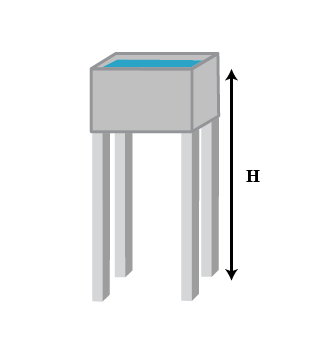
An overhead tank having some water possesses .......... energy.
  • A
    Kinetic
  • B
    Potential
  • C
    Thermal
  • D
    Electrical
Answer
  1. Potential

Explanation:

We know that Potential energy is the energy possessed by a body by the virtue of its position.

$\therefore$ An overhead tank having some water possesses Potential energy, as it is at a height.

View full question & answer
MCQ 231 Mark
A particle is acted upon by a force F which varies with position x as shown in the figure. If the particle at x = 0 has the kinetic energy of 25J, then the kinetic energy of the particle at x = 16m is?
  • A
    45J
  • B
    30J
  • C
    70J
  • D
    135J
Answer
  1. 45J
View full question & answer
MCQ 241 Mark
A coconut fruit hanging high in a palm tree has ......... owing to its location.
  • A
    Free energy.
  • B
    Kinetic energy.
  • C
    Activation energy.
  • D
    Potential energy.
Answer
  1. Potential energy.

Explanation:

The potential energy possessed by the object is the energy present in it by virtue of its position or configuration. So, the hanging coconut has potential energy due to its location (height).

View full question & answer
MCQ 251 Mark
A man, of mass m, standing at the bottom of the staircase, of height L climbs it and stands at its top.
  • A
    Work done by all forces on man is equal to the rise in potential energy mgL.
  • B
    Work done by all forces on man is zero.
  • C
    Work done by the gravitational force on man is mgL.
  • D
    The reaction force from a step does not do work because the point of application of the force does not move while the force exists.
Answer
  1. Work done by all forces on man is zero.
  1. The reaction force from a step does not do work because the point of application of the force does not move while the force exists.

Explanation:

  1. Work done by gravitational force on man is (-mgL) as gravitational force is downward and displacement L is upward. The Work done by man to lift him up by muscular force will be (+mgL) as force applied by muscles is in the direction of displacement. So net work done = -mgL + mgL = 0.
  1. As there is no displacement point where the reaction acts so, Work Done by reaction torce is zero. As the velocity of person atmost zero at top. So KE = 0. Hence, Work Done by reaction force is zero.
View full question & answer
MCQ 261 Mark
If the external forces acting on a system have zero resultant, the centre of mass:
  • A
    May move.
  • B
    May accelerate.
  • C
    Must not move.
  • D
    Must not accelerate.
Answer
  1. May move.
  2. Must not accelerate.

Explanation: 

When external forces acting on a system have zero resultant, the centre of mass may move with a constant velocity i.e. it must not accelerate.

View full question & answer
MCQ 271 Mark
You lift a suitcase from the floor and keep it on a table. The work done by you on the suitcase does not depend on:
  • A
    The path taken by the suitcase.
  • B
    The time taken by you in doing so.
  • C
    The weight of the suitcase.
  • D
    Your weight.
Answer
  1. The path taken by the suitcase.

  2. The time taken by you in doing so.

  1. Your weight.

Explanation:

Work done by us on the suitcase is equal to the change in potential energy of the suitcase.

i.e., W = mgh

Here, mg is the weight of the suitcase and h is height of the table.

Hence, work done by the conservative (gravitational) force does not depend on the path.

View full question & answer
MCQ 281 Mark
Water stored in a dam possesses:
  • A
    No energy.
  • B
    Electrical energy.
  • C
    Kinetic energy.
  • D
    Potential energy.
Answer
  1. Potential energy.

Explanation:

The potential energy possessed by the object is the energy present in it by virtue of its position or configuration. Water stored in a dam, when allowed to flow, has kinetic energy which was earlier stored as potential energy.

View full question & answer
MCQ 291 Mark
When an aeroplane takes off from the ground:
  • A
    Kinetic energy increases and Potential energy decreases
  • B
    Potential energy increases and Kinetic energy remains constant
  • C
    Both Kinetic energy and Potential energy remain constant
  • D
    Both Kinetic energy and Potential energy increase
Answer
  1. Both Kinetic energy and Potential energy increase

Explanation:

Kinetic energy is due to the motion of the object and potential energy is due to relative elevation.

So as the plane takes off height increases and also its speed increase, so both kinetic and potential energy increases.

Kinetic energy$=\frac{1}{2}\text{min}^2$

Potential energy = mgH

View full question & answer
MCQ 301 Mark
A force of 10N is applied on an object of mass 2kg placed on a rough surface having coefficient of friction equal to 0.2. Work done by applied force in 4s is:
  • A
    120J.
  • B
    240J.
  • C
    250J.
  • D
    100J.
Answer
  1. 240J.
View full question & answer
MCQ 311 Mark
How much amount of energy is liberated to convert 1kg of coal into energy?
  • A
    9 × 10¹⁶J.
  • B
    9 × 1015J.
  • C
    3 × 1014J.
  • D
    4 × 106J.
Answer
  1. 9 × 10¹⁶J.
View full question & answer
MCQ 321 Mark
A heavy stone is thrown in from a cliff of height h in a given direction. The speed with which it hits the ground:
  • A
    Must depend on the speed of projection.
  • B
    Must be larger than the speed of projectio.
  • C
    Must be independent of the speed of projection.
  • D
    May be smaller than the speed of projection.
Answer
  1. Must depend on the speed of projection.
  2. Must be larger than the speed of projectio.

Explanation:

Consider that the stone is projected with initial speed v.

As the stone is falls under the gravitational force, which is a conservative force, the total energy of the stone remains the same at every point during its motion.

From the conservation of energy, we have:

Initial energy of the stone = final energy of the stone

i.e., (K.E.)i + (P.E.)= (K.E.)+ (P.E.)f

$=\frac{1}{2}\text{mv}_\text{r}^2+\text{mgh}=\frac{1}{2}\text{m}(\text{v}_\text{max})^2$

$\Rightarrow\text{v}_\text{max}=\sqrt{\text{v}^2+2\text{gh}}$

From the above expression, we can say that the maximum speed with which the stone hits the ground depends on the speed of projection and greater than it.

View full question & answer
MCQ 331 Mark
A particle of mass m1​ moving with a velocity of 5m/ s collides head on with a stationary particle of mass m2​. After collision both the particle move with a common velocity of 4m/ s, then the value m1​/ m2​ is:
  • A
    4 : 1
  • B
    2 : 1
  • C
    1 : 8
  • D
    1 : 2
Answer
  1. 4 : 1

Explanation:

Conservation of Momentum principle, Initial momentum is Mi = 5m1​

Final momentum is Mf​ = 4(m1 ​+ m2​)

By the above stated principle Mi​ = Mf​ = 5m1​ = 4(m1​ + m2​)

⟹ m1​ = 4m2

$\therefore$ m1​ : m2​= 4 : 1

View full question & answer
MCQ 341 Mark
The work done by the external forces on a system equals the change in:
  • A
    Total energy.
  • B
    Kinetic energy.
  • C
    Potential energy.
  • D
    None of these.
Answer
  1. Total energy.

Explanation:

When work is done by an external forces on a system, the total energy of the system will change.

View full question & answer
MCQ 351 Mark
A girl weighing 50kg makes a high jump of 1.2m. What is her kinetic energy at the highest point? (g = 10ms−2)
  • A
    6000J
  • B
    600J
  • C
    60J
  • D
    Zero
Answer
  1. Zero

Explanation:

mass of girl M = 50kg

h = 1. 2m

A girl is jumping vertically upward, when it will reach at maximum Hight its velocity will become zero ie in​= 0

K. And $=\frac{1}{2}\text{min}^2=\frac{1}{2}\text{m}\times0=0$

View full question & answer
MCQ 361 Mark
Work done by a body against friction always results in:
  • A
    Loss in kinetic energy.
  • B
    Loss in potential energy.
  • C
    Gain in kinetic energy.
  • D
    Gain in potential energy.
Answer
  1. Loss in kinetic energy.
View full question & answer
MCQ 371 Mark
The form of energy present in a wound spring is:
  • A
    Chemical.
  • B
    Heat energy.
  • C
    Magnetic.
  • D
    Mechanical.
Answer
  1. Mechanical.

Explanation:

Potential energy is stored in a wound spring. Potential energy is a type of mechanical energy. Hence, energy present in a wound spring is mechanical energy.

View full question & answer
MCQ 381 Mark
The power (P) of an engine lifting a mass of 100kg upto a height of 10m in 1 min is:
  • A
    162.3W
  • B
    163.3W
  • C
    164.3W
  • D
    165W
Answer
  1. 163.3W

 Explanation:

$\text{power}=\frac{\text{Work}}{\text{Time}}=\frac{\text{mgh}}{\text{t}}$

Here, m = 100kg, h = 10m

and t = 1 min = 60s

$\therefore\text{p}=\frac{100\times9.8\times10}{60}=163.3\text{W}$

View full question & answer
MCQ 391 Mark
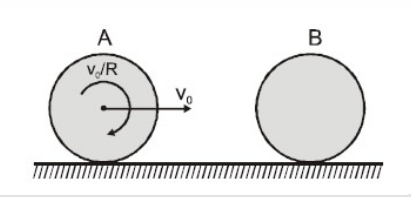
A hollow smooth uniform sphere A of mass m rolls without sliding on a smooth horizontal surface. It collides elastically and head-on with another stationary smooth hollow sphere B of the same mass mm and same radius. The ratio of the kinetic energy of B to that of A just after the collision is:
  • A
    1 : 1
  • B
    2 : 3
  • C
    3 : 2
  • D
    None
Answer
  1. 1 : 1

Explanation:

The sphere is rolling on a smooth surface i.e., no energy is lost to friction and the kinetic energy of sphere A is transferred to the sphere B without any loss as the collision is head-on and elastic.

Thus, the kinetic energy of sphere A and sphere B are equal their ratio will be 1 : 1

View full question & answer
MCQ 401 Mark
When an arrow is released from a bow, potential energy changes into kinetic energy.
  • A
    True
  • B
    False
  • C
    Ambiguous
  • D
    Data insufficient
Answer
  1. True

Explanation:

When an arrow is drawn back by a bow, the work done by us in stretching the bowstring gets stored at potential energy in the bow.

This potential energy of bow is transformed into kinetic energy when the bowstring is released and this gives kinetic energy to the arrow.

View full question & answer
MCQ 411 Mark
Two bodies of masses m, and m, have same momentum. The ratio of their KE is:
  • A
    $\sqrt{\frac{\text{m}_2}{\text{m}_1}}$
  • B
    $\sqrt{\frac{\text{m}_1}{\text{m}_2}}$
  • C
    $\frac{\text{m}_1}{\text{m}_2}$
  • D
    $\frac{\text{m}_2}{\text{m}_1}$
Answer
  1. $\frac{\text{m}_2}{\text{m}_1}$
View full question & answer
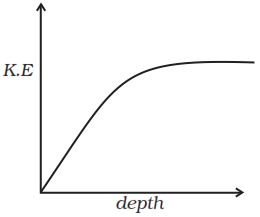
Question 421 Mark
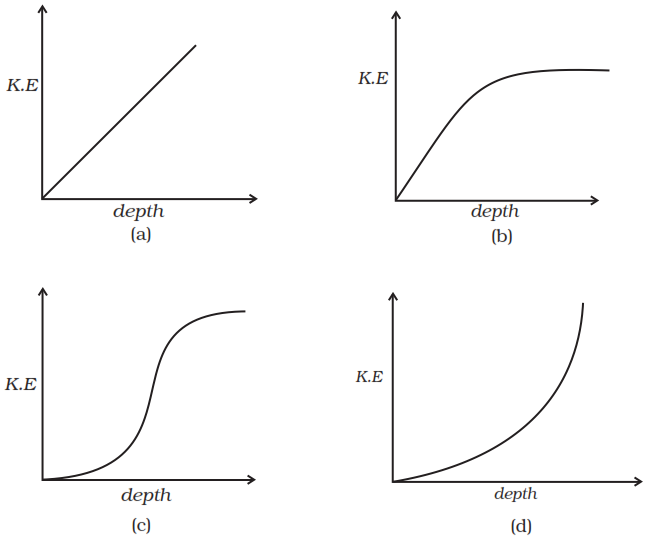
Which of the diagrams in correctly shows the change in kinetic energy of an iron sphere falling freely in a lake having sufficient depth to impart it a terminal velocity?
Answer
  1.  

Explanation:

Constant after some depth. This constant velocity is called terminal velocity, hence KE become constant beyond this depth, which is best represented by (b).

View full question & answer
MCQ 431 Mark
A body of mass 2Kg moving (initially) with 10m/ s is acting upon by a resultant constar which is opposite to its initial velocity. Its speed decreases to 4m/ s in 1s. Then the force:
  • A
    12N
  • B
    28N
  • C
    8N
  • D
    None
Answer
  1. 12N
View full question & answer
MCQ 441 Mark
What is kinetic energy?
  • A
    Energy possessed by a body by the virtue of its motion.
  • B
    Energy possessed by a body by the virtue of its shape.
  • C
    Energy possessed by a body by the virtue of its size.
  • D
    None.
Answer
  1. Energy possessed by a body by the virtue of its motion.

Explanation:

The energy which a body possesses by virtue of being in motion is called as kinetic energy.

If we want to stop a moving body then we must do some work on the body to stop it which means that a moving body possesses energy because of motion.

If an object of mass m moving with the velocity v, The kinetic energy is defined as,

$\text{K.E}=\frac{1}{2}\text{mv}^2$

View full question & answer
MCQ 451 Mark
If the linear momentum is increased by 50%, then kinetic energy will be increased by:
  • A
    50%
  • B
    100%
  • C
    125%
  • D
    25%
Answer
  1. 125%
View full question & answer
MCQ 461 Mark
A boy of mass 40kg  runs up a flight of 50 steps, each 10cm  high in 14s. So, work done by the boy is:
  • A
    1960J
  • B
    19.6J
  • C
    980J
  • D
    9.8J
Answer
  1. 1960J

Explanation:

Mass of the boy, m = 40kg

Number of steps = 50

Height of each step = 10cm 

Force on the boy due to gravity, F = mg = 40 × 9. 8 N = 392N 

While climbing up the steps, the boy does work against gravity.

Displacement in the vertical direction, s = (50 × 10)cm = 500cm = 5m

Displacement is in the direction of force applied by the boy against gravity.

So, work done, In = F × s = 392 × 5J = 1960J

View full question & answer
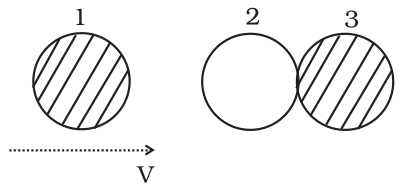
Question 471 Mark
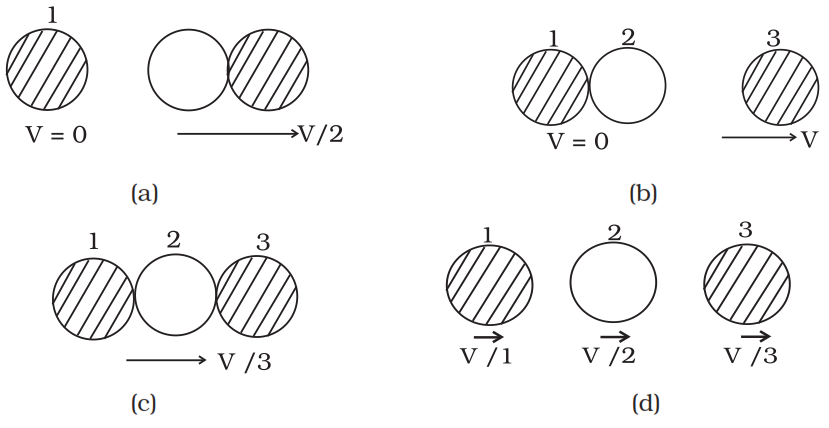
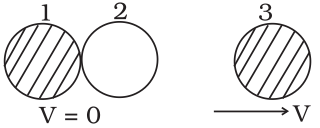
Two identical ball bearings in contact with each other and resting on a frictionless table are hit head-on by another ball bearing of the same mass moving initially with a speed V as shown in:If the collision is elastic, which of the following is a possible result after collision?
Answer
  1.  

Explanation:

Key concept: In a collision if the motion of colliding particles before and after the collision is along the same line, the collision is said to be head on or one dimensional.

When two bodies of equal masses collides elastically, their velocities are interchanged. Kinetic energy and linear momentum remains conserved Total kinetic energy of the system before collision

$=\frac{1}{2}\text{mv}^2+0=\frac{1}{2}\text{mv}^2$

In (a), kinetic energy of the system after collision,

$\text{K}_1=\frac{1}{2}(2\text{m})\Big(\frac{\text{v}}{2}\Big)^2=\frac{1}{4}\text{mv}^2$

Hence this option is incorrect.

In (b), kinetic energy of the system after collision,

$\text{K}_2=\frac{1}{2}(\text{m})(\text{v})^2=\frac{1}{2}\text{mv}^2$

Hence this option will be correct.

In (c), kinetic energy of the system after collision,

$\text{K}_3=\frac{1}{2}(3\text{m})\Big(\frac{\text{v}}{3}\Big)^2=\frac{1}{6}\text{mv}^2$

Hence this option is incorrect.

In (d), kinetic energy of the system after collision,

$\text{K}_4=\frac{1}{2}\text{mv}^2+\frac{1}{2}\text{m}\Big(\frac{\text{v}}{2}\Big)^2+\frac{1}{2}\text{m}\Big(\frac{\text{v}}{3}\Big)^2=\frac{49}{72}\text{mv}^2$

We see that kinetic energy is conserves only in (b).
View full question & answer
MCQ 481 Mark
Complete the following sentence:
The kinetic energy of a body is the energy by virtue of its______ .
  • A
    Force
  • B
    Motion
  • C
    Roughness
  • D
    All the above
Answer
  1. Motion

Explanation:

The kinetic energy of a body is the energy by virtue of its motion. This is the definition of kinetic energy. If it has motion then it will have velocity, hence kinetic energy exists.

$\text{K.E}=\frac{1}{2}\text{mv}^2$

View full question & answer
MCQ 491 Mark
A cricket ball of mass 150g moving with a speed of 126km/ h hits at the middle of the bat, held firmly at its position by the batsman. The ball moves straight back to the bowler after hitting the bat. Assuming that collision between ball and bat is completely elastic and the two remain in contact for 0.001s, the force that the batsman had to apply to hold the bat firmly at its place would be:
  • A
    10.5N
  • B
    21N
  • C
    1.05 × 104
  • D
    N
Answer
  1. $1.05\times10^4\text{N}$

Explanation:

We know that force $\text{F}=\frac{\Delta\text{p}}{\Delta\text{t}}$ and $\frac{\Delta\text{p}}{\Delta\text{t}}=\frac{\text{m}[(-\text{v})-\text{u}]}{\text{t}}=\frac{-2\text{mv}}{\text{t}}$

And the magnitude of force will be, $\text{F}=\frac{2\text{mv}}{\text{t}}$

According to the problem, $\text{m}=150\text{g}=\frac{150}{1000}\text{kg}=\frac{3}{20}\text{kg}$

$\Delta\text{t}=\text{time of contact}=0.001\text{s}$

$\text{u}=126\text{km/ h}=\frac{126\times1000}{60\times60}\text{m/ s}=35\text{}\text{m s}$

$\text{v}=-126\text{km/ h}=-35\text{m/ s}$

Change in momentum of the ball

$\Delta\text{P}=\text{m(v}-\text{u})$

$=\frac{3}{20}(-70)=-\frac{21}{2}$

We know that force $\text{F}=\frac{\Delta\text{P}}{\Delta\text{t}}$

$=\frac{\frac{-21}{2}}{0.001}\text{N}=-1.05\times10^4\text{N}$

Here, -ve sign shows that force will be opposite to the direction of movement of the ball before hitting. So the force that the batsman had to apply to hold the bat firmly at its place would be F = 1.05 × 104N K

View full question & answer
MCQ 501 Mark
The hydroelectric plants do not produce electricity, if the water level in the dam is less than 34m.
Answer
  1. True
View full question & answer
Generate Paper FreeAll Work, Energy, and Power topics
M.C.Q (1 Marks) - Physics STD 11 Science Questions - Vidyadip