Question
In a junction diode, the holes are due to

Answer

(d) In a junction diode, the free electrons combine with a hole and gets converted into a valence electron. Now the thermal energy breaks this electron-hole pair in the depletion layer, the electron drifts to the $n-type$ region leaving behind the hole which drifts to the $p-type$ region.

Need a full question paper?

Generate a complete, print-ready paper with questions like this in minutes — across 16+ boards, with answer keys.
Start Generating Free

Similar questions

Consider two physical quantities A and B related to each other as $E=\frac{B-x^2}{A t}$ where $E, x$ and $t$ have dimensions of energy, length and time respectively. The dimension of $A B$ is
Which of the following loop is in stable equallibrium
The terminal velocity of a copper ball of radius $2.0 \;mm$ falling through a tank of oll at $20\,^{\circ} C$ is $6.5 \;cm s ^{-1} .$ Compute the viscosity of the oil at $20\,^{\circ} C .$ Density of oil is $1.5 \times 10^{3} \;kg m ^{-3},$ density of copper is $8.9 \times 10^{3} \;kg m ^{-3}$
A point mass '$m$" is moved in a vertical circle of radius 'r" with the help of a string. The velocity of the mass is $\sqrt{7 gr }$ at the lowest point. The tension in the string at the lowest point is .......... $mg$
While measuring the thermal conductivity of a liquid, we keep the upper part hot and lower part cool, so that
A boy playing on the roof of a $10\, m$ high building throws a ball with a speed of $10\,m/s$ at an angle of $30^o$ with the horizontal. How far from the throwing point will the ball be at the height of $10\, m$ from the ground ?  $\left[ {g = 10\,m/{s^2},\sin \,{{30}^o} = \frac{1}{2},\cos \,{{30}^o} = \frac{{\sqrt 3 }}{2}} \right]$
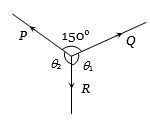
$P, Q$ and $R$ are three coplanar forces acting at a point and are in equilibrium. Given $P = 1.9318 \,kg \,wt$, $\sin {\theta _1} = 0.9659$, the value of $R$ is ( in kg wt)
An electromagnetic wave with frequency $\omega $ and wavelength $\lambda $ travels in the $+ y$ direction . Its magnetic field is along $+\, x-$ axis. The vector equation for the associated electric field ( of amplitude $E_0$) is
Which one of the following statement is false?
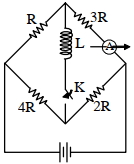
In the circuit shown below, a long time after the key $K$ is closed, the reading in the ammeter is $20 \,mA$. What was the reading (in $mA$) immediately after it was closed.