Question
In a junction diode, the holes are due to(a) Protons(b) Neutrons(c) Extra electrons(d) Missing of electrons
       

Answer

(d) Missing of electrons

Need a full question paper?

Generate a complete, print-ready paper with questions like this in minutes — across 16+ boards, with answer keys.

Start Generating Free

Similar questions

For continuous X-rays produced wavelength is(a) Inversely proportional to the energy of the electrons hitting the target(b) Inversely proportional to the intensity of the electron beam(c) Proportional to intensity of the electron beam(d) Proportional to target temperature


The dispersive powers of glasses of lenses used in an achromatic pair are in the ratio 5 : 3. If the focal length of the concave lens is 15 cm, then the nature and focal length of the other lens would be(a) Convex, 9 cm(b) Concave, 9 cm(c) Convex, 25 cm(d) Concave,  25 cm
       
The main cause of Zener breakdown is:
Two infinitely long parallel conducting plates having surface charge densities $+\sigma$ and $-\sigma$ respectively, are separated by a small distance. The medium between the plates is vacuum. If $\varepsilon_0$ is the dielectric permittivity of vacuum, then the electric field in the region between the plates is
Kinetic energy with which the electrons are emitted from the metal surface due to photoelectric effect is
The magnetic needle of a tangent galvanometer is deflected at an angle $30^{\circ}$ due to a magnet. The horizontal component of earth's magnetic field $0.34 \times 10^{-4} \mathrm{T}$ is along the plane of the coil. The magnetic intensity is
Assertion : For the scattering of $\alpha-$particles at a large angles, only the nucleus of the atom is responsible.
Reason : Nucleus is very heavy in comparison to electrons.
Two light waves of intensities I and 4I, makes fringes by interference. The phase difference between the waves at point A of the screen is $\pi / 2$ and at point B is $\pi$. Then at point A and B the difference between the resulting intensities is :
A capacitor of capacitance C is charged to a potential V. The flux of the electric field through a closed surface enclosing the capacitor is:
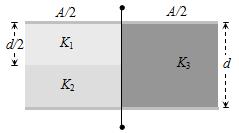
In the figure a capacitor is filled with dielectrics. The resultant capacitance is